On eBird ↗
White-necked Thrush
Live sightings near you, the range map, bar charts of when it is seen, and Macaulay Library photos and recordings.
White-necked Thrush
Turdus albicollis
The white-necked thrush (Turdus albicollis) is a songbird found in forest and woodland in South America. The taxonomy is potentially confusing, and it sometimes includes the members of the T. assimilis group as subspecies, in which case the "combined species" is referred to as the white-throated thrush (a name limited to T. assimilis when the two are split). On the contrary, it may be split into two species, the rufous-flanked thrush (T. albicollis) and the grey-flanked...
From the article White-necked thrush on Wikipedia (CC BY-SA), quoted section by section
Description
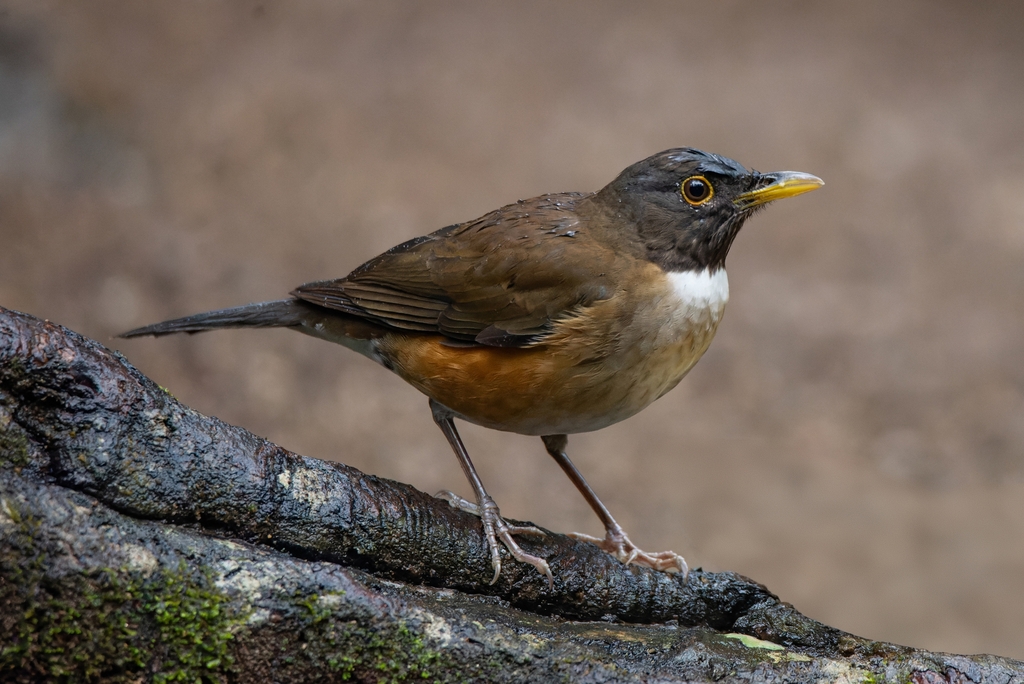
The white-necked thrush is 20.5 to 26 cm (8.1 to 10 in) long and weighs 40 to 84.5 g (1.4 to 3.0 oz). The sexes have the same plumage. Adults of the nominate subspecies T. a. albicollis have a blackish brown head with a blackish-streaked white throat and a yellow to orange eye-ring. Their upperparts, wings, and tail are dark brown. They have a white crescent below the throat, a buff-gray breast and upper belly, brown-washed orangey flanks, and a white lower belly and undertail coverts. They have a brown iris, a yellowish bill, and pinkish brown legs and feet. Juveniles resemble adults with buff flecks on the head, faint wing bars of orange spots, and buffy underparts with brown barring. The other subspecies differ from the nominate and each other thus:
T. a. phaeopygoides: darker and more olive upperparts than nominate, buffish gray breast and flanks, and reddish eye-ring T. a. phaeopygus: like phaeopygoides with browner upperparts and yellow eye-ring T. a. spodiolaemus like phaeopygoides with more rufous olive upperparts and heavier throat streaks T. a. contemptus: brighter upperparts than nominate with dull gray breast and belly and tawny flanks T. a. crotopezus: dull gray breast and belly and tawny flanks T. a. paraguayensis: much like nominate with orange-brown flanks and heavier throat streaks
Range & habitat
The white-necked thrush has a disjunct distribution. The subspecies are found thus:
T. a. phaeopygoides: Trinidad and Tobago; Venezuelan Coastal Range from Carabobo to Miranda; Serranía del Perijá on the Venezuela-Colombia border; and Andes from Venezuela's Barinas southwest into northeastern Colombia T. a. phaeopygus: from eastern Colombia east through Venezuela's Amazonas and Bolívar states, the Guianas, and northern Amazonian Brazil T. a. spodiolaemus: from southeastern Colombia south through eastern Ecuador and eastern Peru into northern Bolivia and from there east into western Brazil T. a. contemptus: southern Bolivia and slightly into southwestern Peru T. a. crotopezus: eastern Brazil from Alagoas south to Espírito Santo T. a. albicollis: southeastern Brazil from Rio de Janeiro state south into central and eastern Uruguay T. a. paraguayensis: from Mato Grosso in Brazil south through eastern Paraguay into northeastern Argentina's Misiones and Corrientes provinces The white-necked thrush inhabits the interior, edges, and clearings of several forest types. It favors terra firme and also is found in várzea and mature secondary forest. It seldom is found in open areas but will come out of cover onto trails and roadsides. …
Wikipedia: “Distribution and habitat”
What it does
The white-necked thrush feeds on insects, other invertebrates like worms, fruit, berries, and seeds. It forages mostly on the ground but in trees up to the forest's mid-story for fruit. It regularly attends swarms of army ants. It does not join mixed-species feeding flocks.
Wikipedia: “Feeding”
Listen
Looking for field recordings…
Where it lives
Recorded sightings
—
geo-referenced records in GBIF, from museums, herbaria and field observers.
Drag the globe to turn it. Dots are where records exist, not a range map; darker means more records.
In the stacks
Searching the stacks…
Every page naming Turdus albicollis in the Biodiversity Heritage Library →
This page is assembled live from iNaturalist, GBIF, Wikipedia, the Source Library and the Internet Archive. It is not yet part of the hand-edited codex. iNaturalist taxon 12746.