On eBird ↗
Lawrence's Thrush
Live sightings near you, the range map, bar charts of when it is seen, and Macaulay Library photos and recordings.
Lawrence's Thrush
Turdus lawrencii
Lawrence's thrush (Turdus lawrencii) is a species of bird in the family Turdidae. It is found in Bolivia, Brazil, Colombia, Ecuador, Peru, and Venezuela. Described in 1878 by George N. Lawrence as Turdus brunneus, a name that was already in use (by Brewer, 1852 and used for Turdus rufescens) the species was therefore renamed as Turdus lawrencii by Elliot Coues in 1880. Its natural habitats are subtropical or tropical moist lowland forests and subtropical or tropical...
From the article Lawrence's thrush on Wikipedia (CC BY-SA), quoted section by section
Description
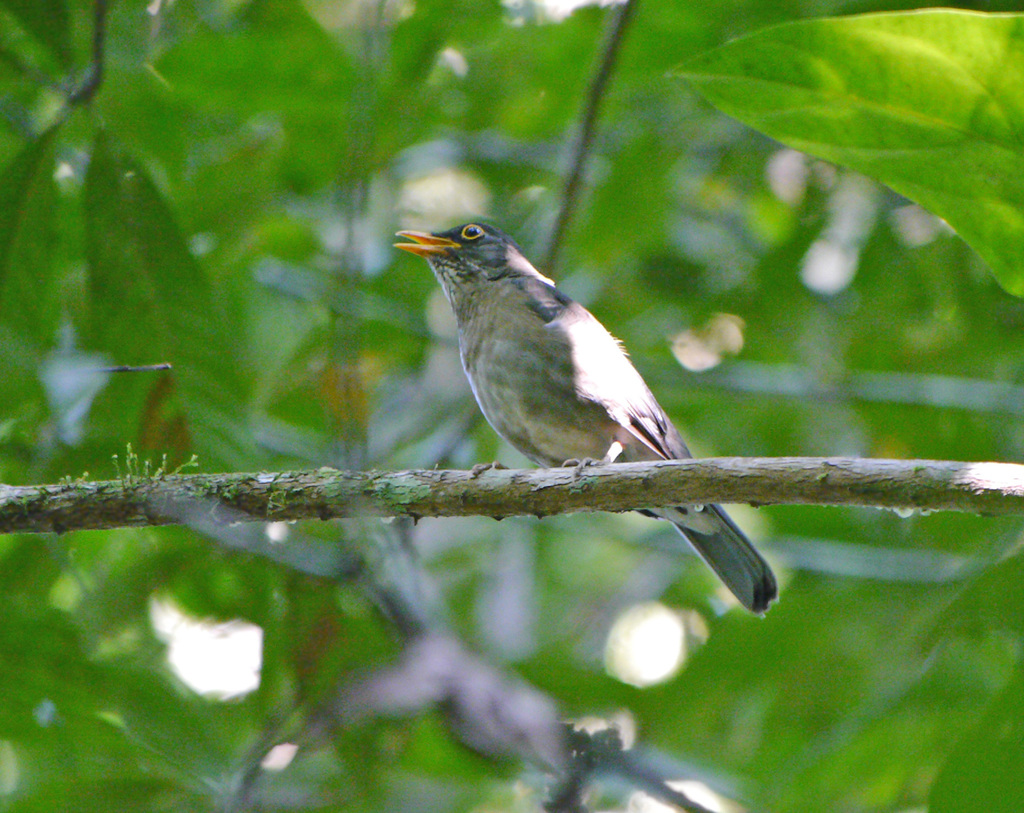
Lawrence's thrush is 21.5 to 23 cm (8.5 to 9.1 in) long and weighs about 73 g (2.6 oz). The species is sexually dimorphic. Adult males have a mostly olive-brown head with a rufous tinge. They have a yellow eye-ring and a white throat with dark streaks. Their bill is yellow. Their upperparts, wings, and tail are rufous-tinged olive-brown. Their breast and flanks are rufous-drab and their belly and vent white. Adult females are similar to males but have a paler breast and flanks and a duller bill. Both sexes have a dark iris and pinkish brown legs and feet. Juveniles have orange-buff streaks on their upperparts and two orange wing bars. Their underparts are buffy with heavy brown mottling.
Range & habitat
Lawrence's thrush is a bird of the upper Amazon Basin. In Venezuela it is found in southeastern Bolívar and far southwestern Amazonas states. From Amazonas its range continues west and south through southern Colombia, eastern Ecuador, and eastern Peru into extreme northwestern Bolivia. From Venezuela its range also extends into northwestern Brazil. From the other countries its range extends east across Brazil south of the Amazon River to Tocantins with a southern boundary in Mato Grosso. Though one source includes Guyana in its range the South American Classification Committee has no records in that country. Lawrence's thrush inhabits humid forest, primarily terra firme (including that on sandy soil) and also várzea and the ecotone between them. In elevation it ranges up to 1,200 m (3,900 ft) in Venezuela, to 500 m (1,600 ft) in Colombia, to 600 m (2,000 ft) in Ecuador, to 700 m (2,300 ft) in Peru, and to 800 m (2,600 ft) in Brazil.
Wikipedia: “Distribution and habitat”
What it does
The diet of Lawrence's thrush has not been studied but is known to include fruit. It forages mostly from the forest's mid-level to its canopy though sometimes on the ground. It occasionally joins mixed-species feeding flocks.
Wikipedia: “Feeding”
Listen
Looking for field recordings…
Where it lives
Recorded sightings
—
geo-referenced records in GBIF, from museums, herbaria and field observers.
Drag the globe to turn it. Dots are where records exist, not a range map; darker means more records.
In the stacks
Searching the stacks…
Every page naming Turdus lawrencii in the Biodiversity Heritage Library →
This page is assembled live from iNaturalist, GBIF, Wikipedia, the Source Library and the Internet Archive. It is not yet part of the hand-edited codex. iNaturalist taxon 12752.