On eBird ↗
Tickell's Thrush
Live sightings near you, the range map, bar charts of when it is seen, and Macaulay Library photos and recordings.
Tickell's Thrush
Turdus unicolor
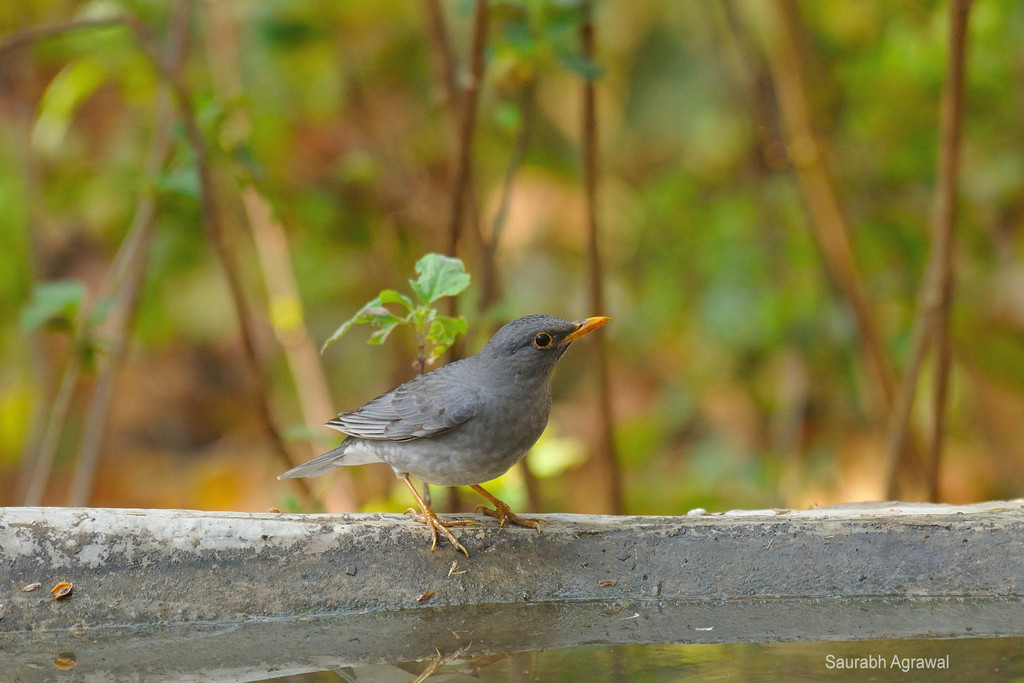
Tickell's thrush (Turdus unicolor) is a passerine bird in the thrush family Turdidae. It is common in open forest in the Himalayas, and migrates seasonally into peninsular India, Nepal and rarely to Bangladesh.
The name commemorates the British ornithologist Samuel Tickell who collected in India and Burma.
From the article Tickell's thrush on Wikipedia (CC BY-SA), quoted section by section
Description
It is a small thrush, 21–25 cm (8.3–9.8 in) long and weighing 57–75 g (2.0–2.6 oz), similar in size to redwing or eyebrowed thrush and distinctly smaller than Indian blackbird. Males have uniform blue-grey upperparts, a whitish belly and vent, while females and young birds have browner upperparts. Adults have yellow beak and legs, while it may be darker in juveniles. There is a yellow eye-ring, which is thinner and fainter than in the Indian blackbird.
Range & habitat
It breeds at middle altitudes of 1,200–2,700 m (3,940–8,860 ft) (rarely up to 3,000 m (9,840 ft)) in the Himalayas, from extreme northeastern Afghanistan east through northern Pakistan, northwestern India and Nepal to Sikkim and western Bhutan. It migrates south and to lower altitudes in Pakistan, India, Nepal and Bangladesh in winter. There is one extralimital record, on Heligoland in Germany, on 15 October 1932, one of the most unusual cases of vagrancy known. The breeding habitat is broadleaf or mixed forest with clearings, including human-altered habitats like orchards and large gardens, where it will feed on lawns. Winter habitats are similar.
== References ==
Wikipedia: “Distribution and habitat”
Listen
Looking for field recordings…
Where it lives
Recorded sightings
—
geo-referenced records in GBIF, from museums, herbaria and field observers.
Drag the globe to turn it. Dots are where records exist, not a range map; darker means more records.
In the stacks
Searching the stacks…
Every page naming Turdus unicolor in the Biodiversity Heritage Library →
This page is assembled live from iNaturalist, GBIF, Wikipedia, the Source Library and the Internet Archive. It is not yet part of the hand-edited codex. iNaturalist taxon 12760.