On eBird ↗
Marañon Thrush
Live sightings near you, the range map, bar charts of when it is seen, and Macaulay Library photos and recordings.
Marañón Thrush
Turdus maranonicus
The Marañón thrush (Turdus maranonicus) is a species of bird in the family Turdidae. It is found in far southern Ecuador and northern Peru. Its natural habitats are subtropical or tropical dry forests and subtropical or tropical moist lowland forests.
From the article Marañón thrush on Wikipedia (CC BY-SA), quoted section by section
Description
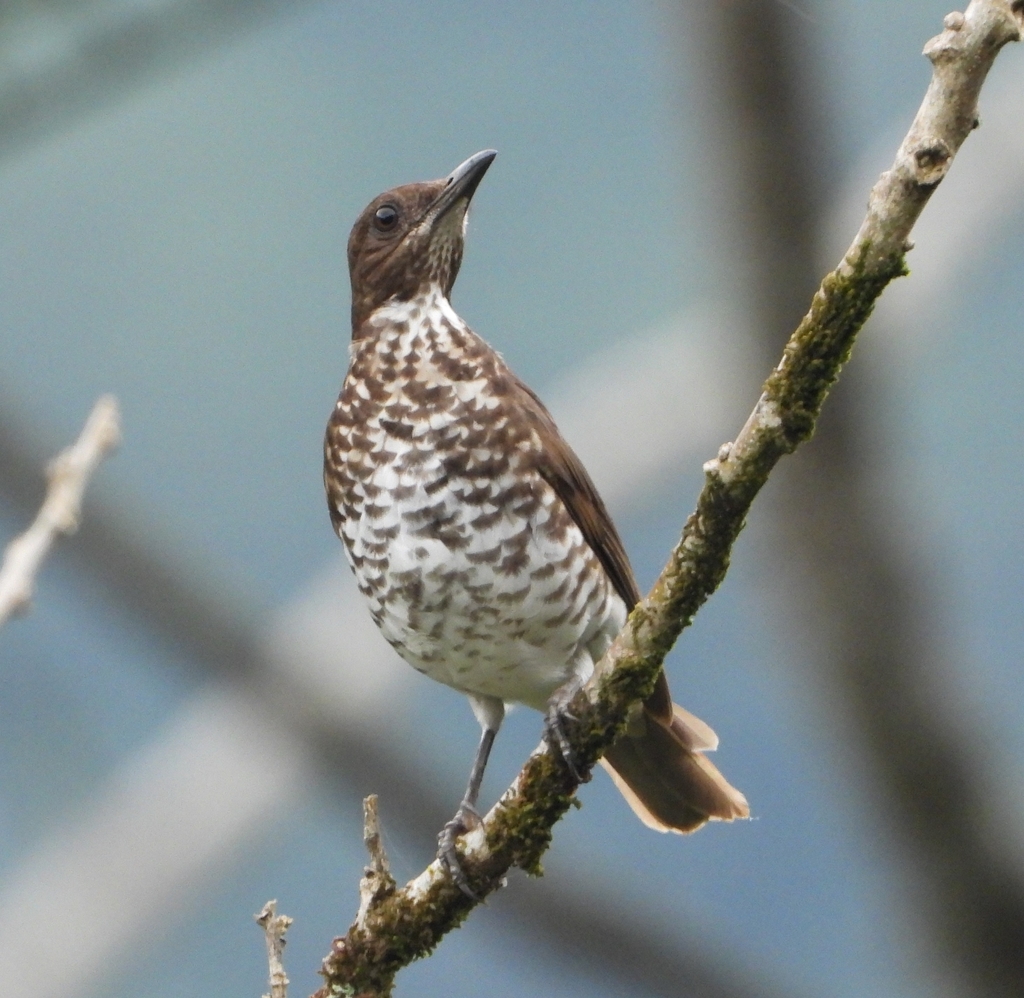
The Maranon thrush is 21.5 to 23 cm (8.5 to 9.1 in) long. The sexes have the same plumage. Adults have a mostly rich brown head with a brown-streaked whitish throat. Their upperparts, wings, and tail are the same rich brown as the head. Their underparts are dull white with a brown scaly and spotted pattern on their breast and flanks. They have a dark iris, a grayish bill, and grayish legs and feet. Juveniles resemble adults with orange-buff spots and streaks on the upperparts and two spotted orange wing bars.
Range & habitat
The Maranon thrush is found in the upper and middle basins of the Marañón River from extreme southern Ecuador into northern Peru to Huánuco Department. It primarily inhabits rather dry landscapes including dry forest and secondary forest, riparian forest, scrublands, and gardens. It also occurs at the edges of more humid forest and woodland. In elevation it ranges between 650 and 1,600 m (2,100 and 5,200 ft) in Ecuador and between 400 and 2,000 m (1,300 and 6,600 ft) in Peru.
Wikipedia: “Distribution and habitat”
What it does
The Maranon thrush's diet is not known. It forages mostly on the ground, often in very open areas like plowed fields and grassy areas.
Wikipedia: “Feeding”
Listen
Looking for field recordings…
Where it lives
Recorded sightings
—
geo-referenced records in GBIF, from museums, herbaria and field observers.
Drag the globe to turn it. Dots are where records exist, not a range map; darker means more records.
In the stacks
Searching the stacks…
Every page naming Turdus maranonicus in the Biodiversity Heritage Library →
This page is assembled live from iNaturalist, GBIF, Wikipedia, the Source Library and the Internet Archive. It is not yet part of the hand-edited codex. iNaturalist taxon 12775.