- Animals
- ›Chordates
- ›Vertebrates
- ›Ray-finned Fishes
- ›Carps, Characins, Catfishes and Allies
- ›Minnows, Suckers, Carps, and Loaches
- ›Carps and Minnows
- ›East Asian Minnows
- ›Zacco
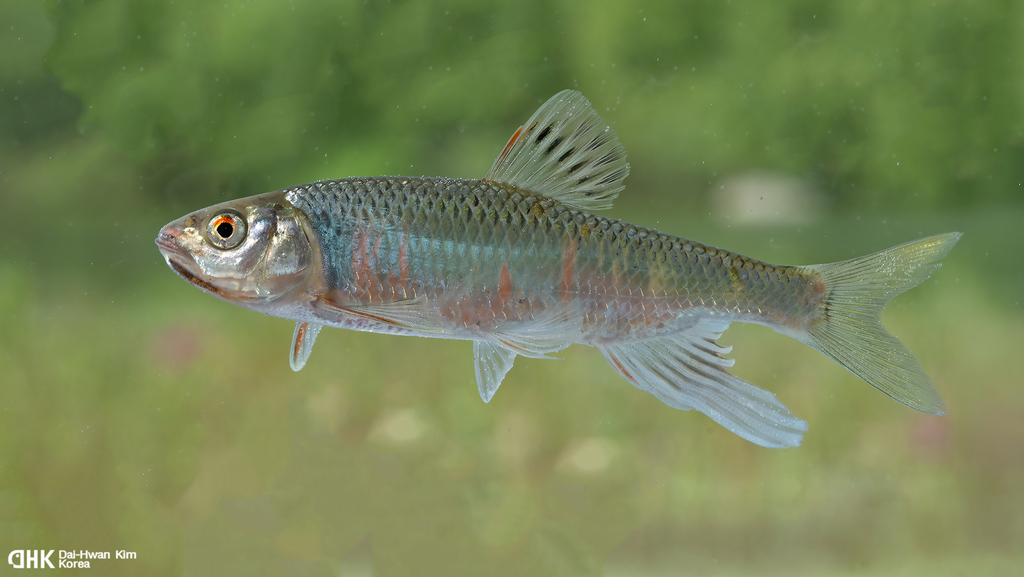
Pale Chub
Zacco platypus
The pale chub (Zacco platypus), also known as pale bleak or fresh-water sprat, is one of the most extensively distributed Asiatic cyprinids and is found in Korea, Japan, Taiwan, and most of Southeast China. This species of fish is native to freshwater rivers and mountainous streams from northern China and Korea to northern Vietnam. They can grow up to 20 centimetres (7.9 in) but usually grow to 13 centimetres (5.1 in). Its diet consists of zooplankton, invertebrates, fish, and debris. It is an invasive species in Taiwan.
Zacco platypus is called Oikawa オイカワ(追河、Opsariichthys platypus) in Japan.
From the article Zacco platypus on Wikipedia (CC BY-SA), quoted section by section
Description
The pale chub has a moderately large head with moderately large eyes that are located on the upper side of the head. They have a large mouth, so much so that the posterior end of the jaw reaches the anterior part of the eye. The pale chub has an elongated body that is more compressed at the posterior end and have a black longitudinal band. Their maximum length is 20 cm (7.9 in) and on average pale chubs are 13 cm (5.1 in) in length. The moderately large cycloid scales that are much larger on the sides than on other parts of the fish, and they have a complete lateral line. They have a forked caudal fin where its upper edge is shorter than the lower. Their fins are bright yellow on the pelvics and dirty on the pectorals and caudal fin. They have a grayish coloration close to the dorsal with the rest of the body being silvery. Zacco platypus have 7 dorsal fin rays and it is located near the midline between its snout tip and caudal peduncle end. Each spine of the first dorsal fin is slightly extended, and the first spine of the male fish is extended similarly like a thread; the edge of the second dorsal fin is straight, and the rays are all branched out. They have elongated anal fin rays with its longest reaching the caudal peduncle with 8-10 anal fin rays and 7-9 pelvic fin rays. …
Range & habitat
The pale chub live primarily in freshwater. The adults prefer shallow waters with a rapid water flow and tend to hide in cracks between rocks in order to remain in water areas with high food availability and low predation. They do not really like deep, stagnant water. They live in waters that have an average of 23–24 °C (73–75 °F). They mainly live by the bottom when adults because that is where their food source is located. However, due to environmental changes and pollution, the population is shrinking in many places.
Wikipedia: “Habitat”
What it does
The life expectancy of a Z. platypus is around 5 years and they are quite tolerant to various environmental stress factors. Male chubs become aggressive during mating season and will head butt, expel, rotational fight, and fight hile swimming parallel to any threatening organisms. Studies have shown that fish living in higher-predation environments led to less spontaneous swimming activity and risk-taking behaviors when compared to fish from low-predation populations.
Wikipedia: “Lifespan and behaviors”
At the table
Zacco platypus are used as bait for sport-fishing for larger fish. They are popular for fly fishers and are caught for consumption. Males are used for aquariums because of their vibrant coloring.
== References ==
Wikipedia: “Uses”
Where it lives
Recorded sightings
—
geo-referenced records in GBIF, from museums, herbaria and field observers.
Drag the globe to turn it. Dots are where records exist, not a range map; darker means more records.
In the stacks
Searching the stacks…
Every page naming Zacco platypus in the Biodiversity Heritage Library →
This page is assembled live from iNaturalist, GBIF, Wikipedia, the Source Library and the Internet Archive. It is not yet part of the hand-edited codex. iNaturalist taxon 128279.