On eBird ↗
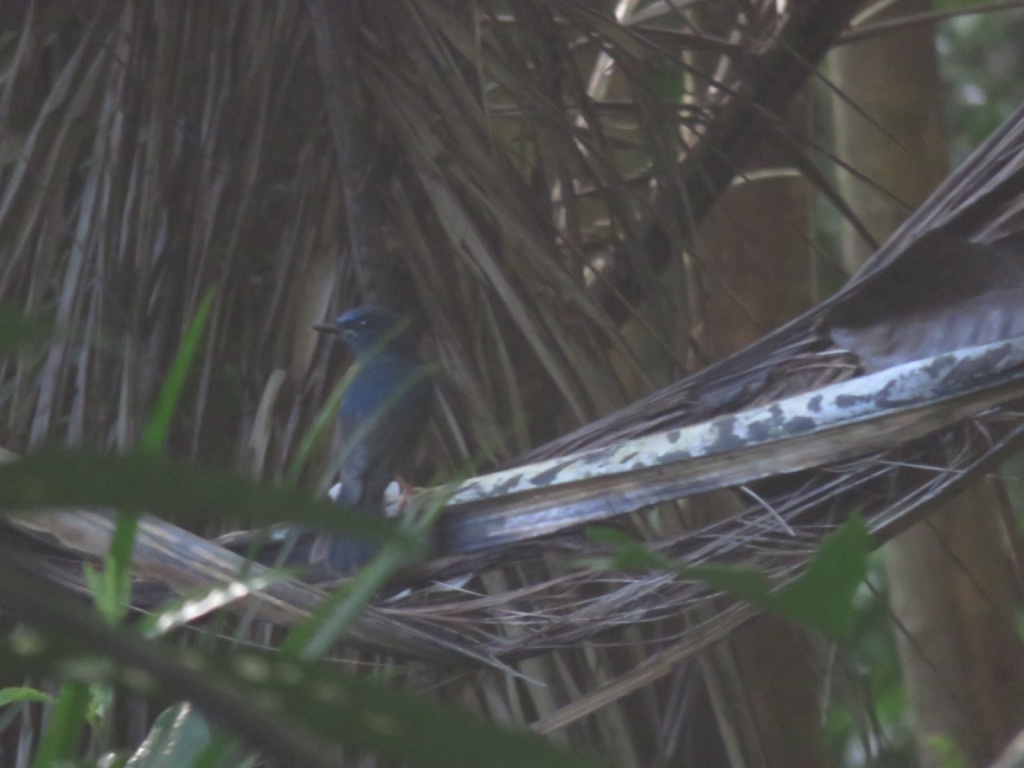
Blue-breasted Blue Flycatcher
Live sightings near you, the range map, bar charts of when it is seen, and Macaulay Library photos and recordings.
Blue-breasted Blue Flycatcher
Cyornis herioti
The blue-breasted blue flycatcher (Cyornis herioti), also known as the blue-breasted flycatcher, is a species of bird in the family Muscicapidae. It is endemic to the Philippines found only north and central parts of Luzon. Its natural habitat is tropical moist lowland forests. The Rufous-breasted blue flycatcher (Cyornis camarinensis) was formerly considered to be a subspecies.
From the article Blue-breasted blue flycatcher on Wikipedia (CC BY-SA), quoted section by section
Description
It was formerly conspecific with the rufous-breasted blue flycatcher from south Luzon. It was split as a separate species based on the male's eponymous blue breast. As the rufous-breasted flycatcher is an extremely rare bird and there are barely and specimens, the differences between the two species' females are poorly understood.
Wikipedia: “Description and taxonomy”
Range & habitat
Its natural habitat is tropical moist lowland forest up to 1,200 m. It is often seen in lowland and foothill forest and secondary forest with bamboo,. The IUCN Redlist has classified this species as near threatened. Its threats are mainly habitat loss due to deforestation for lumber, mining and farmlands. There are no known targeted conservation actions for this bird, but it will indirectly benefit from the conservation of other north Luzon species like the critically endangered Isabela oriole. The stronghold of the Isabela oriole in Baggao is being proposed as a protected area and will thus preserve key habitat for this bird. It is found in a few protected areas includings Mount Makiling, Quezon Protected Landscape, Northern Sierra Madre Natural Park, Aurora Memorial National Park and Kalbario–Patapat Natural Park but actual protection from deforestation is still lax.
Wikipedia: “Habitat and conservation status”
What it does
This species is poorly known. Stomach contents from specimens taken contained insects. This species forages close to the forest floor in the dense understorey. It is extremely unobtrusive and is usually alone or in a pair. Its exact breeding season is still unknown. Males found in breeding condition with enlarged testes found in May to July. A juvenile was seen in April to May. The only recorded nest was recorded in May in a shallow cavity on a rock along a stream. This nest was cup-shaped lined with ferns and an outer layer of moss and contained three eggs. Nest parasitism by the Sunda brush cuckoo has been recorded.
Wikipedia: “Ecology and behaviour”
Listen
Looking for field recordings…
Where it lives
Recorded sightings
—
geo-referenced records in GBIF, from museums, herbaria and field observers.
Drag the globe to turn it. Dots are where records exist, not a range map; darker means more records.
In the stacks
Searching the stacks…
Every page naming Cyornis herioti in the Biodiversity Heritage Library →
This page is assembled live from iNaturalist, GBIF, Wikipedia, the Source Library and the Internet Archive. It is not yet part of the hand-edited codex. iNaturalist taxon 12848.