- Animals
- ›Chordates
- ›Vertebrates
- ›Ray-finned Fishes
- ›Spiny-rayed fishes
- ›Leaffishes, Snakeheads, and Gouramis
- ›Snakeheads
- ›Snakeheads
- ›Channa
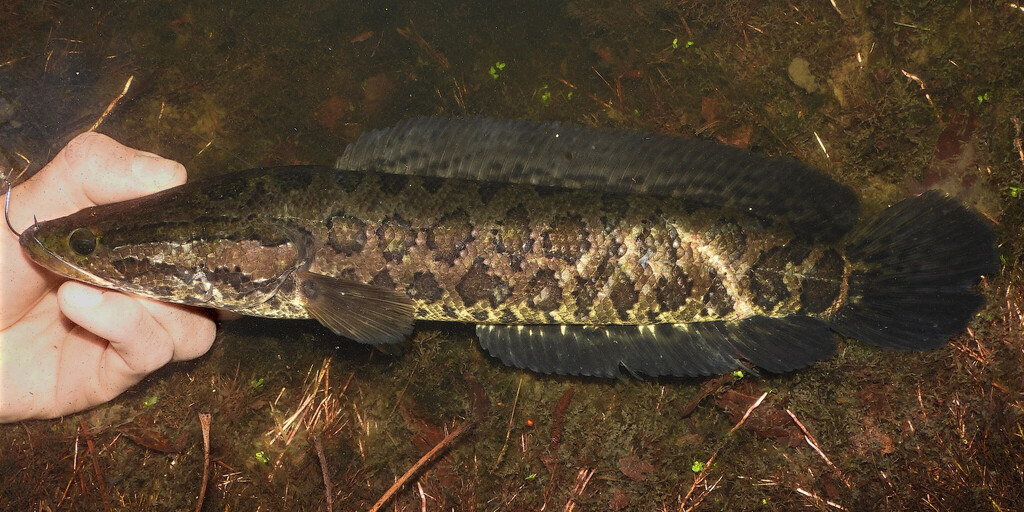
Northern Snakehead
Channa argus
The northern snakehead also known as Chesapeake Channa (Channa argus) in Maryland U.S is a species of snakehead fish native to temperate East Asia, in China, Russia, North Korea, and South Korea. Their natural range goes from the Amur River watershed in Siberia and Manchuria down to Hainan. It is an important food fish and one of the most cultivated in its native region, with 510,000 tonnes annual production worldwide. Due to this, the northern snakehead has been exported throughout the world and has managed to establish non-native populations in Central Asia and North America. In the United States, it is found in Pennsylvania, Virginia, West Virginia, Delaware, Maryland, North Carolina, Arkansas, Missouri, and Mississippi.
From the article Northern snakehead on Wikipedia (CC BY-SA), quoted section by section
Description
The distinguishing features of a northern snakehead include a long dorsal fin with 49–50 rays, an anal fin with 31–32 rays, a small, anteriorly depressed head, the eyes above the middle part of the upper jaw, a large mouth extending well beyond the eye, and villiform teeth in bands, with large canines on the lower jaw and palatines. It is generally reported to reach a length up to 100 cm (3 ft 3 in), but specimens approaching 150 cm (4 ft 11 in) are known according to Russian ichthyologists. The largest registered by the International Game Fish Association weighs 9.53 kg (21 lb 0 oz). Its coloration is a golden tan to pale brown, with dark blotches on the sides and saddle-like blotches across the back. Blotches toward the front tend to separate between top and bottom sections, while rear blotches are more likely to be contiguous. Coloration is nearly the same between juveniles and adults, which is unusual among snakeheads, and is similar to Channa maculata, but can be distinguished by two bar-like marks on the caudal peduncle (where the tail attaches); in C. maculata, the rear bar is usually complete, with pale bar-like areas before and after, while in C. argus, the rear bar is irregular and blotched, with no pale areas around it.
Fish similar in appearance. …
Wikipedia: “Appearance”
What it does
The northern snakehead is a freshwater fish and cannot tolerate salinity in excess of 10 parts per million. It is a facultative air breather, using a suprabranchial organ and a bifurcated ventral aorta that permit both aquatic and aeria respiration. This unusual respiratory system allows it to live outside of water for several days. As an amphibious fish, it can wriggle its way between bodies of water or survive being transported by humans. Only young members of this species (not adults) may be able to move overland for short distances using wriggling motions. The preferred habitats of this species are stagnant water with mud substrate and aquatic vegetation, or slow, murky, swampy streams; it is primarily piscivorous, but is known to eat crustaceans, other invertebrates, and amphibians.
Wikipedia: “Behavior”
In medicine
Northern snakeheads are respected among some Chinese fishermen for their virtue, as parent snakefish are known to sacrifice themselves to protect their young. The young fish are said to rush to feed upon their mother after she gives birth and is temporarily unable to catch prey.
Wikipedia: “In traditional culture”
Where it lives
Recorded sightings
—
geo-referenced records in GBIF, from museums, herbaria and field observers.
Drag the globe to turn it. Dots are where records exist, not a range map; darker means more records.
In the old herbals & bestiaries

In the stacks
Searching the stacks…
Every page naming Channa argus in the Biodiversity Heritage Library →
This page is assembled live from iNaturalist, GBIF, Wikipedia, the Source Library and the Internet Archive. It is not yet part of the hand-edited codex. iNaturalist taxon 128487.