On eBird ↗
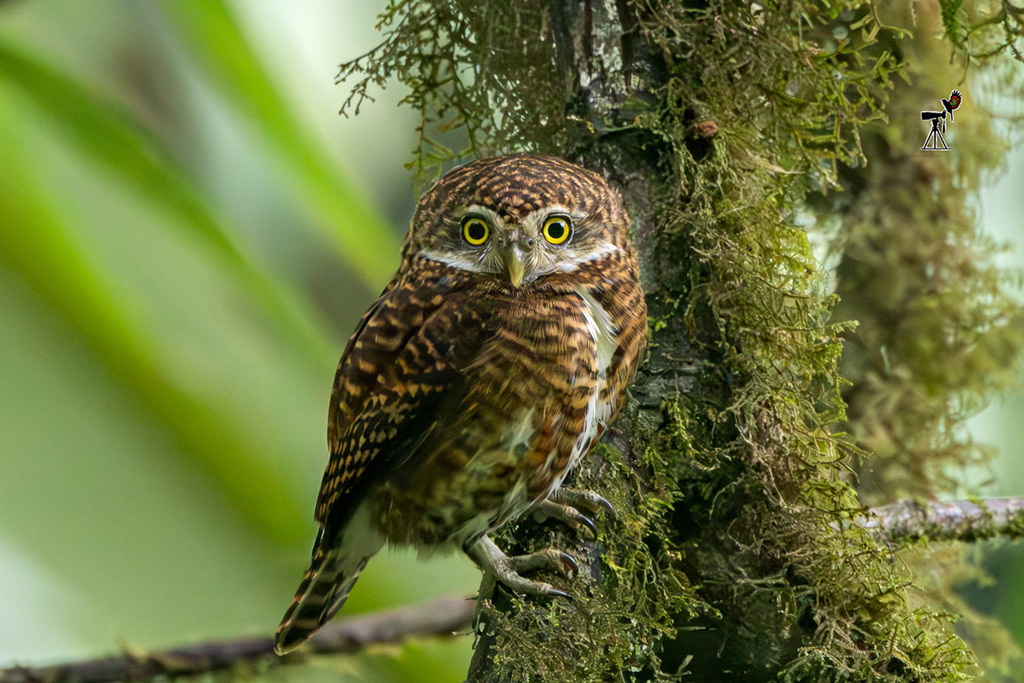
Collared Owlet
Live sightings near you, the range map, bar charts of when it is seen, and Macaulay Library photos and recordings.
Collared Owlet
Taenioptynx brodiei
The collared owlet (Taenioptynx brodiei), also known as the collared pygmy owl, is a species of owl in the family Strigidae. Its natural habitat is submontane and montane forests with open spaces and is distributed throughout oriental Asia. It is the smallest owl in Asia, at 15 cm (5.9 in) and 60 g (2.1 oz).
From the article Collared owlet on Wikipedia (CC BY-SA), quoted section by section
Description
The collared owlet, being Asia's smallest owl species, measures between 15 and 17 cm. Females are generally larger than the males, weighing approximately 63 g, whereas males weigh in at 52 g. This bird has a grey-brown colour (depending on age-morph) and has a barred back and flanks, while the head is more spotted than barred. They have prominent white eyebrows, vibrant lemon-yellow-coloured eyes and a white throat patch. The chin, center of the breast and belly are mostly white. The pale collar and the two black spots on each side of the nape imitate eye spots and make it seem like the owl is staring at you from behind. This is known as the "occipital face". It has a greyish-brown pale-spotted pectoral band on upper breast and lacks ear-tufts. You can see its tail when in flight, longer than most pygmy owls, and has rapid wingbeats.
Colour morphs. Collared owlets transition through various age-dependent colour morphs. A capture-recapture study of collared owlets in Taiwan provided evidence of this. On the first capture, the individual was 56 days old and showed fledgling colour morph stage; having less spots and barring on the back and top of the head and not having a completely formed occipital. …
Range & habitat
The collared owlet has a very large range occurring in the Himalayas of northern Pakistan all the way to eastern China and Taiwan. Its range extends southwards through Malaysia. This bird can be found in the following countries: Bhutan, Brunei Darussalam, Cambodia, China, India, Laos, Malaysia, Myanmar, Nepal, Pakistan, Taiwan, Thailand and Vietnam.
Wikipedia: “Distribution”
What it does
The collared owlet is most active during daylight. Being diurnal, this bird can be seen perching, hunting and calling during most parts of the day, and sometimes during the night. It is often mobbed by other small birds when roosting.
Breeding. Although not much is known about the reproductive methods of the collared owlet, it is believed that the mating couple only remains together during the period of breeding season, which is from March to April. As mentioned previously, they nest in natural tree hollows or holes created by woodpeckers or barbets, which are often very rotten and found high in tree trunks that are in a clearing or in an open area in the forest. Clutch size varies from 3 to 5 eggs, which are round and white. The eggs are laid between late April and mid-June and their young are fledged from mid-June to early August.
Food and feeding. Few studies have precisely identified the exact diet of the collared owlet, but we can presume that it is similar to the diet of its closest relative, the jungle owlet. The jungle owlet is seen to prey on small mammals such as house mice, little Indian field mice, brown spiny mice and white-toothed pygmy shrews; reptiles such as skinks; birds; amphibians and many invertebrates. Therefore, the diet of the collared owlet consists mainly of small birds, insect, lizards, invertebrates and small mammals. …
Wikipedia: “Behaviour and ecology”
Listen
Looking for field recordings…
Where it lives
Recorded sightings
—
geo-referenced records in GBIF, from museums, herbaria and field observers.
Drag the globe to turn it. Dots are where records exist, not a range map; darker means more records.
In the stacks
Searching the stacks…
Every page naming Taenioptynx brodiei in the Biodiversity Heritage Library →
This page is assembled live from iNaturalist, GBIF, Wikipedia, the Source Library and the Internet Archive. It is not yet part of the hand-edited codex. iNaturalist taxon 1286804.