On eBird ↗
Sedge Wren
Live sightings near you, the range map, bar charts of when it is seen, and Macaulay Library photos and recordings.
Sedge Wren
Cistothorus stellaris
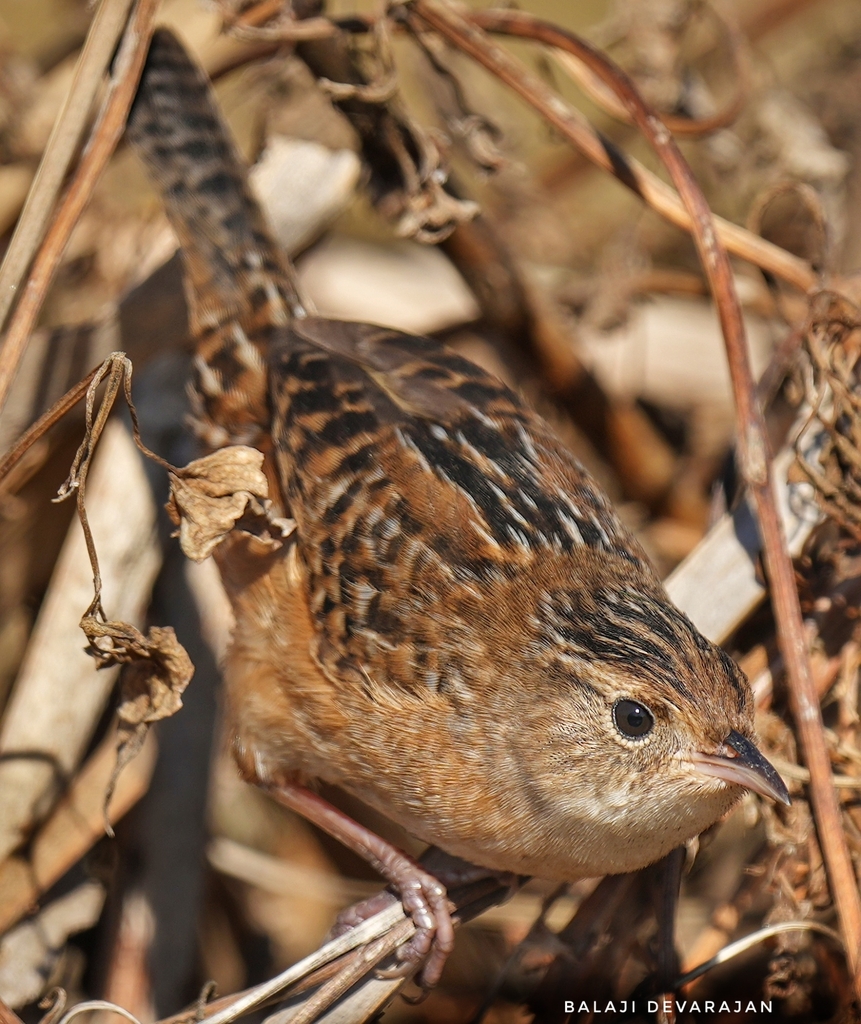
The sedge wren (Cistothorus stellaris) is a small and secretive passerine bird in the family Troglodytidae. It is widely distributed in North America. It is often found in wet grasslands and meadows where it nests in the tall grasses and sedges and feeds on insects. The sedge wren was formerly considered as conspecific with the non-migratory grass wren of central and South America.
From the article Sedge wren on Wikipedia (CC BY-SA), quoted section by section
Description
The sedge wren is a relatively small wren that measures 10 to 12 cm (3.9 to 4.7 in), weighs 7 to 10 g (0.25 to 0.35 oz) and has a wing-chord of 4.1 to 4.6 cm (1.6 to 1.8 in). Wingspan ranges from 4.7 to 5.5 in (12-14 cm). Females and males have the same plumage but males are slightly larger. Their head and back are tawny brown streaked with black and white. They have a pale buff supercilium and brown irises. Their rump is orange and tail is tawny brown bared with black. Wings are tawny brown bared with black, white and pale buff. They have a white throat and belly with pale buff on the side. Their beak is long and slender. and measures on average 6.77 to 6.95 mm The upper mandible of the beak is brown while the lower mandible is yellow. They have pink legs and feet. Juveniles are overall similar to adults but have less streaking on the head and nape and their chest is paler than adults. The sedge wren can be differentiated from the similar marsh wren (Cistothorus palustris) by its smaller size, streaked crown and different song.
Range & habitat
During the breeding season they are found in the southern half of Alberta and Saskatchewan and in southern Ontario and Quebec in Canada and in the United States, west of the Appalachians, from the Canadian border to Missouri and northern Arkansas. During migration and winter they are found from the southern half of Arkansas down to Texas and Florida.
Wikipedia: “Distribution”
What it does
Sedge wren forage on the ground for insects and spiders. They eat many types of insects such as moths, flies and grasshoppers.
Wikipedia: “Diet”
Listen
Looking for field recordings…
Where it lives
Recorded sightings
—
geo-referenced records in GBIF, from museums, herbaria and field observers.
Drag the globe to turn it. Dots are where records exist, not a range map; darker means more records.
In the stacks
Searching the stacks…
Every page naming Cistothorus stellaris in the Biodiversity Heritage Library →
This page is assembled live from iNaturalist, GBIF, Wikipedia, the Source Library and the Internet Archive. It is not yet part of the hand-edited codex. iNaturalist taxon 1286843.