On eBird ↗
Riparian Parrotlet
Live sightings near you, the range map, bar charts of when it is seen, and Macaulay Library photos and recordings.
Riparian Parrotlet
Forpus crassirostris
The riparian parrotlet (Forpus crassirostris) or large-billed parrotlet is a species of parrot in the family Psittacidae.
From the article Riparian parrotlet on Wikipedia (CC BY-SA), quoted section by section
Description
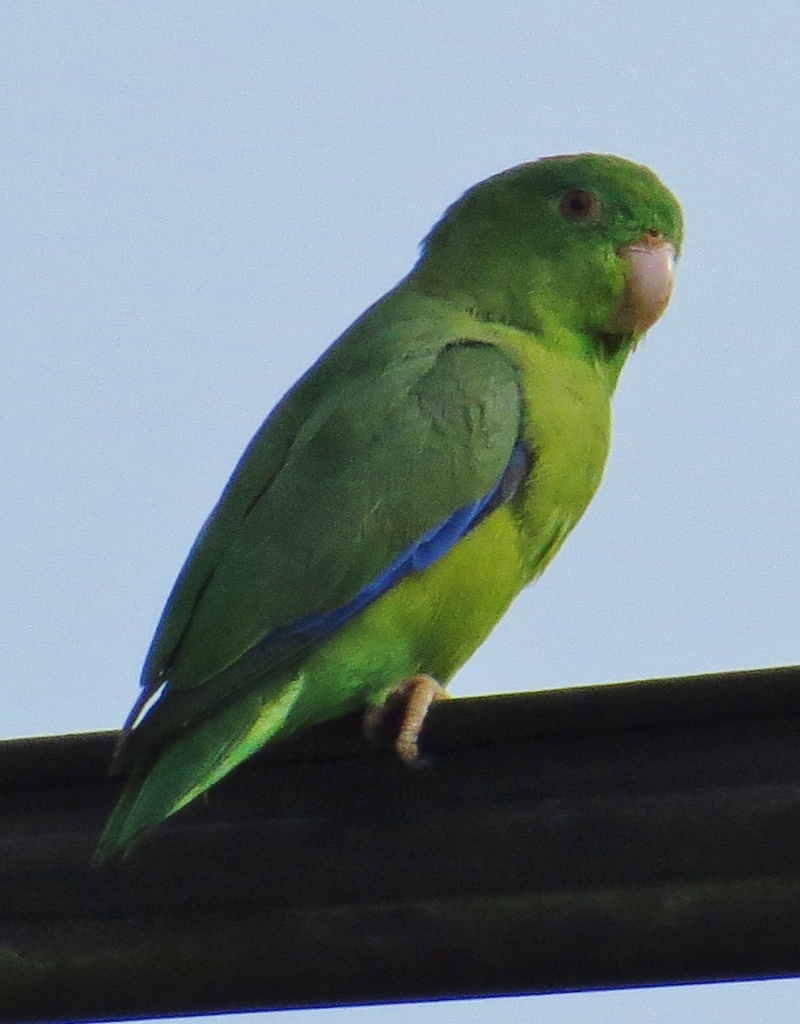
Riparian parrotlets are typically 12–13 centimetres (4.7–5.1 in) long and weigh about 28 grams (0.99 oz). Their bodies are mostly yellow-green. Eyes are dark brown and beaks and feet are light peach. Riparian parrotlets are sexually dimorphic: males have blue rumps and lower backs, with blue feathers along the leading edges of their wings and blue secondaries; primary coverts are blue-gray. Females have no blue feathers and a yellow-green belly.
Range & habitat
Riparian parrotlets are found in southeastern Colombia to northern Peru and western Brazil. There is a small population on São Sebastião Island. Though they do not fully migrate, it has been suggested that riparian parrotlets are altitudinal migrants: abundance of the species in lowland areas increased during winter and spring; this is likely because during these seasons, the main plants of the large-billed parrotlets' diet were budding and providing more food. Riparian parrotlets tend to inhabit forest edges, riparian woodlands, and degraded or deforested areas.
Wikipedia: “Distribution”
What it does
Riparian parrotlets nest in tree cavities or similar places. They have been known to use the abandoned nests of rufous horneros and other unrelated species. Females lay 3-7 small white eggs, which are incubated for approximately 18 days before hatching.
Wikipedia: “Reproduction”
Listen
Looking for field recordings…
Where it lives
Recorded sightings
—
geo-referenced records in GBIF, from museums, herbaria and field observers.
Drag the globe to turn it. Dots are where records exist, not a range map; darker means more records.
In the stacks
Searching the stacks…
Every page naming Forpus crassirostris in the Biodiversity Heritage Library →
This page is assembled live from iNaturalist, GBIF, Wikipedia, the Source Library and the Internet Archive. It is not yet part of the hand-edited codex. iNaturalist taxon 1286946.