On eBird ↗
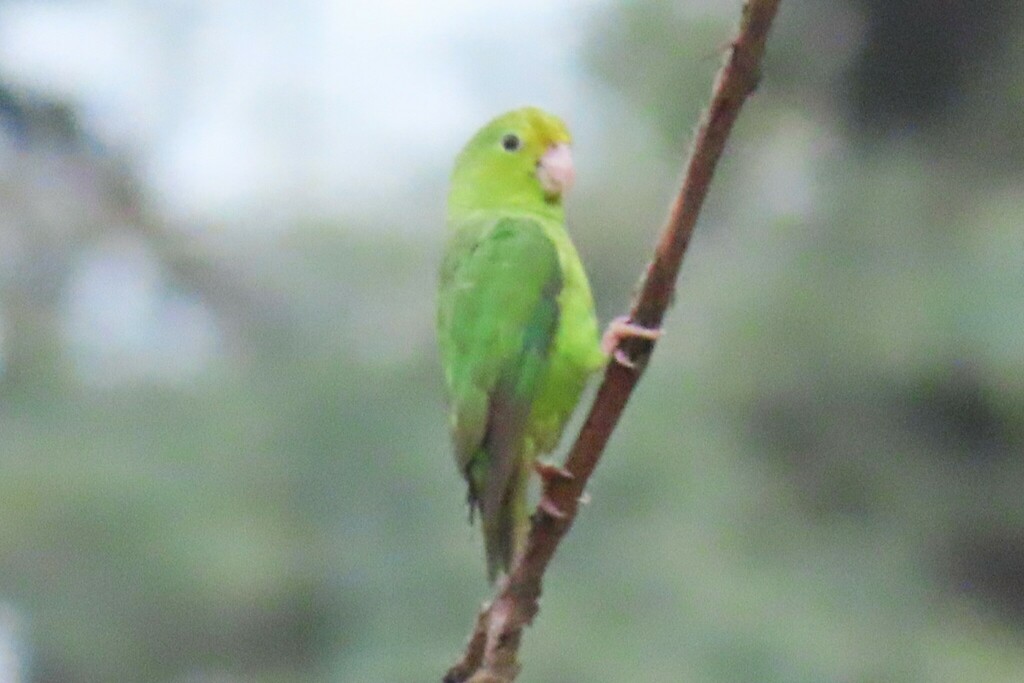
Turquoise-winged Parrotlet
Live sightings near you, the range map, bar charts of when it is seen, and Macaulay Library photos and recordings.
Turquoise-winged Parrotlet
Forpus spengeli
The turquoise-winged parrotlet (Forpus spengeli) is a species of parrot in the family Pscittacidae.
From the article Turquoise-winged parrotlet on Wikipedia (CC BY-SA), quoted section by section
Description
Turquoise-winged parrotlets are typically 12 centimetres (4.7 in) long and weigh about 28 grams (0.99 oz). Their bodies are mostly yellow-green; eyes are dark brown and legs and beak are light peach. Turquoise-winged parrotlets are sexually dimorphic: males have bright turquoise feathers on their lower backs and rumps, and have purple-blue underwing coverts and axillaries. Females have no blue markings, but their foreheads and faces are brighter yellow-green than males'. Like all parrots, turquoise-winged parrotlets exhibit zygodactyly: two toes face forward and two toes face backward.
Range & habitat
Turquoise-winged parrotlets are found in northern Colombia from the Caribbean coastal region southwest of the Santa Marta Mountains, Atlantico, and south along the Rio Magdalena in Bolívar and Cesar. Turquoise-winged parrotlets are most often found in drier, open or riparian woodlands, cerrado, caatinga, savanna, palm groves, semi-arid scrubland, and pastures.
Wikipedia: “Distribution and habitat”
What it does
The turquoise-winged parrotlet's breeding season is May to August. Females lay 3-7 small white eggs.
Wikipedia: “Reproduction”
Listen
Looking for field recordings…
Where it lives
Recorded sightings
—
geo-referenced records in GBIF, from museums, herbaria and field observers.
Drag the globe to turn it. Dots are where records exist, not a range map; darker means more records.
In the stacks
Searching the stacks…
Every page naming Forpus spengeli in the Biodiversity Heritage Library →
This page is assembled live from iNaturalist, GBIF, Wikipedia, the Source Library and the Internet Archive. It is not yet part of the hand-edited codex. iNaturalist taxon 1286947.