On eBird ↗
Rusty-winged Antwren
Live sightings near you, the range map, bar charts of when it is seen, and Macaulay Library photos and recordings.
Rusty-winged Antwren
Herpsilochmus frater
The rusty-winged antwren (Herpsilochmus frater) is a species of bird in subfamily Thamnophilinae of family Thamnophilidae, the "typical antbirds". It is found in Bolivia, Brazil, Colombia, Ecuador, Guyana, Panama, Peru, Suriname, and Venezuela.
From the article Rusty-winged antwren on Wikipedia (CC BY-SA), quoted section by section
Description
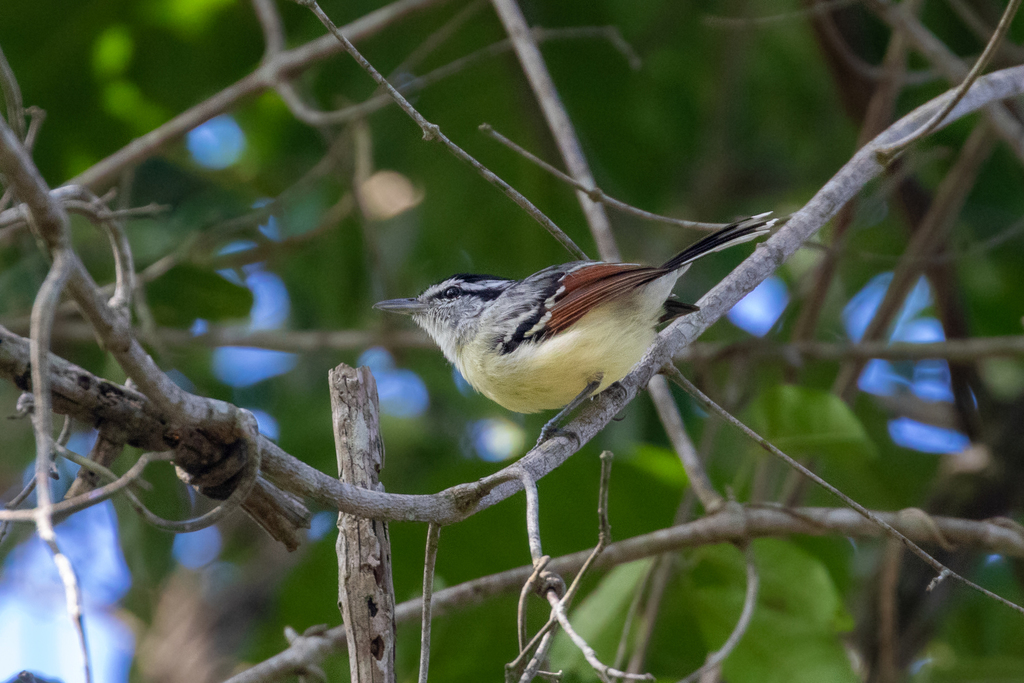
The rusty-winged antwren is 10 to 12.5 cm (3.9 to 4.9 in) long and weighs about 10 to 12.5 g (0.35 to 0.44 oz). Adult males of the nominate subspecies H. f. frater have a black crown and nape, a wide white supercilium, a black stripe through the eye, and black and white striped ear coverts. Their upperparts are ashy gray with scattered black spots and streaks and a black patch between the scapulars. Their wing coverts are black with wide white tips; most of their flight feathers are blackish with dark cinnamon red outer webs and their tertiaries are blackish with white outer edges. Their tail feathers are black with white tips whose extent increases from the central pair to the almost entirely white outermost. Their throat is white and their underparts are pale yellowish. Adult females have a rich chestnut-rufous crown, a buffy chestnut tinge to their supercilium, brownish olive-gray upperparts, and more white on the tail than males. Their underparts are a stronger yellow than the male's and sometimes have a pale buff wash on the sides of the breast. Their wings are like the male's. Both sexes have a dark gray to brownish iris, a black maxilla, a light gray mandible with a darker tip, and gray to olive-gray legs and feet. Subspecies H. f. exiguus is somewhat smaller than the nominate. Males have nearly pure black upperparts and deep amber edges on the flight feathers. …
Range & habitat
Both subspecies of the rusty-winged antwren have disjunct distributions. Subspecies H. f. exiguus has the smaller and more westerly range of the two. It is found in Panama from eastern Panamá Province through Darién Province into northwestern Colombia's Córdoba and Bolívar departments. A separate population is found very locally in western Ecuador. The nominate subspecies H. f. frater is found from Colombia's Eastern Andes south through eastern Ecuador and Peru into northern Bolivia, east from Colombia through Venezuela and southern Guyana into Suriname, and northeast from Ecuador, Peru, and Bolivia across Amazonian Brazil south of the Amazon to western Maranhão. A separate population is found coastally in northeastern Brazil's Paraíba, Pernambuco, and Alagoas states. The rusty-winged antwren inhabits the interior and edges of lowland and foothill evergreen forest of several types including terra firme and gallery forest. It typically is found from the forest's mid-storey to its subcanopy and favors dense vine tangles. In Panama it is found up to about 1,050 m (3,400 ft) of elevation, in Brazil, Venezuela, and the Guianas to 1,500 m (4,900 ft), in Colombia to 1,300 m (4,300 ft), and in Peru to 1,150 m (3,800 ft). In western Ecuador it occurs below 200 m (700 ft) and in eastern Ecuador mostly between 600 and 1,300 m (2,000 and 4,300 ft).
Wikipedia: “Distribution and habitat”
What it does
The rusty-winged antwren's diet has not been detailed, but is known to be primarily insects and also includes spiders. It usually forages singly, in pairs, and in family groups, and often joins a mixed-species feeding flock as it passes through its territory. It typically feeds between 8 and 30 m (25 and 100 ft) above the ground though as low as 3 m (10 ft) in stunted forest on sandy soil. It forages actively and methodically, and usually captures prey by gleaning from leaves, stems, and vines by reaching and sometimes lunging from a perch. It occasionally makes short sallies to glean from the underside of leaves.
Wikipedia: “Feeding”
Listen
Looking for field recordings…
Where it lives
Recorded sightings
—
geo-referenced records in GBIF, from museums, herbaria and field observers.
Drag the globe to turn it. Dots are where records exist, not a range map; darker means more records.
In the stacks
Searching the stacks…
Every page naming Herpsilochmus frater in the Biodiversity Heritage Library →
This page is assembled live from iNaturalist, GBIF, Wikipedia, the Source Library and the Internet Archive. It is not yet part of the hand-edited codex. iNaturalist taxon 1286959.