On eBird ↗
Chestnut-headed Chachalaca
Live sightings near you, the range map, bar charts of when it is seen, and Macaulay Library photos and recordings.
Chestnut-headed Chachalaca
Ortalis ruficeps
The chestnut-headed chachalaca (Ortalis ruficeps) is a bird in the family Cracidae, the chachalacas, guans, and curassows. It is endemic to Brazil.
From the article Chestnut-headed chachalaca on Wikipedia (CC BY-SA), quoted section by section
Description
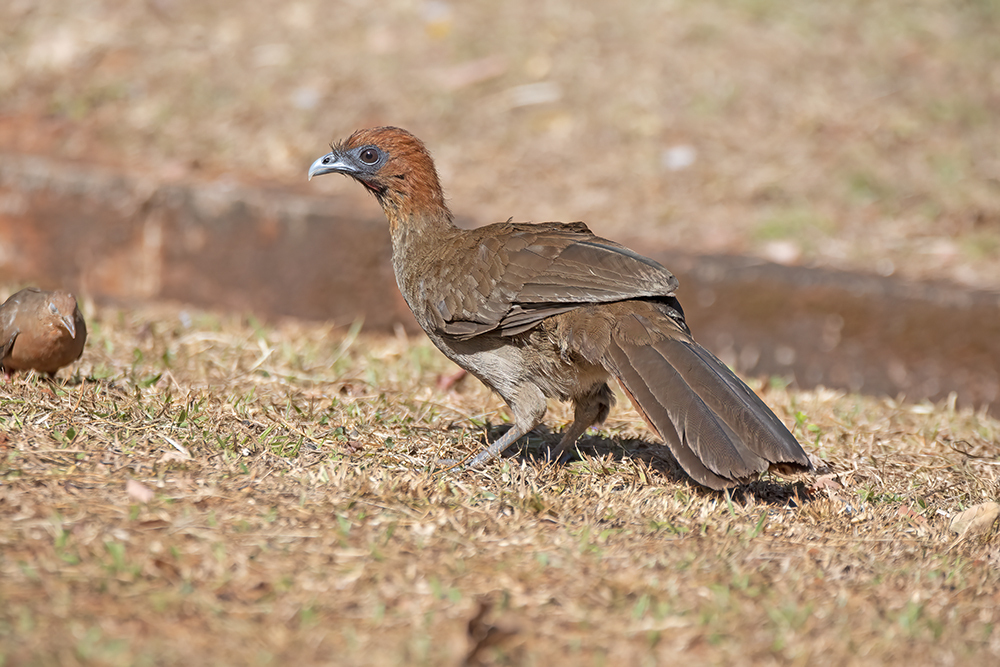
The chestnut-headed chachalaca is 43 to 54 cm (1.4 to 1.8 ft) long and weighs 345 to 620 g (0.76 to 1.4 lb). It has a reddish-chestnut head, grayish brown upperparts, grayish underparts, and dark brown primary flight feathers.
Range & habitat
The chestnut-headed chachalaca is found only in north-central Brazil, south of the Amazon River between rio Tapajós in Pará state and rio Araguaia in Tocantins state. Though its habitat has not been well studied, it is believed to be similar to that of the little chachalaca: landscapes such as dense secondary forest and the undergrowth along rivers, in clearings, and abandoned pastures. It probably avoids the interior of dense forest.
Wikipedia: “Distribution and habitat”
What it does
The chestnut-headed chachalaca's feeding behavior and diet are assumed to be the same as those of little chachalaca. That species forages in trees or on the ground, usually in pairs or small flocks. Its primary diet is berries and fruits although it also eats flowers and leaves.
Wikipedia: “Feeding”
Listen
Looking for field recordings…
Where it lives
Recorded sightings
—
geo-referenced records in GBIF, from museums, herbaria and field observers.
Drag the globe to turn it. Dots are where records exist, not a range map; darker means more records.
In the stacks
Searching the stacks…
Every page naming Ortalis ruficeps in the Biodiversity Heritage Library →
This page is assembled live from iNaturalist, GBIF, Wikipedia, the Source Library and the Internet Archive. It is not yet part of the hand-edited codex. iNaturalist taxon 1286973.