- Animals
- ›Chordates
- ›Vertebrates
- ›Ray-finned Fishes
- ›Spiny-rayed fishes
- ›Butterflyfishes, Angelfishes, and Allies
- ›Drums
- ›Sciaenops
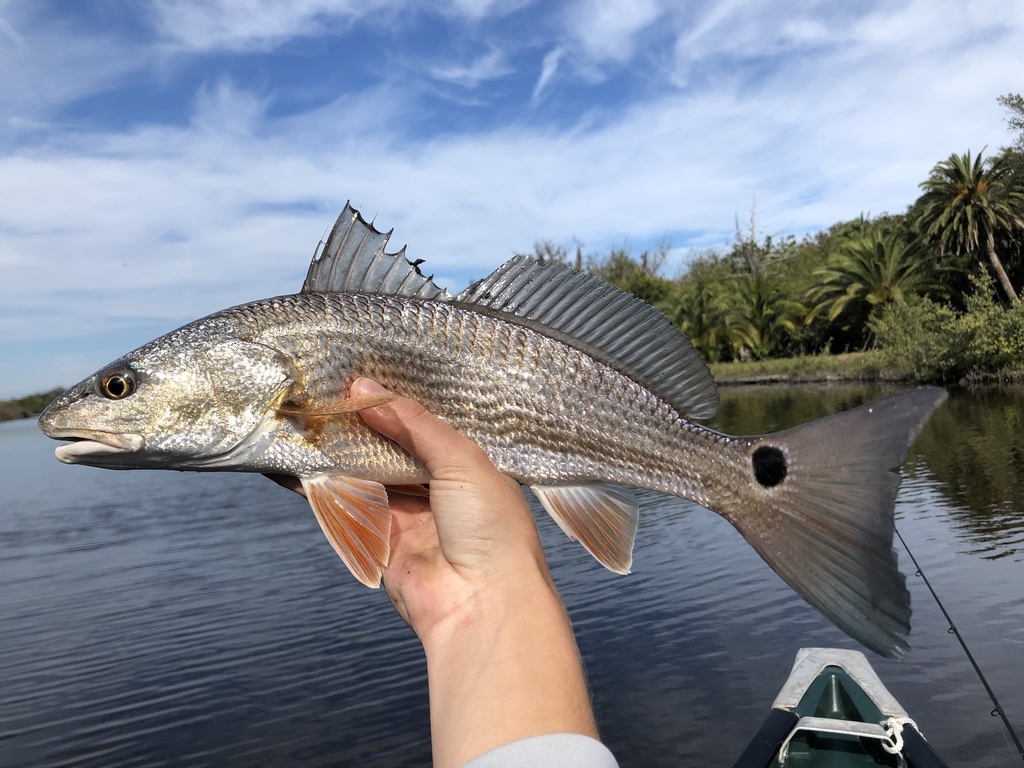
Red Drum
Sciaenops ocellatus
The red drum (Sciaenops ocellatus), also known as redfish, channel bass, puppy drum, spottail bass, or simply red, is a game fish found in the Atlantic Ocean from Massachusetts to Florida and in the Gulf of Mexico from Florida to northern Mexico. It is the only species in the genus Sciaenops.
The red drum is related to the black drum (Pogonias cromis), and the two species are often found near to each other; they can interbreed and form a robust hybrid, and younger fish are often indistinguishable in flavor.
From the article Red drum on Wikipedia (CC BY-SA), quoted section by section
Description
Red drum are a dark red color on the back, which fades into white on the belly. The red drum has a characteristic eyespot near the tail and is somewhat streamlined. Three-year-old red drum typically weigh 6 to 8 pounds (2.7–3.6 kg). The largest red drum on record weighed just over 94 pounds (43 kg) and was caught in 1984 on Hatteras Island. Male red drum make a knocking or drumming sound during spawning by vibrating their swim bladders. The most distinguishing mark on the red drum is one large black spot on the upper part of the tail base. Having multiple spots is not uncommon for this fish, but having no spots is extremely rare. As the fish with multiple spots grow older, they seem to lose their excess spots. Scientists believe that the black spot near their tail helps fool predators into attacking the red drum's tail instead of its head, allowing the red drum to escape. The red drum uses its senses of sight and touch, and its downturned mouth, to locate forage on the bottom through vacuuming or biting. On the top and middle of the water column, it uses changes in the light that might look like food. In the summer and fall, adult red drum feed on crabs, shrimp, and mullet; in the spring and winter, adults primarily feed on menhaden, mullet, pinfish, sea robin, lizardfish, spot, Atlantic croaker, and mudminnows.
Wikipedia: “Characteristics”
Range & habitat
Red drum naturally occur along the eastern and southern Atlantic and Gulf of Mexico coasts of Louisiana, Texas, Alabama, Mississippi, Florida, Georgia, the Carolinas, and Virginia. They are a highly prized game fish in the Gulf of Mexico. Aquaculture activities involving them occur around the world. Several individuals have been recently reported from the Mediterranean Sea off Israel and Sicily, all likely escapees from aquaculture farms. Immature red drum prefer grass marsh areas of bays and estuaries when available. Both younger mature red drum (3–6 years of age) and bull red drum prefer rocky outcroppings including jetties and manmade structures, such as oil rigs and bridge posts. Around this type of structure, they are found throughout the water column.
Wikipedia: “Distribution”
What it does
Mature red drum spawn in near shorelines from mid-August to mid-October. The red drum's eggs incubate for 24 hours. A female lays about 1.5 million (with a range of 200,000 up to more than three million) eggs per batch. Scharf (2000) reported that in the first year, young red drum in Texas estuaries grew about 0.6 mm per day, though the rates varied with location and year and were higher in more southerly estuaries. Larvae are approximately 0.07 inches (1.8 mm) long at hatching. After the first year, they may be 271 – 383 mm long. About half of red drum are able to reproduce by age 4 years, when they are 660–700 mm long and 3.4 – 4 kg in weight. Red drum can live to be 60 years old. Adults mature by 3 – 5 years of age; approximate length at maturity: males – 28 inches, females – 33 inches. Spawn during late summer and fall occurs near estuary inlets and passes along barrier island beaches. Males produce drumming sounds using muscular contractions to vibrate the swimbladder, to attract females. Larval red drum likely use vertical migrations to ride high salinity tidal currents into tidal creeks and shallow salt marsh nursery habitats. As red drum grow longer, they increase in weight exponentially. …
Wikipedia: “Reproduction and growth”
Where it lives
Recorded sightings
—
geo-referenced records in GBIF, from museums, herbaria and field observers.
Drag the globe to turn it. Dots are where records exist, not a range map; darker means more records.
In the stacks
Searching the stacks…
Every page naming Sciaenops ocellatus in the Biodiversity Heritage Library →
This page is assembled live from iNaturalist, GBIF, Wikipedia, the Source Library and the Internet Archive. It is not yet part of the hand-edited codex. iNaturalist taxon 128750.