On eBird ↗
Black-billed Nightingale-Thrush
Live sightings near you, the range map, bar charts of when it is seen, and Macaulay Library photos and recordings.
Black-billed Nightingale-Thrush
Catharus gracilirostris
The black-billed nightingale-thrush (Catharus gracilirostris) is a small thrush endemic to the highlands of Costa Rica and western Panama. Its position in the genus Catharus is somewhat equivocal, but it is apparently closer to the hermit thrush than to the other nightingale-thrushes except the russet nightingale-thrush and/or the ruddy-capped nightingale-thrush (Winker & Pruett, 2006).
From the article Black-billed nightingale-thrush on Wikipedia (CC BY-SA), quoted section by section
Description
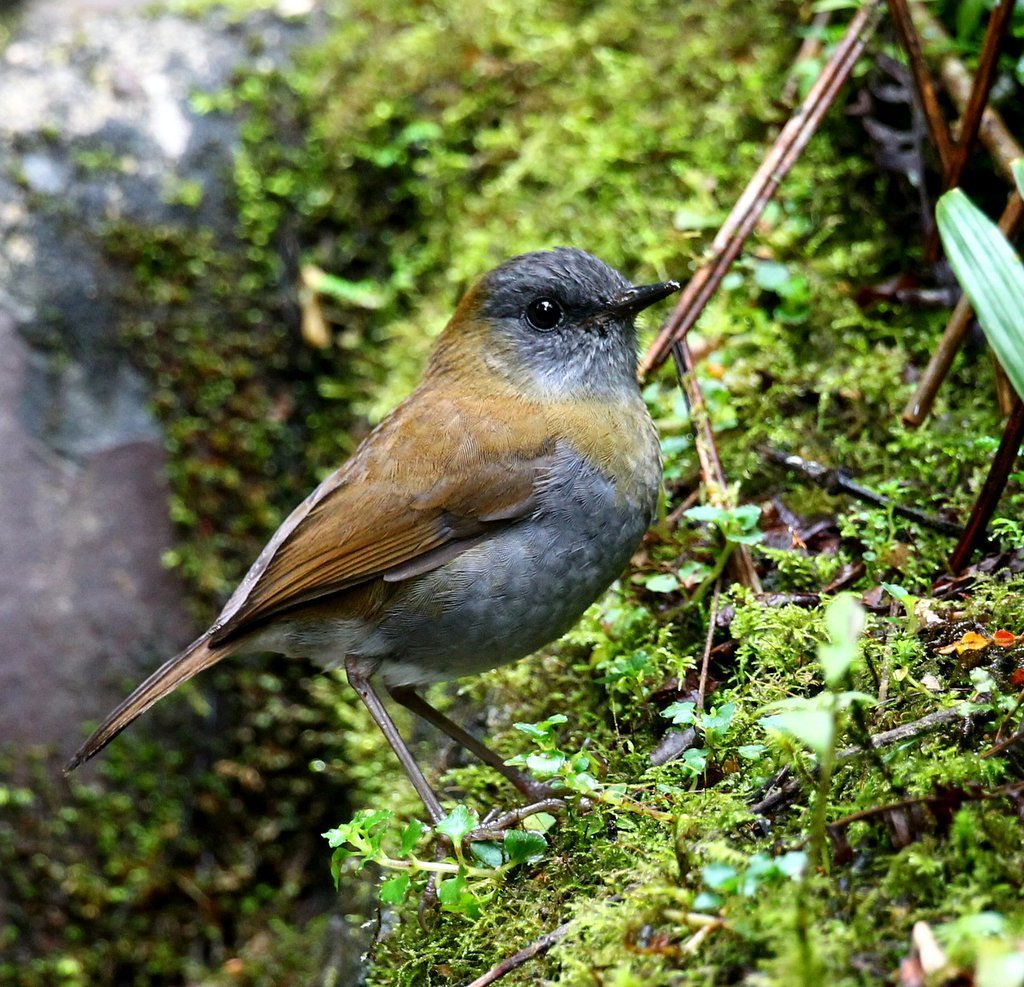
The black-billed nightingale-thrush is about 15 cm (5.9 in) long and weighs about 20 g (0.71 oz) The sexes have the same plumage. Adults of the nominate subspecies have a slate-gray forecrown, an olive-brown crown, and a slate-gray face. Their upperparts, wings, and the upper side of their tail are olive-brown. Their throat is whitish, the middle of their lower belly light gray to whitish, and the rest of their underparts slate-gray with an olivaceous band across the breast. They have a dark brown iris, a black bill, and dark gray legs and feet. Juveniles have more olive in their upperparts than adults, with an olive-tinged sooty gray face and throat and darker underparts with some spotting on the breast and upper belly. Subspecies C. g. accentor has more reddish-brown upperparts, a paler breast band, and blacker legs and feet than the nominate. C. g. bensoni also has more reddish-brown upperparts, with a blackish brown forecrown, a dark reddish brown breast band, and blacker legs and feet.
Range & habitat
The black-billed nightingale-thrush has the smallest range of any Catharus thrush, and its distribution is disjunct. The nominate subspecies is found in Costa Rica's Cordillera Central and Cordillera de Talamanca. In the Cordillera Central it occurs on four volcanos separated by low passes, and a major valley separates them from the Cordillera de Talamanca. The other two subspecies are found in western Panama's Chiriquí Province, C. g. accentor in the west and C. g. bensoni in the east. The exact geographical divisions among the three subspecies in eastern Costa Rica and western Panama have not been fully resolved. The black-billed nightingale-thrush primarily inhabits montane evergreen forest, elfin forest, and paramo in the upper subtropical and temperate zones. It also occurs in pastures, gardens, and along roads when seeking food. One source states that overall it ranges from 1,800 m (5,900 ft) up to the timber line. In Costa Rica it ranges from 2,200 m (7,200 ft) to above timberline.
Wikipedia: “Distribution and habitat”
What it does
The black-billed nightingale-thrush feeds mostly on small insects and also includes spiders and small amounts of fruit in its diet. It forages singly and, during the breeding season, in pairs, and usually on the ground. On the ground it tosses leaves and leaf litter to expose prey. It will forage in the forest canopy as high as about 25 m (80 ft) and along forest trails. It often is quite tame.
Wikipedia: “Feeding”
Listen
Looking for field recordings…
Where it lives
Recorded sightings
—
geo-referenced records in GBIF, from museums, herbaria and field observers.
Drag the globe to turn it. Dots are where records exist, not a range map; darker means more records.
In the stacks
Searching the stacks…
Every page naming Catharus gracilirostris in the Biodiversity Heritage Library →
This page is assembled live from iNaturalist, GBIF, Wikipedia, the Source Library and the Internet Archive. It is not yet part of the hand-edited codex. iNaturalist taxon 12888.