On eBird ↗
Blue Finch
Live sightings near you, the range map, bar charts of when it is seen, and Macaulay Library photos and recordings.
Blue Finch
Rhopospina caerulescens
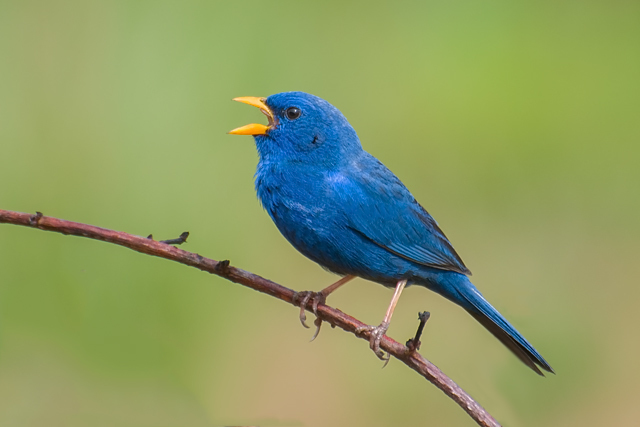
The blue finch or yellow-billed blue finch (Rhopospina caerulescens) is a species of small bird. Although it was long classified in the bunting family Emberizidae, or the cardinal family Cardinalidae, more recent molecular studies have shown it fits comfortably in the Thraupini tribe within the family Thraupidae.
From the article Blue finch on Wikipedia (CC BY-SA), quoted section by section
Description
The blue finch is about 12.5 cm (4.9 in) long and weighs about 13 g (0.46 oz). It is a slim bird with a long tail and a long bill. The species is sexually dimorphic. Adult males are almost entirely bright indigo-blue. They have blackish lores, blackish wings and tail with wide blue feather edges, and rufous tips on the feathers of the back that quickly wear away. Adult females have a mostly pale brownish head with a paler supercilium and crescents above and below the eye. Their upperparts are mostly warm brown with thin darker streaks on the back. Their rump and uppertail coverts are grayish. Their wing coverts are warm brown with paler tips that show as two faint wing bars. Their wings are dark grayish with warm brown edges on the flight feathers. Their tail is dark grayish. Their throat and underparts are buffy white with thin brown streaks on the throat, breast, and flanks and heavier streaks on the undertail coverts. Both sexes have a dark brown iris and dull pink legs and feet. Males have a yellow bill; the female's is a duller yellow with a dark tip and culmen.
Range & habitat
The blue finch has a "tilted V" main range that in Brazil is roughly within a line from west-central Rondônia east to northern Goiás, then northeast to northeastern Maranhão and northern Piauí, south to southern Minas Gerais, and west to far northwestern Mato Grosso do Sul. There are also very small scattered populations outside the main range. Its range extends west into eastern and southern Bolivia's Beni, Santa Cruz, and probably Chuquisaca departments. It primarily inhabits the cerrado, a tropical savanna landscape. Within it the species greatly favors campos rupestres, a grassland with rocky outcrops, some bushes, and relatively few trees. In Brazil it ranges in elevation from sea level to 1,100 m (3,600 ft).
Wikipedia: “Distribution and habitat”
What it does
The blue finch feeds mostly on seeds with invertebrates making up about 20% of its diet. It forages on the ground, in the breeding season mostly singly or in pairs and outside it in small flocks.
Wikipedia: “Feeding”
Listen
Looking for field recordings…
Where it lives
Recorded sightings
—
geo-referenced records in GBIF, from museums, herbaria and field observers.
Drag the globe to turn it. Dots are where records exist, not a range map; darker means more records.
In the stacks
Searching the stacks…
Every page naming Rhopospina caerulescens in the Biodiversity Heritage Library →
This page is assembled live from iNaturalist, GBIF, Wikipedia, the Source Library and the Internet Archive. It is not yet part of the hand-edited codex. iNaturalist taxon 1289359.