On eBird ↗
Chestnut-hooded Laughingthrush
Live sightings near you, the range map, bar charts of when it is seen, and Macaulay Library photos and recordings.
Chestnut-hooded Laughingthrush
Pterorhinus treacheri
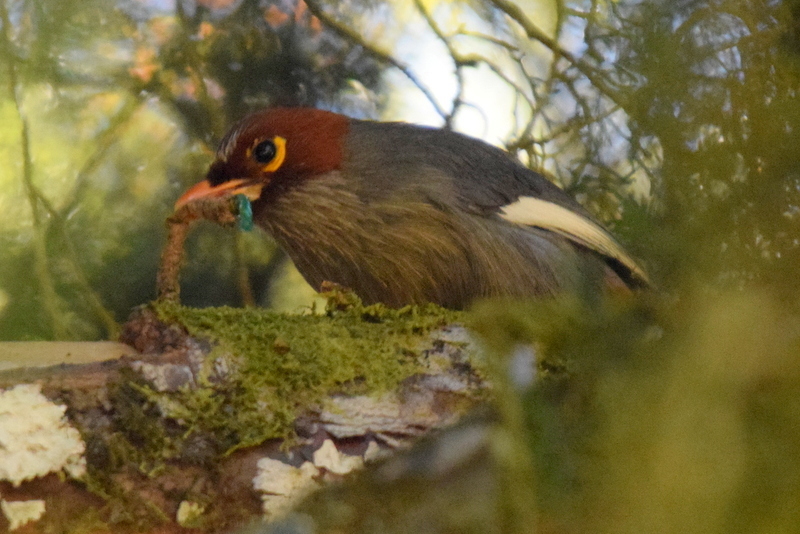
The chestnut-hooded laughingthrush (Pterorhinus treacheri) is a species of bird in the laughingthrush family Leiothrichidae endemic to Borneo. Described by the British ornithologist Richard Bowdler Sharpe as a distinct species in 1879, it was subsequently considered a subspecies of the chestnut-capped laughingthrush until 2007, when it was again raised to species status by the ornithologists Nigel Collar and Craig Robson. It is 22–24 cm (8.7–9.4 in) long, with a chestnut brown head and chin, with grey feathering on the top of the head. The upperparts and the side of the neck are slaty-grey, with a long white wing patch. The throat, breast, and upper belly are dull yellowish-brown, with purer grey flanks and a reddish-brown vent, lower belly, and thighs. It has a yellow half eye-ring behind and below the eye, while the tail has a blackish tip. Both sexes look similar, while juveniles are duller than adults.
The species inhabits montane and hill forest, forest edge, disturbed vegetation, and cultivated areas in mountains in the north-central and southeastern parts of Borneo. It is mainly found at elevations of 600–2,800 m (2,000–9,200 ft), but can be found down to 200 m (660 ft) and as high as 3,350 m (10,990 ft). It is omnivorous, feeding on arthropods, fruit, and flowers. Breeding occurs from February to April and in October, with the species building cup nests and laying clutches of two bright blue to greenish-blue eggs.
From the article Chestnut-hooded laughingthrush on Wikipedia (CC BY-SA), quoted section by section
Description
The chestnut-hooded laughingthrush is 22–24 cm (8.7–9.4 in) long, with both sexes having similar appearances. In the nominate subspecies, the chin, lores (area between the eyes and nostrils), supercilium (line above the eye), feathers around the nostrils, and the area around the base of the bill are chestnut brown. The forehead, front of the crown (top of the head), and the area from the eyes down to the chin are darker, with some greyish-white feathering on the crown. The throat, breast, and upper belly are dull yellowish-brown with a greyish tinge and dull yellowish-brown streaking. The flanks are purer grey, while the lower belly, thighs, and vent are reddish-brown. The side of the neck and the upperparts are slaty-grey with a slight yellowish-brown tinge, with a long white patch on the primaries. The tail is darker grey and has a blackish tip. The iris is red to reddish-brown, with a yellow half eye-ring behind and below the eye. The bill is dull orange to yellowish-brown, while the legs are yellowish. Juveniles are duller than adults. P. t. damnatus has a duller breast with less streaking, while P. t. griswoldi has more intense chestnut on the vent. …
Range & habitat
The chestnut-hooded laughingthrush is endemic to Borneo, where it is found in the north-central mountain ranges from Mount Kinabalu to Barito Ulu, along with the Meratus Mountains in the southeast of the island. It inhabits evergreen montane forest and hill forest, forest edge, secondary forest, disturbed vegetation, and cultivated areas such as short growth in old rice fields. It is usually found at elevations of 600–2,800 m (2,000–9,200 ft), but may sometimes be seen as low as 200 m (660 ft) and as high as 3,350 m (10,990 ft).
Wikipedia: “Distribution and habitat”
What it does
The chestnut-hooded laughingthrush forages in small groups of 4–5 birds, frequently joining mixed-species foraging flocks that can include the Sunda cuckooshrike, Sunda laughingthrush, Whitehead's broadbill, and Whitehead's trogon. These flocks can include Tupaia treeshrews and Dremomys squirrels on the ground and Sundasciurus squirrels in the canopy.
Feeding. The chestnut-hooded laughingthrush is omnivorous. It feeds on arthropods such as grasshoppers, ants, crickets, earwigs, moths, caterpillars, leafhoppers, bug larva, flies, small black beetles, and small millipedes. It also eats the fruit of Glochidion, Macaranga, Trema cannabina, Embelia ribes, Sambucus, and melastomes like Medinilla, along with the flowers of the invasive Passiflora edulis and both the fruits and flowers of Rhodamnia. The species forages by hopping up slanting branches in a woodpecker-like manner without using its tail for support and taking insects from the surface. It sometimes clings to vertical surfaces like the trunks of tree ferns. It will also forage on forest floors and lawns like a Turdus thrush, holding its tail up. It has been recorded feeding on flying ants that are unable to fly and insects hit by vehicles. Foraging is mainly conducted within a few metres of the ground, but the species also sometimes feeds in the canopy.
Breeding. …
Wikipedia: “Behaviour and ecology”
Listen
Looking for field recordings…
Where it lives
Recorded sightings
—
geo-referenced records in GBIF, from museums, herbaria and field observers.
Drag the globe to turn it. Dots are where records exist, not a range map; darker means more records.
In the stacks
Searching the stacks…
Every page naming Pterorhinus treacheri in the Biodiversity Heritage Library →
This page is assembled live from iNaturalist, GBIF, Wikipedia, the Source Library and the Internet Archive. It is not yet part of the hand-edited codex. iNaturalist taxon 1289405.