On eBird ↗
Mountain Black-eye
Live sightings near you, the range map, bar charts of when it is seen, and Macaulay Library photos and recordings.
Mountain Blackeye
Zosterops emiliae
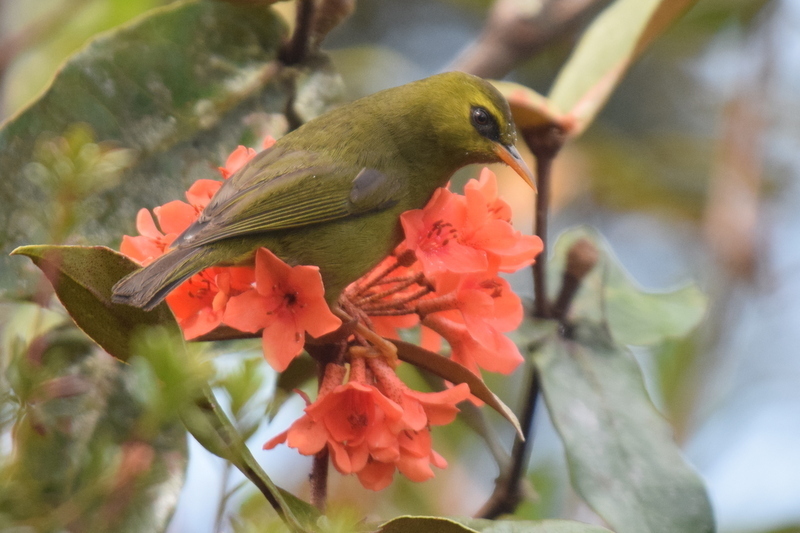
The mountain blackeye (Zosterops emiliae), sometimes referred to as the olive blackeye or simply black-eye, is a species of passerine bird in the family Zosteropidae. It is endemic to the highest mountains on the island of Borneo. It is known from both Malaysian states on the island, and four of the five Indonesian provinces, but has never been recorded in Brunei. Typically found at elevations above 1,800 m (5,900 ft), the mountain blackeye sometimes moves to lower altitudes during periods of drought. There are four subspecies, which show clinal variations in size and coloring. Birds in the north are largest, darkest, and proportionately longer-tailed, while those further south are smaller, paler, and proportionately shorter-tailed. Adults are dark olive-green with a sharply-pointed, bright yellow-orange bill and a small dark mask connecting black lores with a black eye-ring. The subspecies show varying amounts of yellow in their plumage, particularly on the face and underparts. Young birds resemble their parents, but have less brightly colored bills.
It feeds on insects, nectar, pollen, and small fruits, and is a major pollinator of several species of Rhododendron. It is also a minor partner in a symbiotic relationship with the pitcher-plant Nepenthes lowii. Little is known about its breeding ecology. Its nest is a shallow cup made of rootlets and lined with bits of moss. The female lays a single egg, and the nestling takes 14–15 days to fledge after hatching. The International Union for Conservation of Nature lists it as a species of least concern.
From the article Mountain blackeye on Wikipedia (CC BY-SA), quoted section by section
Description
The mountain blackeye is a small passerine, ranging in length from 11 to 14 cm (4.3 to 5.5 in). Compared to most other white-eyes, it is larger and longer-tailed. The only known measured individual (sex unknown) weighed 13.9 g (0.49 oz). Male and female are similarly plumaged. The adult of the nominate race, emiliae, is dark olive-green on the head and upperparts with a blackish tinge to the green, particularly on the crown. Its underparts are somewhat paler, with a yellowish tint, particularly towards the center of the belly. It has a black eye-ring and black lores, which connect to form a small dark mask, edged by a yellow border. It has a bright yellow-green supraloral and throat. Its iris is brown, and its long, slender, pointed, decurved bill is brown on the upper mandible and bright yellow-orange on the lower. Its legs and feet are dark yellowish-brown to black, with yellow soles. The immature bird is like the adult, though with a duller-colored bill; this is typically dull orange to blackish. The subspecies trinitae is similar to emiliae, but brighter and more yellowish overall. Its belly is almost completely yellow, and it shows more yellow on the face. The subspecies fusciceps is smaller and relatively shorter-tailed than emiliae, with a sepia tint to its crown and forehead. Its underparts are yellow. The subspecies moultoni is similar to fusciceps. …
Range & habitat
The mountain blackeye is endemic to the high mountains of Borneo, where it is the most common bird on the summit slopes of the island's highest mountains: Kinabalu, Tambuyukon and Trus Madi. It is also found on several isolated lower mountains. It occurs in both Malaysian states (Sabah and Sarawak) and four of the five Indonesian provinces (North Kalimantan, East Kalimantan, Central Kalimantan, and West Kalimantan) on the island, but has never been recorded in Brunei. Its habitats include primary upper montane forest, summit scrub, and gully vegetation. While it generally occurs at elevations above 1,800 m (5,900 ft), it may move to lower elevations during periods of drought.
Wikipedia: “Distribution and habitat”
What it does
Much of the life history and ecology of the mountain blackeye is not well-known. The species is resident, with no migratory movements. Its generation length is estimated at 4.4 years.
Feeding. The mountain blackeye feeds on nectar, pollen, insects (particularly caterpillars, grasshoppers and beetles), and small berries, including raspberries. It has a modified tongue—tubular with a brush-like tip—which allows it to easily sip nectar. It feeds at all heights, from the ground to the canopy, often foraging in small groups. It visits the flowers of Eugenia, Schima, Elaeocarpus and several Rhododendron species. Studies indicate that it may be an important pollinator of Rhododendron buxifolium; it also regularly visits Rhododendron ericoides and Rhododendron acuminatum. It is an occasional partner in a symbiotic relationship with Nepenthes lowii, a pitcher-plant which is also endemic to Borneo. The plant produces waxy secretions on the lid of its pitcher. Although treeshrews are the primary consumers of these secretions, mountain blackeyes also partake, sometimes defecating into the pitchers as they do so. Treeshrew and bird feces provide nutrients for the plant; studies have shown that some plants get 57–100% of their nitrogen from animal feces. …
Wikipedia: “Ecology”
Listen
Looking for field recordings…
Where it lives
Recorded sightings
—
geo-referenced records in GBIF, from museums, herbaria and field observers.
Drag the globe to turn it. Dots are where records exist, not a range map; darker means more records.
In the stacks
Searching the stacks…
Every page naming Zosterops emiliae in the Biodiversity Heritage Library →
This page is assembled live from iNaturalist, GBIF, Wikipedia, the Source Library and the Internet Archive. It is not yet part of the hand-edited codex. iNaturalist taxon 1289451.