On eBird ↗
Chestnut-vented Warbler
Live sightings near you, the range map, bar charts of when it is seen, and Macaulay Library photos and recordings.
Chestnut-vented Warbler
Curruca subcoerulea
The chestnut-vented warbler, chestnut-vented tit-babbler or rufous-vented warbler (Curruca subcoerulea) is an Old World warbler of the family Sylviidae.
The chestnut-vented warbler breeds in southern Africa in Angola, Botswana, Zimbabwe, Zambia, Namibia, South Africa, Lesotho, Mozambique and Eswatini. This is a common species found in a range of habitats including fynbos, scrub, thickets and dry riverbeds.
From the article Chestnut-vented warbler on Wikipedia (CC BY-SA), quoted section by section
Description
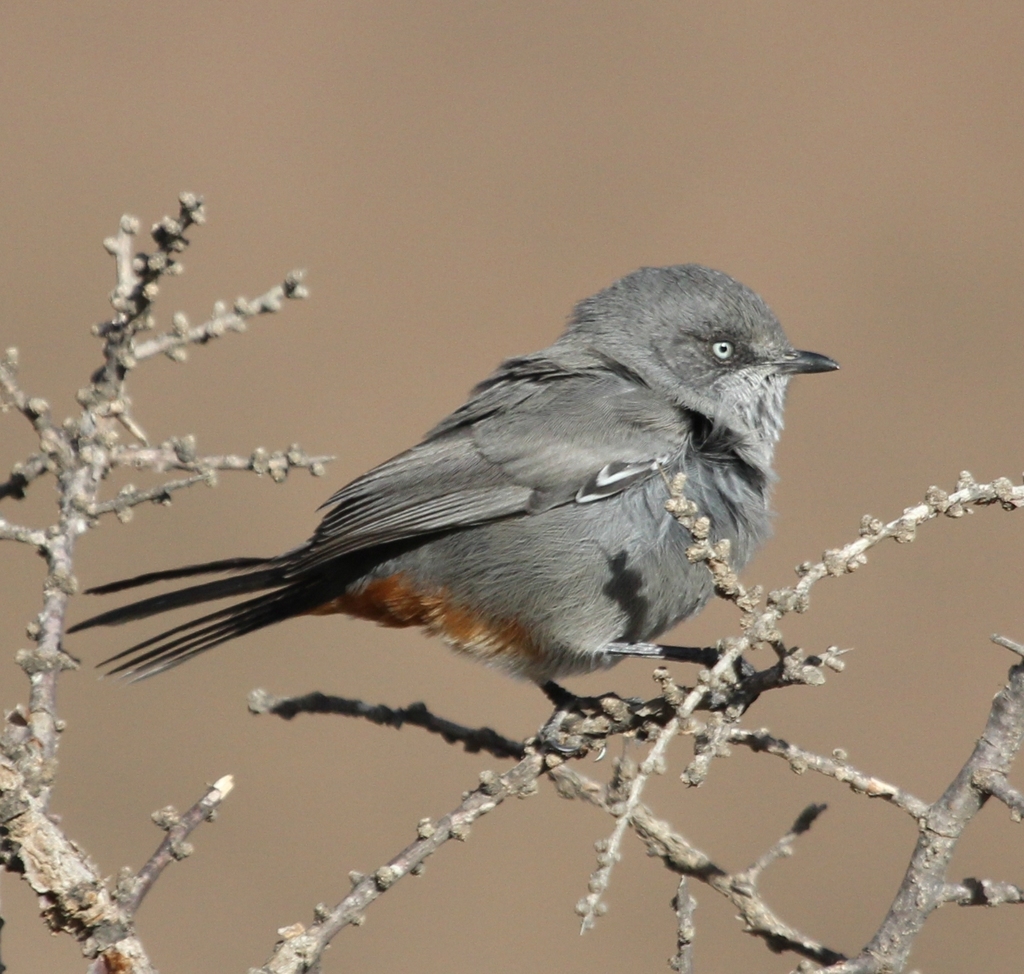
The chestnut-vented warbler is 14–15 cm long and weighs around 16 g. Its upperparts are grey-brown, and the tail is black with a broad white band at its tip. This warbler has a white eye ring. The throat is grey with heavy dark streaking, the breast and belly are grey, and the vent area is bright chestnut. The legs are black and the eyes are grey. The sexes are similar, but the juvenile has an unstreaked throat. The call is a loud fluted cheerup-chee-chee. Layard's warbler, Curruca layardi, is the only similar species, but is paler, has more white in the tail, and lacks the chestnut vent.
What it does
The chestnut-vented warbler builds a cup nest low in vegetation. This species is monogamous, pairing for life. It is usually seen alone or in pairs, moving through vegetation as it forages for insects and other small invertebrates.
Wikipedia: “Behaviour”
Listen
Looking for field recordings…
Where it lives
Recorded sightings
—
geo-referenced records in GBIF, from museums, herbaria and field observers.
Drag the globe to turn it. Dots are where records exist, not a range map; darker means more records.
In the stacks
Searching the stacks…
Every page naming Curruca subcoerulea in the Biodiversity Heritage Library →
This page is assembled live from iNaturalist, GBIF, Wikipedia, the Source Library and the Internet Archive. It is not yet part of the hand-edited codex. iNaturalist taxon 1289485.