On eBird ↗
Rusty-backed Monjita
Live sightings near you, the range map, bar charts of when it is seen, and Macaulay Library photos and recordings.
Rusty-backed Monjita
Neoxolmis rubetra
The rusty-backed monjita (Neoxolmis rubetra) is a species of bird in the family Tyrannidae. It is endemic to Argentina. Its natural habitats are subtropical or tropical dry shrubland and pastureland.
From the article Rusty-backed monjita on Wikipedia (CC BY-SA), quoted section by section
Description
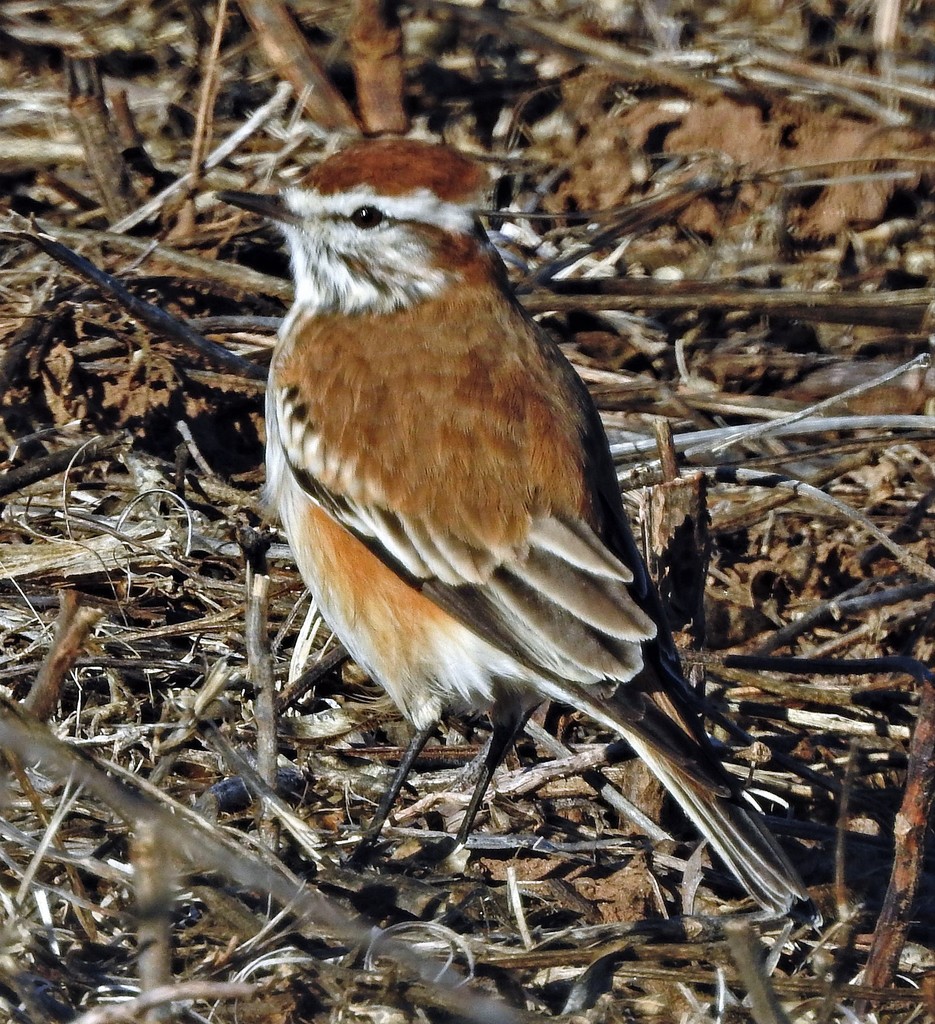
The rusty-backed monjita is 18 to 19 cm (7.1 to 7.5 in) long. Adult males have a rufescent crown and a long white supercilium on an otherwise black-streaked white face. Their upperparts are mostly rufescent or rufous-brown with a grayish white rump. Their wings are mostly black. Their wing's greater and median coverts have grayish white edges and tips, the lesser coverts are rufescent, and the tertials have white edges. Their tail is mostly black with white outer webs on the three outer pairs of feathers. Their throat and underparts are mostly white with black streaks on the sides of the neck and across the breast and a rufous tinge on the flanks. Adult females are duller and less rufescent than males. Both sexes have a dark iris, a black bill, and black legs and feet. Immatures have dull buffy upperparts and a buffish throat and breast.
Range & habitat
The rusty-backed monjita is found in Argentina in an area roughly bounded by the provinces of Tucumán, Entre Ríos, and northeastern Santa Cruz. In addition, it has been recorded as a vagrant in extreme southern Brazil and in Chile. The species inhabits grasslands and steppe with scattered small bushes; it sometimes is found along the shores of lakes. In elevation it ranges up to 1,000 m (3,300 ft).
Wikipedia: “Distribution and habitat”
What it does
The rusty-backed monjita feeds on insects. During the breeding season it primarily forages in pairs or groups of up to about five; in winter it joins in flocks as large as 30 individuals. It is often terrestrial, walking or running with pauses to scan or capture prey, but it will perch on bushes, wires, or fence posts and drop onto prey.
Wikipedia: “Feeding”
Listen
Looking for field recordings…
Where it lives
Recorded sightings
—
geo-referenced records in GBIF, from museums, herbaria and field observers.
Drag the globe to turn it. Dots are where records exist, not a range map; darker means more records.
In the stacks
Searching the stacks…
Every page naming Neoxolmis rubetra in the Biodiversity Heritage Library →
This page is assembled live from iNaturalist, GBIF, Wikipedia, the Source Library and the Internet Archive. It is not yet part of the hand-edited codex. iNaturalist taxon 1289525.