On eBird ↗
Puno Antpitta
Live sightings near you, the range map, bar charts of when it is seen, and Macaulay Library photos and recordings.
Puno Antpitta
Grallaria sinaensis
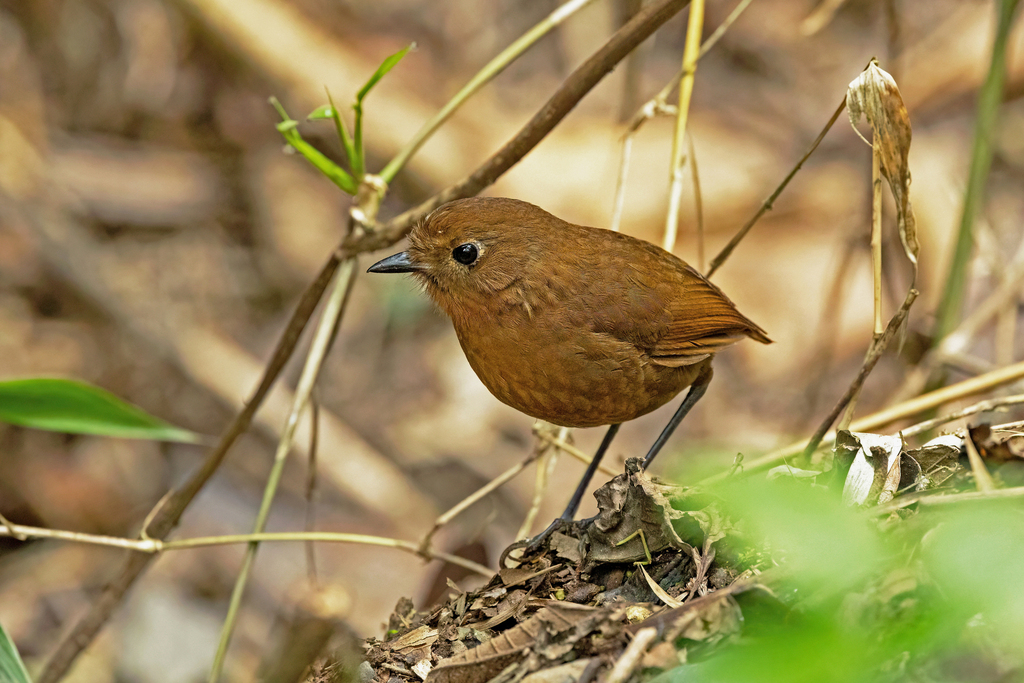
The Puno antpitta (Grallaria sinaensis) is a species of bird in the family Grallariidae. It is found in Bolivia and Peru.
From the article Puno antpitta on Wikipedia (CC BY-SA), quoted section by section
Description
Grallaria antpittas are a "wonderful group of plump and round antbirds whose feathers are often fluffed up...they have stout bills [and] very short tails". The holotype Puno antpitta, a male, weighed 34.2 g (1.2 oz). The sexes have the same plumage. Adults have a mostly dark reddish yellow-brown crown, upperparts, wings, and tail with lighter edges on the flight feathers. They have a pale eyering. Their throat and breast are light reddish yellow-brown, their belly and undertail coverts pale buffy brown, and their flanks dark reddish yellow-brown. Their lower breast and belly have thin darker streaks. Both sexes have a dark brown iris, a black bill, and bluish gray legs and feet.
Range & habitat
The Puno antpitta has a very restricted range in Peru's Puno Department and Bolivia's La Paz Department. All of the records come from between the Sandia River valley in the north and the Consata River valley in the south. Its exact habitat requirements have not been documented. The holotype was collected in temperate forest. At least in Bolivia, it favors areas of dense undergrowth at treeline, along rivers, and at forest edges; it is sometimes associated with bamboo. In elevation it is known between 2,700 and 3,150 m (8,900 and 10,300 ft).
Wikipedia: “Distribution and habitat”
What it does
The Puno antpitta's diet is not known except that it includes insects. Its diet is assumed to be similar to those of other Grallaria antpittas, which feed on arthropods, earthworms, and other invertebrates. Its foraging behavior is also unknown, but again it is assumed to be like that of other antpittas. They run or hop on the forest floor and stop to find prey by flipping aside leaf litter and probing the soil.
Wikipedia: “Feeding”
Listen
Looking for field recordings…
Where it lives
Recorded sightings
—
geo-referenced records in GBIF, from museums, herbaria and field observers.
Drag the globe to turn it. Dots are where records exist, not a range map; darker means more records.
In the stacks
Searching the stacks…
Every page naming Grallaria sinaensis in the Biodiversity Heritage Library →
This page is assembled live from iNaturalist, GBIF, Wikipedia, the Source Library and the Internet Archive. It is not yet part of the hand-edited codex. iNaturalist taxon 1289553.