- Animals
- ›Chordates
- ›Vertebrates
- ›Birds
- ›Parrots
- ›Old World Parrots
- ›Lories, Lorikeets, Budgerigar and Fig-Parrots
- ›Charmosynopsis
On eBird ↗
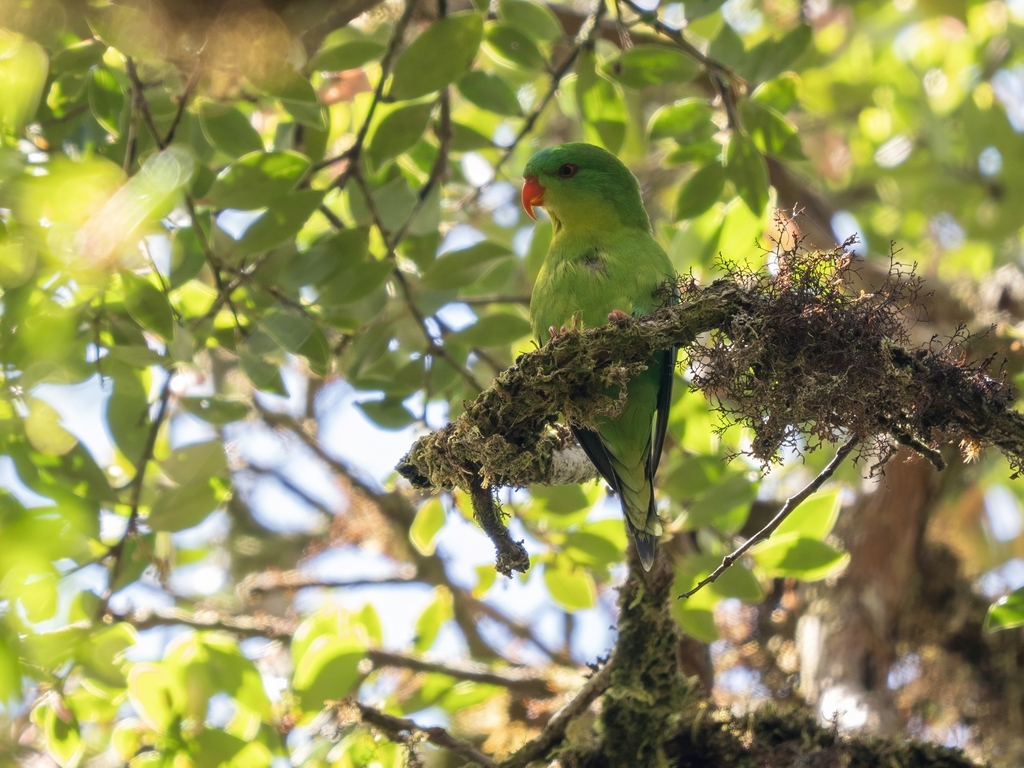
Blue-fronted Lorikeet
Live sightings near you, the range map, bar charts of when it is seen, and Macaulay Library photos and recordings.
Blue-fronted Lorikeet
Charmosynopsis toxopei
The blue-fronted lorikeet (Charmosynopsis toxopei) also known as the Buru lorikeet, is a parrot endemic to the Indonesian island of Buru.
From the article Blue-fronted lorikeet on Wikipedia (CC BY-SA), quoted section by section
Range & habitat
Toxopeus noted that the bird's habitat on Buru is likely restricted to the western part of the Rana plateau in the center of the island (settlements of Wa Temun, Wa Fehat and Nal Besi), as the local name of the bird, utu papua, was not known anywhere else on the island. Two indigenous hunters caught blue-fronted lorikeets for food north-west from the Rana lake, but the bird was not found in the mangroves of the Kayeli Bay at the eastern part of Buru. The locals living at the Rana plateau reported that the bird feeds on nectar and pollen of the flowering trees. Toxopeus found the bird at elevations of 840–1,000 m (2,760–3,280 ft). Four blue-fronted lorikeets were observed in the 1980s, in very different areas at the north-western (Bara settlement) and southern coasts of Buru, at a coconut plantation and in a disturbed lowland forest between the coastal farming fields and the base of the nearby hills. Flocks of several birds were found in another area at elevation of 600 meters (2,000 ft). In November 2014, it was rediscovered and the first photographs were published by birders from BirdQuest in the internet. The analysis of all observations suggested that the blue-fronted lorikeet preferably inhabits forests at the altitude of several hundred meters.
Wikipedia: “Distribution and habitat”
What it does
The blue-fronted lorikeets usually live in pairs, but may form groups up to 10 individuals. They grow to about 16 cm (6.3 in). The voice was described by Toxopeus as a ti–ti–ti–ti–tititi shrill, but might be related not to the blue-fronted lorikeet, but to the red-flanked lorikeet (Charmosyna placentis) which was later observed in the same area. In nature the blue-fronted lorikeets feed on flowering trees of the family Myrtaceae, and in captivity they consumed bananas and milk.
Wikipedia: “Behaviour”
In human culture
The first foreign scientist who described the blue-fronted lorikeet and the only one who managed to capture it (seven individuals in the 1920s, using lime) was the Java-born Dutch lepidopterist Lambertus Johannes Toxopeus, which is reflected in the Latin name of the bird. His observations were summarized by the Dutch ornithologist Hendrik Cornelis Siebers (1890–1949) in 1930.
Wikipedia: “History”
Listen
Looking for field recordings…
Where it lives
Recorded sightings
—
geo-referenced records in GBIF, from museums, herbaria and field observers.
Drag the globe to turn it. Dots are where records exist, not a range map; darker means more records.
In the stacks
Searching the stacks…
Every page naming Charmosynopsis toxopei in the Biodiversity Heritage Library →
This page is assembled live from iNaturalist, GBIF, Wikipedia, the Source Library and the Internet Archive. It is not yet part of the hand-edited codex. iNaturalist taxon 1289574.