On eBird ↗
European Shag
Live sightings near you, the range map, bar charts of when it is seen, and Macaulay Library photos and recordings.
European Shag
Gulosus aristotelis
The European shag or common shag (Gulosus aristotelis) is a species of cormorant. It is the only member of the monotypic genus Gulosus. It breeds around the rocky coasts of western and southern Europe, southwest Asia and north Africa, mainly wintering in its breeding range except for the northernmost birds. In Britain this seabird is usually referred to as simply the shag. The scientific genus name derives from the Latin for glutton. The species name aristotelis commemorates the Greek philosopher Aristotle.
From the article European shag on Wikipedia (CC BY-SA), quoted section by section
Description
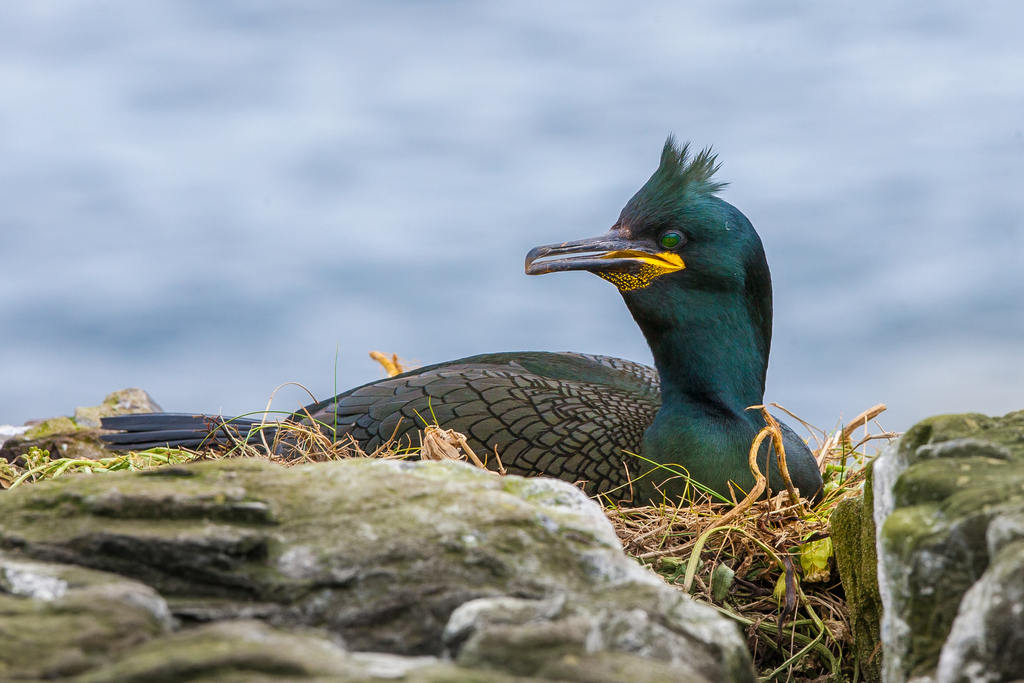
This is a medium-large black bird, 68 to 78 cm (27 to 31 in) long and with a 95-to-110-centimetre (37 to 43 in) wingspan. It has a longish tail and a yellow throat patch. Adults have a small crest in the breeding season. It is distinguished from the great cormorant by its smaller size, lighter build, thinner bill, and, in breeding adults, by the crest and metallic green-tinged sheen on the feathers. Among those differences are that a shag is smaller and has a lighter, narrower beak, and the juvenile shag has darker underparts. The European shag's tail has 12 feathers, as do the great cormorant's 14 feathers. The green sheen on the feathers results in the alternative name green cormorant sometimes being given to the European shag.
Range & habitat
The European shag can be readily seen among the following locations during the breeding season, between late April and mid-July: Saltee Islands, Ireland; Farne Islands and Isles of Scilly, England; Isle of May, Deerness and Fowlsheugh, Scotland; Runde, Norway; Iceland; Denmark; Faroe Islands; Galicia, Northern Spain; Dalmatia and Istria, Croatia. In April 2017, eight new European shags were born in Monaco. The British population was 18,000 pairs in 2015. A large colony of European shags is in the Cíes Islands, Spain, with 2,500 pairs.
Wikipedia: “Distribution”
What it does
The shag is a pursuit-diving seabird that feeds predominantly in benthic habitats. Due to the relative ease with which diet samples can be collected from this species (regurgitated food or pellets) and the perceived conflict between the Phalacrocoracidae and fisheries, shag diet competition has been the subject of substantial scientific interest. Evidence collected at one colony, the Isle of May, Scotland, between 1985 and 2014, suggests that shag chick diet composition in this population has diversified in response to ocean warming. Shags also feed on fewer sandeel on windy days, presumably due to the strong effect of wind on flight in this species. The year-round diet of full-grown shags at this colony has also changed over the past 3 decades, from sandeel specialists to an increasingly diverse prey base.
Wikipedia: “Diet”
Listen
Looking for field recordings…
Where it lives
Recorded sightings
—
geo-referenced records in GBIF, from museums, herbaria and field observers.
Drag the globe to turn it. Dots are where records exist, not a range map; darker means more records.
In the stacks
Searching the stacks…
Every page naming Gulosus aristotelis in the Biodiversity Heritage Library →
This page is assembled live from iNaturalist, GBIF, Wikipedia, the Source Library and the Internet Archive. It is not yet part of the hand-edited codex. iNaturalist taxon 1289604.