- Animals
- ›Chordates
- ›Vertebrates
- ›Birds
- ›Swifts and Hummingbirds
- ›Hummingbirds
- ›Bee Hummingbirds, Emeralds, Mountain-gems, and Allies
- ›Emerald Hummingbirds and Allies
- ›Chlorestes
On eBird ↗
Blue-throated Goldentail
Live sightings near you, the range map, bar charts of when it is seen, and Macaulay Library photos and recordings.
Blue-throated Goldentail
Chlorestes eliciae
The blue-throated goldentail (Chlorestes eliciae), also known as the blue-throated sapphire, is a species of hummingbird in the family Trochilidae. It is found in Belize, Colombia, Costa Rica, El Salvador, Guatemala, Honduras, Mexico, Nicaragua, and Panama. Its natural habitats are subtropical or tropical moist lowland forest and heavily degraded former forest.
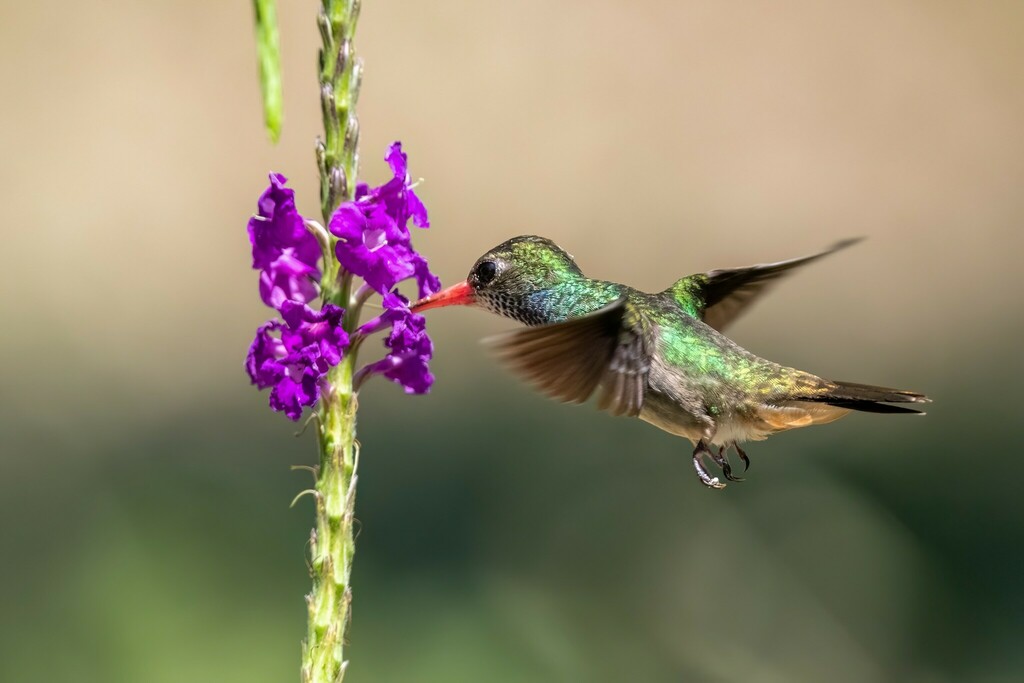
The male blue-throated goldentail is a little bit larger than the female and display similar patterns but brighter colors on its plumage. This species can be distinguished by its straight, bright red bill with a black tip. The crown and upperparts of the male blue-throated goldentail are green, and more coppery or golden on the rectrices. The throat is glittering blue-violet to violet, the belly is cream-brown buff, and the sides of the breast and the flanks are streaked with green. The female's throat is rather violet blue, mixed with gray buff, and the belly is paler than the male's. The immature looks like the female adult as it has duller colors. This characteristic more pronounced in the female juvenile.
From the article Blue-throated goldentail on Wikipedia (CC BY-SA), quoted section by section
Description
This medium-sized hummingbird measures 9 cm (3.5 in) and weighs 3.6 g (0.13 oz). On average, the male's wings measure 49.7 mm (1.96 in), its tail 26.7 mm (1.05 in), and its bill (i.e. culmen from base) 18.2 mm (0.72 in). The female's parts are a little bit smaller, as its wings measure 47.7 mm (1.88 in), its tail 25.9 mm (1.02 in), and its bill 19.4 mm (0.76 in). The crown and upperparts are green, shading to the metallic golden-green tail. The wings are dusky, while the sides and belly are green. The throat is metallic blue-violet. The bill is straight, coral red with a black tip, and broad at the base. The female is paler overall, with more black on the bill and more grey on the throat, but still bears bright golden-green upper tail coverts. Both males and females' irises and toes are dark brown. After hatching, the juvenile completes its preformative plumage between March and August, and finish developing its definitive prebasic plumage at the same period (i.e. March–August) of the following year. During its first year after hatch, the female juvenile's plumage changes. The blackish culmen fades away into a more dusky one with some red wash on 50% of the basal, the throat's initial greenish-blue spotting turn into more extensive dark-blue spotting, and the outer rectrices display cinnamon tips that then vanish as the female's plumage alters. …
Range & habitat
The blue-throated goldentail is endemic to the Americas. Its range extends from southern Mexico to western Panama along both slopes, with a few occurrences in northern Chocó in Colombia. The Blue-throated goldentail occupies lowlands and valleys, and its elevational range varies between 950 m. a.s.l. in Costa Rica and 1000 m. a.s.l. in Mexico. Yet, some specimens have been recorded up to 2000 m a.s.l in the Braulio National Park in Costa Rica, as well as in El Salvador. Though its seasonal movements are poorly documented, the blue-throated goldentail is considered resident throughout most of its range and is relatively sedentary but it may display local wandering during flowering. Some studies suggest that these unusual records at high elevations could be an effect of climate change, as bird species occupying high elevations have been shown to be declining in abundance, while other bird species occurring in lower elevations have started to move upwards. The species' natural habitats are humid to semihumid forest, second-growth forest, plantations, semi-open, light woodland, gardens and gallery forest in drier regions.
Wikipedia: “Distribution and habitat”
What it does
The blue-throated goldentail is mainly nectarivorous. Its diet comprises flowers of Stachytarpheta, Hamelia, Heliconia, Renealmia, Thalea, Inga, Psidium, Lobelia, and some epiphytes. The blue-throated goldentail also consume small arthropods in small proportions. More research needs to be done on the details of its diet, as well as on its foraging behavior.
Wikipedia: “Diet”
Listen
Looking for field recordings…
Where it lives
Recorded sightings
—
geo-referenced records in GBIF, from museums, herbaria and field observers.
Drag the globe to turn it. Dots are where records exist, not a range map; darker means more records.
In the stacks
Searching the stacks…
Every page naming Chlorestes eliciae in the Biodiversity Heritage Library →
This page is assembled live from iNaturalist, GBIF, Wikipedia, the Source Library and the Internet Archive. It is not yet part of the hand-edited codex. iNaturalist taxon 1289631.