- Animals
- ›Chordates
- ›Vertebrates
- ›Birds
- ›Swifts and Hummingbirds
- ›Hummingbirds
- ›Bee Hummingbirds, Emeralds, Mountain-gems, and Allies
- ›Emerald Hummingbirds and Allies
- ›Elliotomyia
On eBird ↗
Green-and-white Hummingbird
Live sightings near you, the range map, bar charts of when it is seen, and Macaulay Library photos and recordings.
Green-and-white Hummingbird
Elliotomyia viridicauda
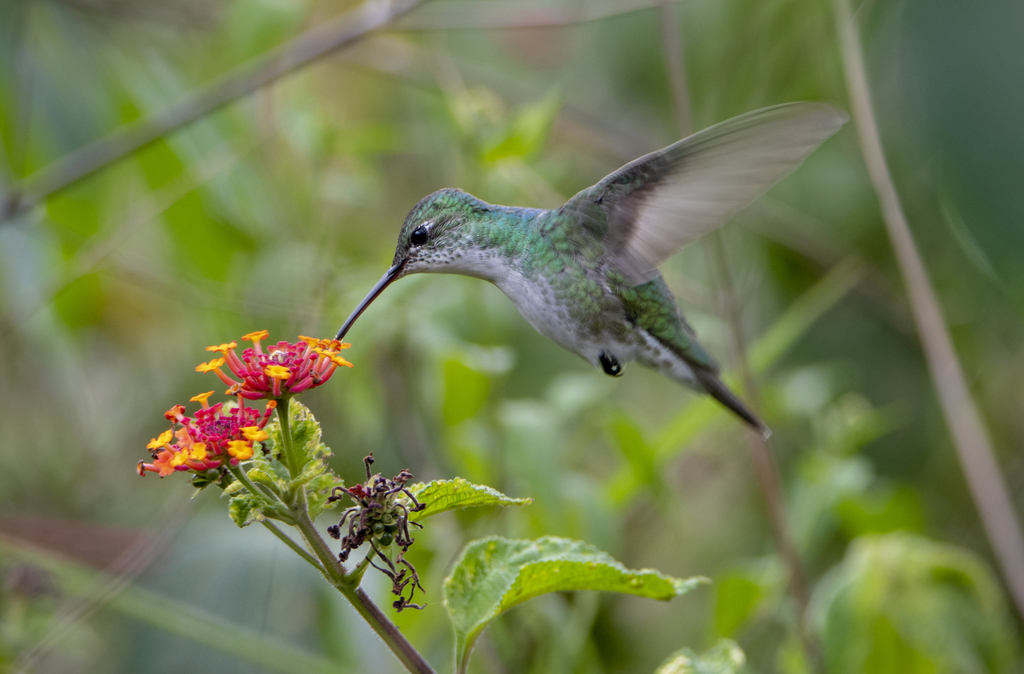
The green-and-white hummingbird (Elliotomyia viridicauda) is a species of hummingbird in the "emeralds", tribe Trochilini of subfamily Trochilinae. It is endemic to Peru.
From the article Green-and-white hummingbird on Wikipedia (CC BY-SA), quoted section by section
Description
The green-and-white hummingbird is 10 to 11 cm (3.9 to 4.3 in) long. Males weigh about 6.0 g (0.21 oz) and females about 5.5 g (0.19 oz). Both sexes have a medium length straight bill with a blackish maxilla and a reddish mandible with a dark tip. Adult males have brilliant green to bronze-green upperparts and flanks. Their undersides are whitish from the chin to the undertail coverts with greenish spots on the sides of the chin and throat and sometimes some golden-green on the coverts. Their tail is grayish green to golden green. Adult females are very similar to males, but with a light cream chin and throat that are more heavily spotted. Juveniles are similar to adult females with the cream of the throat extending to the belly.
Range & habitat
The green-and-white hummingbird is found on the east slope of the Peruvian Andes discontinuously from Huánuco Department south to Cuzco, including at Machu Picchu. It inhabits the edges and clearings of mature subtropical forest and also secondary forest between the elevations of 1,000 and 2,500 m (3,300 and 8,200 ft).
Wikipedia: “Distribution and habitat”
What it does
The white-bellied hummingbird forages for nectar at a variety of flowering plants, shrubs, and trees, though its diet is not known in detail. In addition to nectar it feeds on small arthropods.
Wikipedia: “Feeding”
Listen
Looking for field recordings…
Where it lives
Recorded sightings
—
geo-referenced records in GBIF, from museums, herbaria and field observers.
Drag the globe to turn it. Dots are where records exist, not a range map; darker means more records.
In the stacks
Searching the stacks…
Every page naming Elliotomyia viridicauda in the Biodiversity Heritage Library →
This page is assembled live from iNaturalist, GBIF, Wikipedia, the Source Library and the Internet Archive. It is not yet part of the hand-edited codex. iNaturalist taxon 1289636.