- Animals
- ›Chordates
- ›Vertebrates
- ›Birds
- ›Swifts and Hummingbirds
- ›Hummingbirds
- ›Bee Hummingbirds, Emeralds, Mountain-gems, and Allies
- ›Emerald Hummingbirds and Allies
- ›Chrysuronia
On eBird ↗
Humboldt's Sapphire
Live sightings near you, the range map, bar charts of when it is seen, and Macaulay Library photos and recordings.
Humboldt's Sapphire
Chrysuronia humboldtii
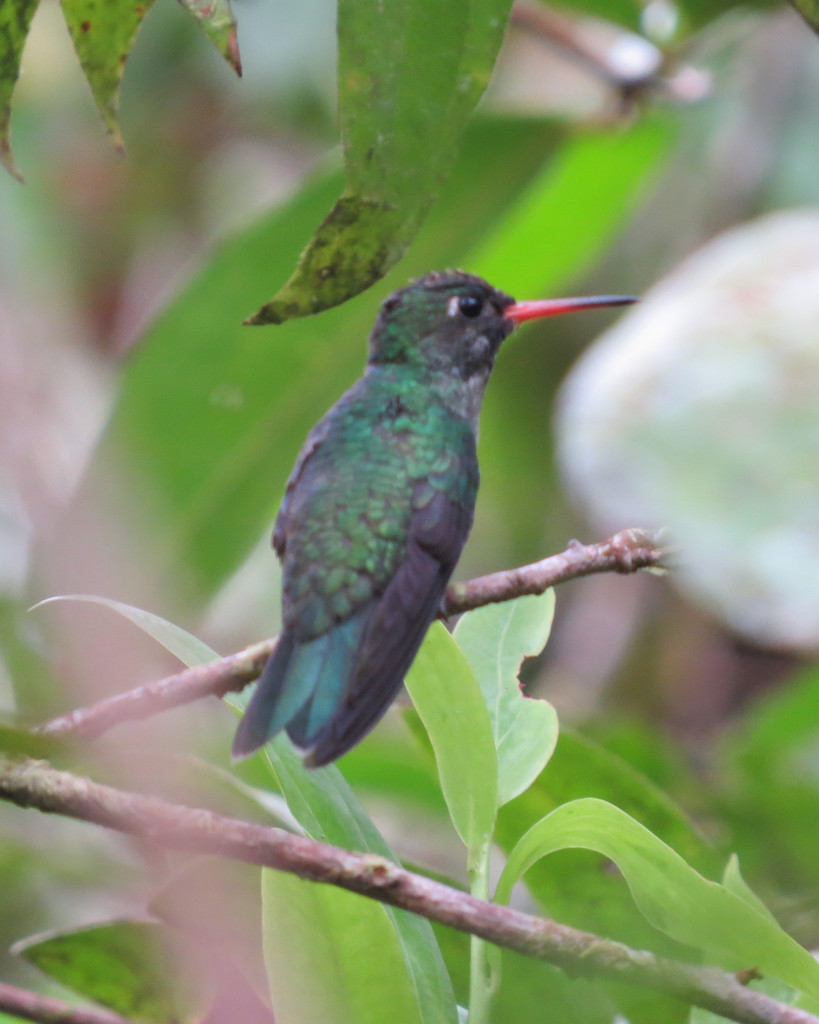
Humboldt's sapphire or Humboldt's hummingbird (Chrysuronia humboldtii) is a species of hummingbird in the "emeralds", tribe Trochilini of subfamily Trochilinae. It is found in Colombia, Ecuador, and Panama.
From the article Humboldt's sapphire on Wikipedia (CC BY-SA), quoted section by section
Description
Humboldt's sapphire is 9 to 12.5 cm (3.5 to 4.9 in) long. Males weigh 6.3 to 6.6 g (0.22 to 0.23 oz) and females 5.8 to 6.4 g (0.20 to 0.23 oz). Males have a straightish coral red bill with a black tip. Females' bills have a black maxilla with red at its base and a mostly pinkish mandible with a black tip. Adult males have a deep blue forehead and center of the throat. Their crown is dull dark blue-green and the rest of their upperparts metallic green to bronze-green. Their tail is dark metallic green to blue with dusky gray tips on the outer feathers. Their chest, sides of the neck, and cheeks are blue-green to green, their sides green, and the center of their belly and their undertail coverts white. Adult females have a blue crown and metallic green to bronze-green upperparts and tail; their outer tail feathers have dusky gray tips. Their underparts are mostly white with bright green flecks on the sides of the throat and breast. Juvenile males have much white below, with a bronze-flecked breast, and their crown and face are dull dark bluish green.
Range & habitat
Humboldt's sapphire is found in a narrow Pacific coastal band from extreme southeastern Panama through western Colombia into northwestern Ecuador's Esmeraldas Province. It inhabits mangroves and adjacent wet secondary forest, mostly below 50 m (160 ft) of elevation. It is most common in stands of Pacific (or tea) mangrove (Pelliciera rhizophorae).
Wikipedia: “Distribution and habitat”
What it does
The Humboldt's sapphire's preferred nectar source is the flowers of tea mangrove, though it has been observed feeding at flowering trees, shrubs, and herbs near the mangrove belt. In addition to nectar, it feeds on insects taken by hawking from a perch or by gleaning from vegetation.
Wikipedia: “Feeding”
Listen
Looking for field recordings…
Where it lives
Recorded sightings
—
geo-referenced records in GBIF, from museums, herbaria and field observers.
Drag the globe to turn it. Dots are where records exist, not a range map; darker means more records.
In the stacks
Searching the stacks…
Every page naming Chrysuronia humboldtii in the Biodiversity Heritage Library →
This page is assembled live from iNaturalist, GBIF, Wikipedia, the Source Library and the Internet Archive. It is not yet part of the hand-edited codex. iNaturalist taxon 1289643.