- Animals
- ›Chordates
- ›Vertebrates
- ›Birds
- ›Swifts and Hummingbirds
- ›Hummingbirds
- ›Bee Hummingbirds, Emeralds, Mountain-gems, and Allies
- ›Emerald Hummingbirds and Allies
- ›Chrysuronia
On eBird ↗
Sapphire-throated Hummingbird
Live sightings near you, the range map, bar charts of when it is seen, and Macaulay Library photos and recordings.
Sapphire-throated Hummingbird
Chrysuronia coeruleogularis
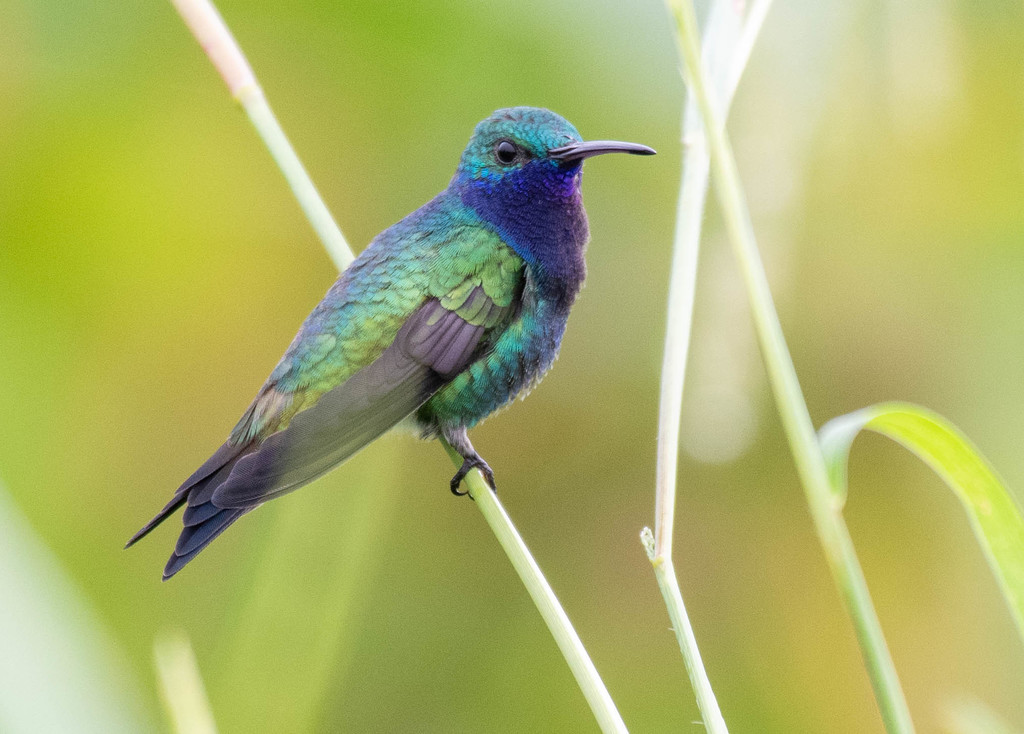
The sapphire-throated hummingbird (Chrysuronia coeruleogularis) is a shiny metallic-green hummingbird found in Panama, Colombia, and more recently Costa Rica. The sapphire-throated hummingbird is separated into three subspecies; Chrysuronia coeruleogularis coeruleogularis, Chrysuronia coeruleogularis coelina, and Chrysuronia coeruleogularis conifis.
Measuring 9 cm (3.5 in), this hummingbird sports a distinctively forked tail, which helps to distinguish it from other similarly sized and colored hummingbirds. The male is metallic green overall, with a violet-blue throat and dark tail. The female has entirely white underparts from throat to vent and distinctive green spots along the sides of the breast.
From the article Sapphire-throated hummingbird on Wikipedia (CC BY-SA), quoted section by section
Description
The sapphire-throated hummingbird has a full shiny metallic-green plumage, except for its darker tail and wings. The male has a broad, glistening blue-patched throat, whereas the female has a white-patched throat. The female also has distinct green spots along the sides of its breast. The tail is deeply notched and tipped with black coloration. The nominate subspecies Lepidopyga coeruleogularis coeruleogularis has a darker throat patch, whereas the subspecies Chrysuronia coeruleogularis conifis has a more turquoise tone, and the subspecies Chrysuronia coeruleogularis coelina has a lighter-blue tone. Small in size, the hummingbird measures about 8.5–9.5 cm (3.3–3.7 in) centimeters in length and 4–4.5 grams (0.14–0.16 oz) in weight. The males have a straight, short bill with the maxilla colored black and the mandible colored a more pinkish tone and tipped with black. The sapphire-throated hummingbird is often mistaken for the other members of its genus which includes the sapphire-bellied hummingbird (Chrysuronia lilliae) and the shining-green hummingbird (Chrysuronia goudoti). Unlike the sapphire-throated hummingbird, the male sapphire-bellied hummingbird has a darker shiny blue coloration on its throat which covers its entire ventral-side with the exception of the white undertail. …
Range & habitat
The sapphire-throated hummingbird has a large range, with an estimated distribution size of 88,900 km2. Although the global population size has not been calculated, it is described to be patchy. Overall, the hummingbird is found throughout Panama, Colombia and most recently Costa Rica. The nominate subspecies Chrysuronia coeruleogularis coeruleogularis can be found in Pacific western Panama, ranging from Chiriquí to Canal Zone. The subspecies Chrysuronia coeruleogularis confinis is more specifically found on the Caribbean slope in eastern Panama and north-west Columbia. Whereas the subspecies Chrysuronia coeruleogularis coelina is more specifically found in the northern parts of Colombia, from north Chocó through Ciénaga Grande de Santa Marta. In 2008, a male species of sapphire-throated hummingbird was discovered in Costa Rica as far as 35 kilometers north of the Panamanian border. This suggests that the hummingbirds are slowly dispersing northwards and establishing new territories. However, some unconfirmed records from 1962 in Costa Rica are thought to have been a mislabeled specimen, which was later found to be a sapphire-throated hummingbird.
Wikipedia: “Distribution”
What it does
Since it is a Central and South American species, the sapphire-throated hummingbird does not undergo huge migrations like other northern hummingbirds such as the ruby-throated hummingbird. However, they may undergo local altitude dispersal due to habitat change. They live a solitary life in which they neither live nor migrate in flocks. During flight, hummingbirds have one of the highest metabolism and therefore require to eat more than their own weight in nectar each day to avoid starvation. Unlike most birds, the hummingbirds flap their wings upwards instead of downwards by inverting their wings, and therefore having a similar mechanism to insects.
Courtship. The sapphire-throated hummingbird is polygamous, and therefore remains solitary until the need to reproduce. Typically, only the males exhibit promiscuity, however sometimes females may also mate with several males. In order to gain the female's approval, the male performs a courtship display by flying in a u-shaped pattern for the female. Once the female accepts the male, and copulation is complete, the male immediately separates and leaves the female. The males are only involved in mating and neglect to contribute to choosing nest location, building the nest, or raising the young.
Nesting and incubation. After copulation, the female hummingbird chooses a location for a nest, typically in a shrub, bush or tree. …
Wikipedia: “Behaviour”
Listen
Looking for field recordings…
Where it lives
Recorded sightings
—
geo-referenced records in GBIF, from museums, herbaria and field observers.
Drag the globe to turn it. Dots are where records exist, not a range map; darker means more records.
In the stacks
Searching the stacks…
Every page naming Chrysuronia coeruleogularis in the Biodiversity Heritage Library →
This page is assembled live from iNaturalist, GBIF, Wikipedia, the Source Library and the Internet Archive. It is not yet part of the hand-edited codex. iNaturalist taxon 1289645.