- Animals
- ›Chordates
- ›Vertebrates
- ›Birds
- ›Swifts and Hummingbirds
- ›Hummingbirds
- ›Bee Hummingbirds, Emeralds, Mountain-gems, and Allies
- ›Emerald Hummingbirds and Allies
- ›Saucerottia
On eBird ↗
Chestnut-bellied Hummingbird
Live sightings near you, the range map, bar charts of when it is seen, and Macaulay Library photos and recordings.
Chestnut-bellied Hummingbird
Saucerottia castaneiventris
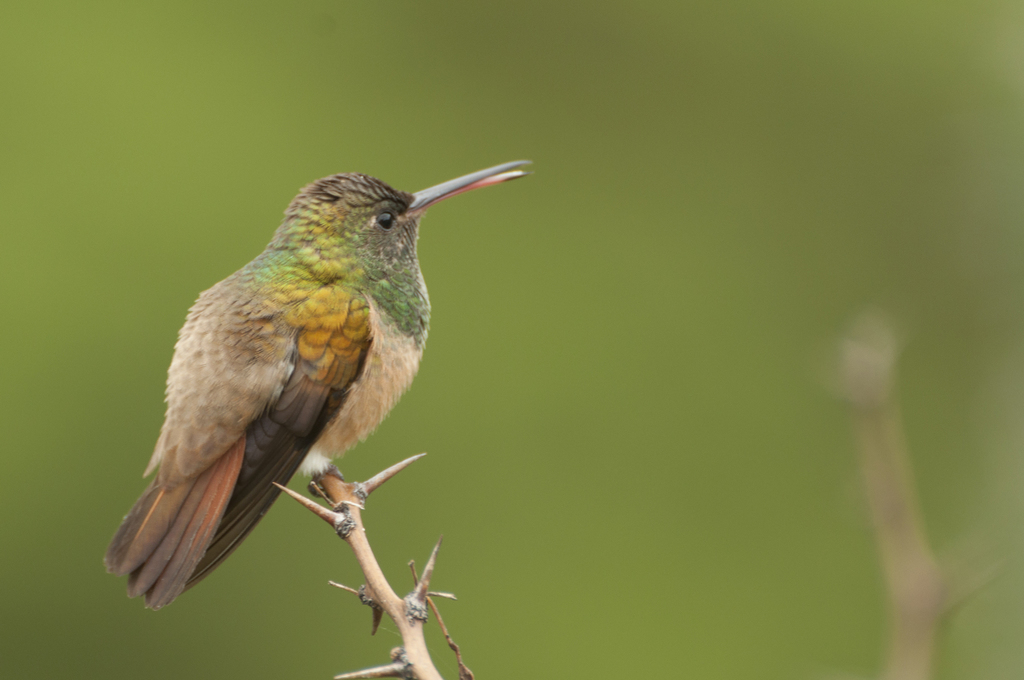
The chestnut-bellied hummingbird (Saucerottia castaneiventris) is a Near Threatened species of hummingbird in the "emeralds", tribe Trochilini of subfamily Trochilinae. It is endemic to Colombia.
From the article Chestnut-bellied hummingbird on Wikipedia (CC BY-SA), quoted section by section
Description
The chestnut-bellied hummingbird is about 9 cm (3.5 in) long. Both sexes have a black bill with a red base to the mandible. The adult male has bronze-green upperparts and a chestnut tail. Its throat and upper breast are glittering green, the belly chestnut, and the undertail coverts chestnut with greenish edges. The female is similar but with a slightly paler belly and white bars near the end of some throat feathers. Immatures are similar to the female with rufous edges on the feathers of the neck and rump.
Range & habitat
The chestnut-bellied hummingbird appears to be restricted to the dryer parts of the Magdalena Valley of Colombia, with a core known range in the Chicamocha, Suárez and Chucurí River valleys. As of 2019 it was known from at least 14 sites. However, it is not regularly documented at most of them, perhaps because of unknown seasonal movements. Most records are from arid brushy canyons with a few from the lower edges of humid montane forest. Most records are from elevations between 500 and 1,500 m (1,600 and 4,900 ft) but some extend to between 340 and 2,200 m (1,100 and 7,200 ft) and one is at 120 m (390 ft).
Wikipedia: “Distribution and habitat”
What it does
Details are lacking about the chestnut-bellied hummingbird's feeding technique and diet, but it is known to take nectar from Salvia and Trichanthera. It also feeds on small arthropods.
Wikipedia: “Feeding”
Listen
Looking for field recordings…
Where it lives
Recorded sightings
—
geo-referenced records in GBIF, from museums, herbaria and field observers.
Drag the globe to turn it. Dots are where records exist, not a range map; darker means more records.
In the stacks
Searching the stacks…
Every page naming Saucerottia castaneiventris in the Biodiversity Heritage Library →
This page is assembled live from iNaturalist, GBIF, Wikipedia, the Source Library and the Internet Archive. It is not yet part of the hand-edited codex. iNaturalist taxon 1289652.