- Animals
- ›Chordates
- ›Vertebrates
- ›Birds
- ›Swifts and Hummingbirds
- ›Hummingbirds
- ›Bee Hummingbirds, Emeralds, Mountain-gems, and Allies
- ›Emerald Hummingbirds and Allies
- ›Saucerottia
On eBird ↗
Blue-vented Hummingbird
Live sightings near you, the range map, bar charts of when it is seen, and Macaulay Library photos and recordings.
Blue-vented Hummingbird
Saucerottia hoffmanni
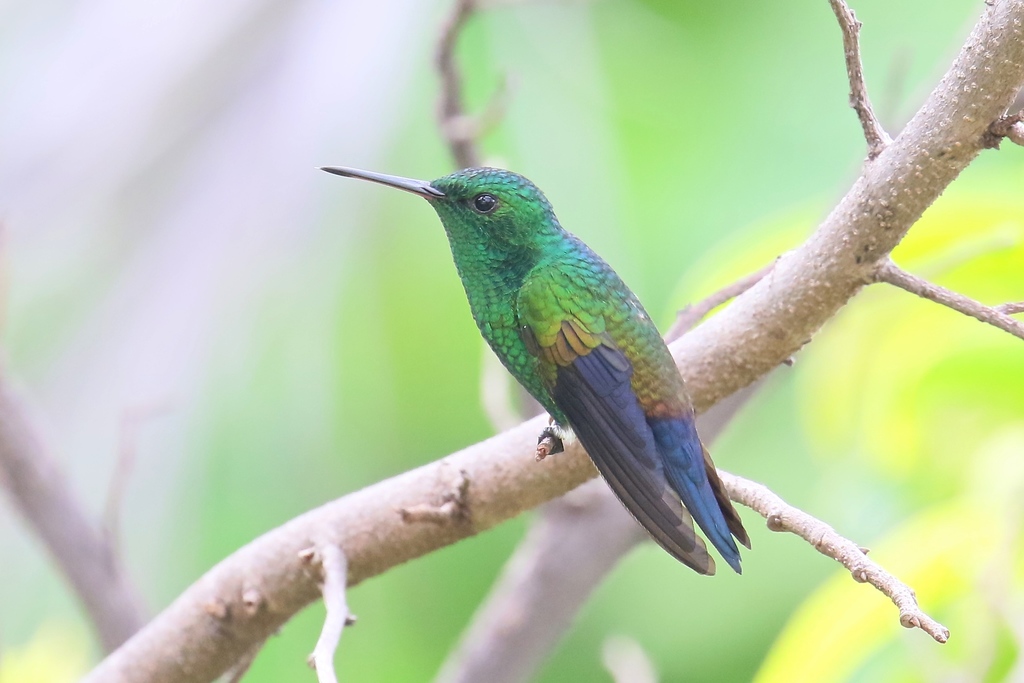
The blue-vented hummingbird (Saucerottia hoffmanni) is a species of hummingbird in the "emeralds", tribe Trochilini of subfamily Trochilinae. It is found in Costa Rica and Nicaragua.
From the article Blue-vented hummingbird on Wikipedia (CC BY-SA), quoted section by section
Description
The blue-vented hummingbird is 8 to 11 cm (3.1 to 4.3 in) long and weighs an average of 4.45 g (0.16 oz). Both sexes have a straight bill with a blackish maxilla and a coral-red mandible with a dark tip. Adult males have golden-green upperparts with coppery to purplish rump and uppertail coverts. Their underparts are dark glittering golden-green with greenish to steel blue undertail coverts. Their tail is pale steel blue and slightly forked. Adult females are similar but with a duller green lower breast and belly. Their throat feathers have white bars near the end, the feathers of their vent area have grayish-buff edges, and their outer tail feathers have purplish tips. Juveniles are darker than adults and duller green below with a grayish-brown belly. Their throat is darkish gray and their back and rump feathers have brownish edges.
Range & habitat
The blue-vented hummingbird is found from southern Nicaragua to central Costa Rica. It inhabits semi-open landscapes such as scrublands, savanna, the edges of mature forest, secondary forest, and gardens. It tends to prefer dryish habitats except in the dry season, when it is found in moister areas. In elevation it ranges from sea level to at most 1,800 m (5,900 ft).
Wikipedia: “Distribution and habitat”
What it does
The blue-vented hummingbird forages for nectar at a wide variety of plants, vines, shrubs, and trees. It tends to forage only as high as the tops of small trees and often defends feeding territories. In addition to nectar if feeds on insects that it captures on the wing and sometimes from the surface of water.
Wikipedia: “Feeding”
Listen
Looking for field recordings…
Where it lives
Recorded sightings
—
geo-referenced records in GBIF, from museums, herbaria and field observers.
Drag the globe to turn it. Dots are where records exist, not a range map; darker means more records.
In the stacks
Searching the stacks…
Every page naming Saucerottia hoffmanni in the Biodiversity Heritage Library →
This page is assembled live from iNaturalist, GBIF, Wikipedia, the Source Library and the Internet Archive. It is not yet part of the hand-edited codex. iNaturalist taxon 1289658.