- Animals
- ›Chordates
- ›Vertebrates
- ›Birds
- ›Swifts and Hummingbirds
- ›Hummingbirds
- ›Bee Hummingbirds, Emeralds, Mountain-gems, and Allies
- ›Emerald Hummingbirds and Allies
- ›Goldmania
On eBird ↗
Pirre Hummingbird
Live sightings near you, the range map, bar charts of when it is seen, and Macaulay Library photos and recordings.
Pirre Hummingbird
Goldmania bella
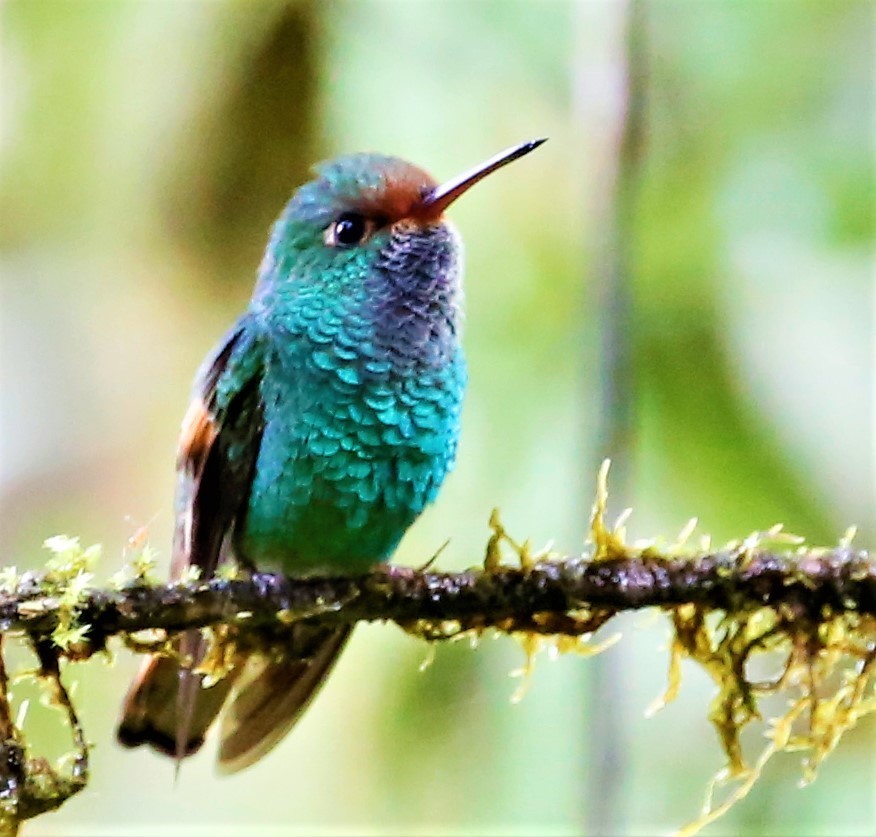
The Pirre hummingbird (Goldmania bella), also somewhat misleadingly known as the rufous-cheeked hummingbird, is a Near Threatened species of hummingbird in the "emeralds", tribe Trochilini of subfamily Trochilinae. It is found in Panama and far northwestern Colombia.
From the article Pirre hummingbird on Wikipedia (CC BY-SA), quoted section by section
Description
The Pirre hummingbird is 8.4 to 9.5 cm (3.3 to 3.7 in) long. Males weigh about 3.0 to 3.5 g (0.11 to 0.12 oz) and females 3.0 to 4.0 g (0.11 to 0.14 oz). Both sexes have a slightly decurved bill with a black maxilla and a black-tipped pink mandible. The male has a chestnut forehead and lores. Its crown, back, rump, and uppertail coverts are metallic green; the lower back and rump have a bronzy cast. Its central pair of tail feathers have bronze green bases and black tips and the rest are cinnamon buff with black tips. Its chin is cinnamon buff, the throat, breast, and belly shiny bluish green, and the undertail coverts white. Females have entirely green upperparts without the male's chestnut forehead. Their lores are chestnut and their underparts pale cinnamon buff.
Range & habitat
The Pirre hummingbird is found on a few isolated ridges in Panama's eastern Darién Province and in adjacent Chocó Department in Colombia. It inhabits the understory of the edges and interior of humid montane forest at elevations between 600 and 1,650 m (2,000 and 5,400 ft).
Wikipedia: “Distribution and habitat”
What it does
The Pirre hummingbird forages for nectar from near the ground to the middle levels of the forest. Its diet has not been described in detail but it has been observed feeding at Cephalus shrubs. In addition to nectar it is assumed to also feed on small arthropods like other hummingbirds.
Wikipedia: “Feeding”
Listen
Looking for field recordings…
Where it lives
Recorded sightings
—
geo-referenced records in GBIF, from museums, herbaria and field observers.
Drag the globe to turn it. Dots are where records exist, not a range map; darker means more records.
In the stacks
Searching the stacks…
Every page naming Goldmania bella in the Biodiversity Heritage Library →
This page is assembled live from iNaturalist, GBIF, Wikipedia, the Source Library and the Internet Archive. It is not yet part of the hand-edited codex. iNaturalist taxon 1289667.