- Animals
- ›Chordates
- ›Vertebrates
- ›Birds
- ›Swifts and Hummingbirds
- ›Hummingbirds
- ›Bee Hummingbirds, Emeralds, Mountain-gems, and Allies
- ›Emerald Hummingbirds and Allies
- ›Basilinna
On eBird ↗
Xantus's Hummingbird
Live sightings near you, the range map, bar charts of when it is seen, and Macaulay Library photos and recordings.
Xantus's Hummingbird
Basilinna xantusii
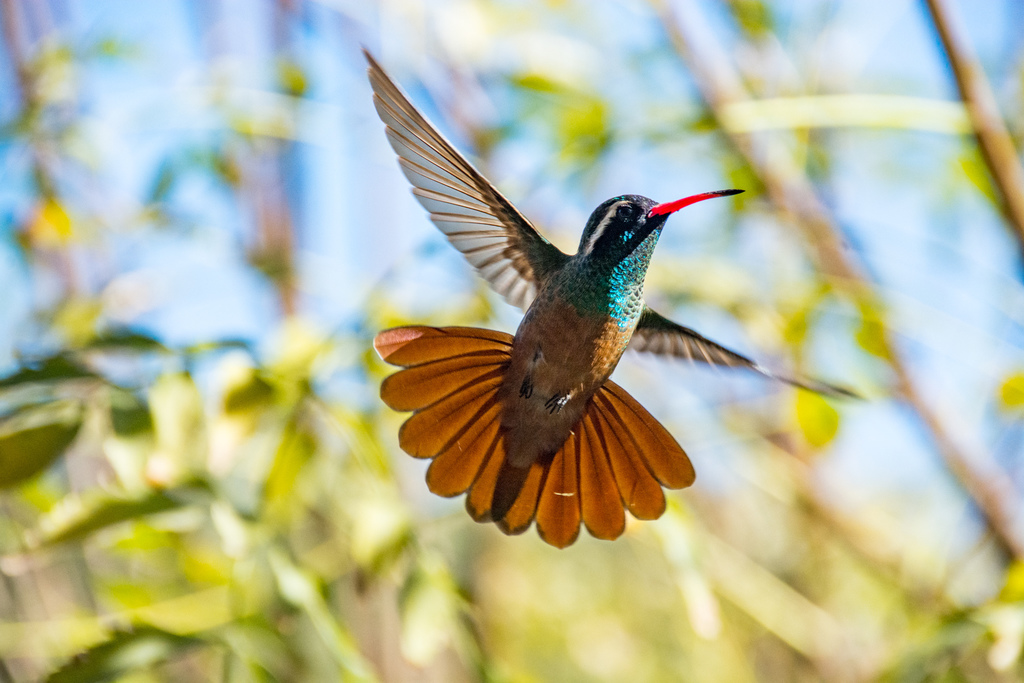
Xantus's hummingbird (Basilinna xantusii), previously known as the black-fronted hummingbird, is a species in the "emeralds", tribe Trochilini of subfamily Trochilinae. It is endemic to the Baja California Peninsula.
From the article Xantus's hummingbird on Wikipedia (CC BY-SA), quoted section by section
Description
Xantus's hummingbird is 8.5 to 9.5 cm (3.3 to 3.7 in) long. Males weigh an average of 3.5 g (0.12 oz) and females 3.4 g (0.12 oz). Their bills are straight and about 1.7 cm (0.67 in) long; males' are red with a black tip. Females' maxilla is black with a pinkish base and their mandible pinkish red with a black tip. Males have a golden green to emerald green crown, nape, and upperparts with rufous edging on the uppertail coverts. Their forehead and chin are black, their face mostly black with a wide white stripe behind the eye, and their throat iridescent emerald green. Their underparts are cinnamon with some green mottling on the flanks and pale cinnamon undertail coverts. Their tail is rufous chestnut; the innermost pair of feathers have wide iridescent green edges and the other four pairs thin green edges. The females' face is blackish brown with a pale buffy stripe behind the eye. Their forehead is dull brownish and their upperparts iridescent golden green with some rufous edging on the uppertail coverts. The underparts including the throat and undertail coverts are pale to medium cinnamon. Their tail's central pair of feathers are golden green with a rufous shaft and the other four pairs dark rufous that pales towards the end, a black and bronzy green band near the end, and thin white tips.
Range & habitat
Xantus's hummingbird is found from central Baja California south to the peninsula's tip. It has also been recorded as a vagrant twice in California and once in British Columbia. The species inhabits arid woodlands of scrub, oak, and pine-oak at elevations between 150 and 1,500 m (490 and 4,900 ft) and also visits coastal desert, gardens, and feeders.
Wikipedia: “Distribution and habitat”
What it does
Xantus's hummingbird forages for nectar at a very wide variety of flowering plants, shrubs and trees, and feeds at all levels of the vegetation. It defends feeding territories. It has been noted as a major pollinator of madrone (Arbutus peninsularis), a preferred nectar source. In addition to nectar, it also feeds on small insects captured in flight and by gleaning from vegetation.
Wikipedia: “Feeding”
Listen
Looking for field recordings…
Where it lives
Recorded sightings
—
geo-referenced records in GBIF, from museums, herbaria and field observers.
Drag the globe to turn it. Dots are where records exist, not a range map; darker means more records.
In the stacks
Searching the stacks…
Every page naming Basilinna xantusii in the Biodiversity Heritage Library →
This page is assembled live from iNaturalist, GBIF, Wikipedia, the Source Library and the Internet Archive. It is not yet part of the hand-edited codex. iNaturalist taxon 1289673.