On eBird ↗
Orange-billed Nightingale-Thrush
Live sightings near you, the range map, bar charts of when it is seen, and Macaulay Library photos and recordings.
Orange-billed Nightingale-Thrush
Catharus aurantiirostris
The orange-billed nightingale-thrush (Catharus aurantiirostris) is a species of bird in the family Turdidae. It is found in Colombia, Costa Rica, El Salvador, Guatemala, Honduras, Mexico, Nicaragua, Panama, Trinidad and Tobago, and Venezuela. Its natural habitats are subtropical or tropical dry forests, subtropical or tropical moist lowland forests, subtropical or tropical moist montane forests, and heavily degraded former forest.
From the article Orange-billed nightingale-thrush on Wikipedia (CC BY-SA), quoted section by section
Description
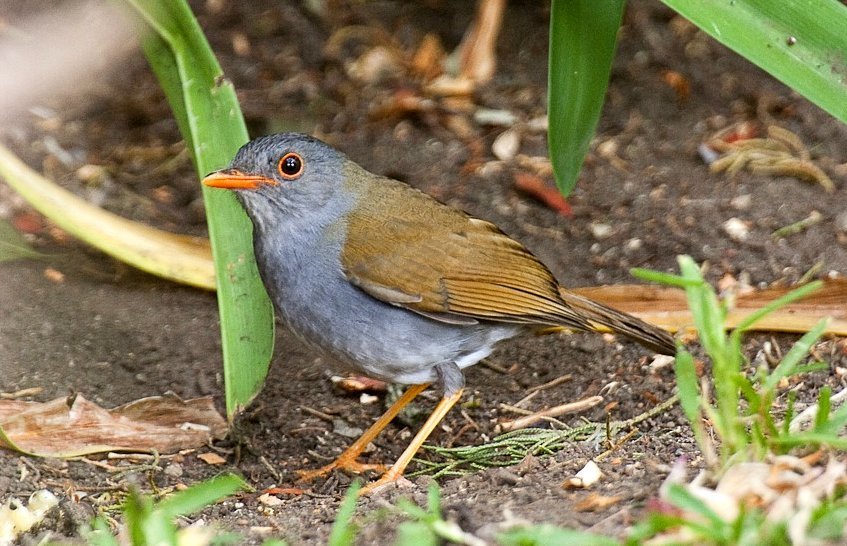
The orange-billed nightingale-thrush is 15.5 to 17 cm (6.1 to 6.7 in) long and weighs 21 to 32 g (0.74 to 1.1 oz). The sexes have the same plumage. Adults of the nominate subspecies C. a. aurantiirostris are olive-brown with a rufous tinge on their crown, nape, back, rump, wings, and tail. The rufous is strongest on the last three areas. Their face is grayish brown with a thin orange eye-ring. Their throat is whitish that darkens to pale gray on the rest of the underparts. They have a long, strong, orange bill and brownish orange legs and feet. Juveniles are mostly brown with much buff flecking and mottling. The other subspecies differ from the nominate and each other thus:
C. a. clarus: warm olive-brown upperparts C. a. melpomene: more rufous on wings and tail C. a. costaricensis: richer rufous on wings and tail than melpomene C. a. griseiceps: gray head; grayer underparts C. a. phaeopleurus: like griseiceps with stronger olive-brown upperparts and orange-red bill C. a. birchalli: more rufous with darker gray flanks C. a. barbaritoi: no rufous on upperparts; darker grayish underparts C. a. sierrae: like the nominate C. a. inornatus: stronger olive-brown upperparts with whiter throat and underparts than griseiceps but with no rufous; orange-red bill C. a. insignis: duller than nominate with vague streaks on the throat
Range & habitat
The orange-billed nightingale-thrush has a disjunct distribution The subspecies are found thus:
C. a. clarus: Mexico from southwestern Chihuahua south to western Puebla and southwestern Tamaulipas C. a. melpomene: from Puebla and Veracruz in southern Mexico south through Guatemala and El Salvador and across Honduras C. a. costaricensis: northwestern and central Costa Rica C. a. griseiceps: from southwestern Costa Rica into western Panama as far as Chiriquí and Veraguas provinces C. a. phaeopleurus: central Colombia C. a. aurantiirostris: Venezuelan Coastal Range and inland in Guárico C. a. birchalli: Trinidad and northeastern Venezuelan states of Anzoátegui, Sucre, and northern Monagas C. a. barbaritoi Serranía del Perijá on the Colombia-Venezuela border C. a. sierrae northern Colombia's isolated Sierra Nevada de Santa Marta C. a. inornatus: western slope of Colombia's Eastern Andes in Santander Department C. a. insignis: eastern slopes of Colombia's Western and Central Andes The South American Classification Committee has documented records of the species in Brazil. There are two records in the United States. One bird was photographed in southern Texas in 1996. …
Wikipedia: “Distribution and habitat”
What it does
The orange-billed nightingale-thrush feeds on invertebrates such as insects, spiders, and worms and also on seeds and berries. It forages in the forest understory and on the ground, where it flips over leaf litter. It has been observed following army ant swarms on Trinidad.
Wikipedia: “Feeding”
Listen
Looking for field recordings…
Where it lives
Recorded sightings
—
geo-referenced records in GBIF, from museums, herbaria and field observers.
Drag the globe to turn it. Dots are where records exist, not a range map; darker means more records.
In the stacks
Searching the stacks…
Every page naming Catharus aurantiirostris in the Biodiversity Heritage Library →
This page is assembled live from iNaturalist, GBIF, Wikipedia, the Source Library and the Internet Archive. It is not yet part of the hand-edited codex. iNaturalist taxon 12900.