- Animals
- ›Chordates
- ›Vertebrates
- ›Birds
- ›Perching Birds
- ›Old World Flycatchers, Robins, and Chats
- ›Saxicola
On eBird ↗
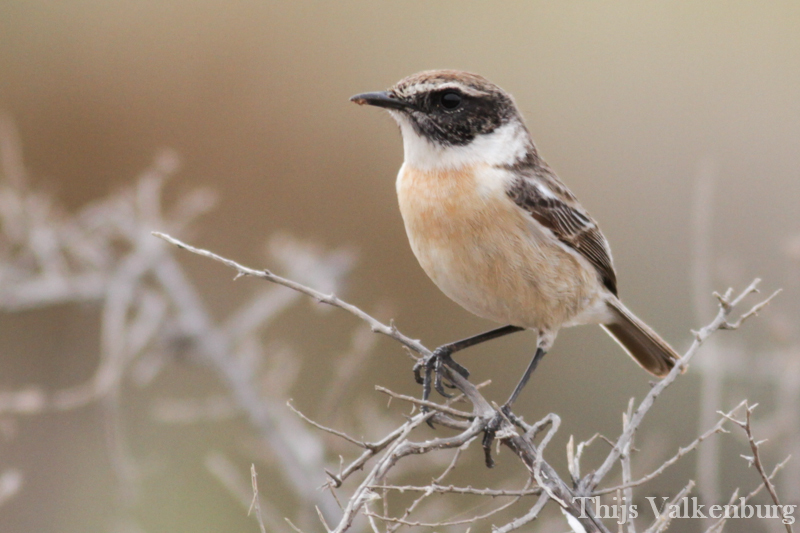
Fuerteventura Stonechat
Live sightings near you, the range map, bar charts of when it is seen, and Macaulay Library photos and recordings.
Fuerteventura Stonechat
Saxicola dacotiae
The Canary Islands stonechat (Saxicola dacotiae), also known as the Fuerteventura stonechat or Fuerteventura chat, and formerly known as the Canary Islands chat due to its once widespread distribution on the Canary Islands, is a sedentary resident bird found only on the island of Fuerteventura where it is known as the Caldereta.
From the article Canary Islands stonechat on Wikipedia (CC BY-SA), quoted section by section
Description
The Canary Islands stonechat is intermediate in appearance between the European stonechat and the whinchat; its body size and shape reminiscent of a lithe European robin. Its upperparts are generally coloured as the whinchat, but more contrasting, dark brown with a blackish head and back streaks. It has a purer white supercilium reaching behind the eye and white neck sides, and a light orangey-chestnut breast becoming duller and paler on the underside towards the whitish belly. The rump and tail are dark, the latter with a white pattern visible in flight. There is also a white wing band. The female is similar to a washed-out version of the male, with a brown, black-streaked head and no white neck patches. The male has a ticking call like a pebble hitting another, and a high twittering song like a European stonechat.
What it does
This Canary Islands stonechat is highly faithful to good habitat. Its main occurrence and only breeding habitat is in barrancos, ravines and rocky slopes with fairly sparse (30-50% open ground), shrubby vegetation (Illera et al., 2006). Although they sometimes also venture into more open and arid areas such as malpaís (old lava flows with resurgent vegetation), the species prefers copses of palm trees and shrubs (Álamo Tavío 1975) such as the aulaga Launaea arborescens, the saltwort Caroxylon vermiculatum and the boxthorn Lycium intricatum (BirdLife International 2004). Males sing from exposed perches, from where the birds also like to hunt insects on the wing; occasionally, they venture into fields or gardens for feeding. Completely open habitat appears only to be utilised when gathering food for their young (BirdLife International 2004). Laying 4-5 eggs per clutch and incubating for 13 days, it usually manages to raise two clutches of young a year.
Wikipedia: “Ecology”
Listen
Looking for field recordings…
Where it lives
Recorded sightings
—
geo-referenced records in GBIF, from museums, herbaria and field observers.
Drag the globe to turn it. Dots are where records exist, not a range map; darker means more records.
In the stacks
Searching the stacks…
Every page naming Saxicola dacotiae in the Biodiversity Heritage Library →
This page is assembled live from iNaturalist, GBIF, Wikipedia, the Source Library and the Internet Archive. It is not yet part of the hand-edited codex. iNaturalist taxon 12913.