On eBird ↗
Andean Solitaire
Live sightings near you, the range map, bar charts of when it is seen, and Macaulay Library photos and recordings.
Andean Solitaire
Myadestes ralloides
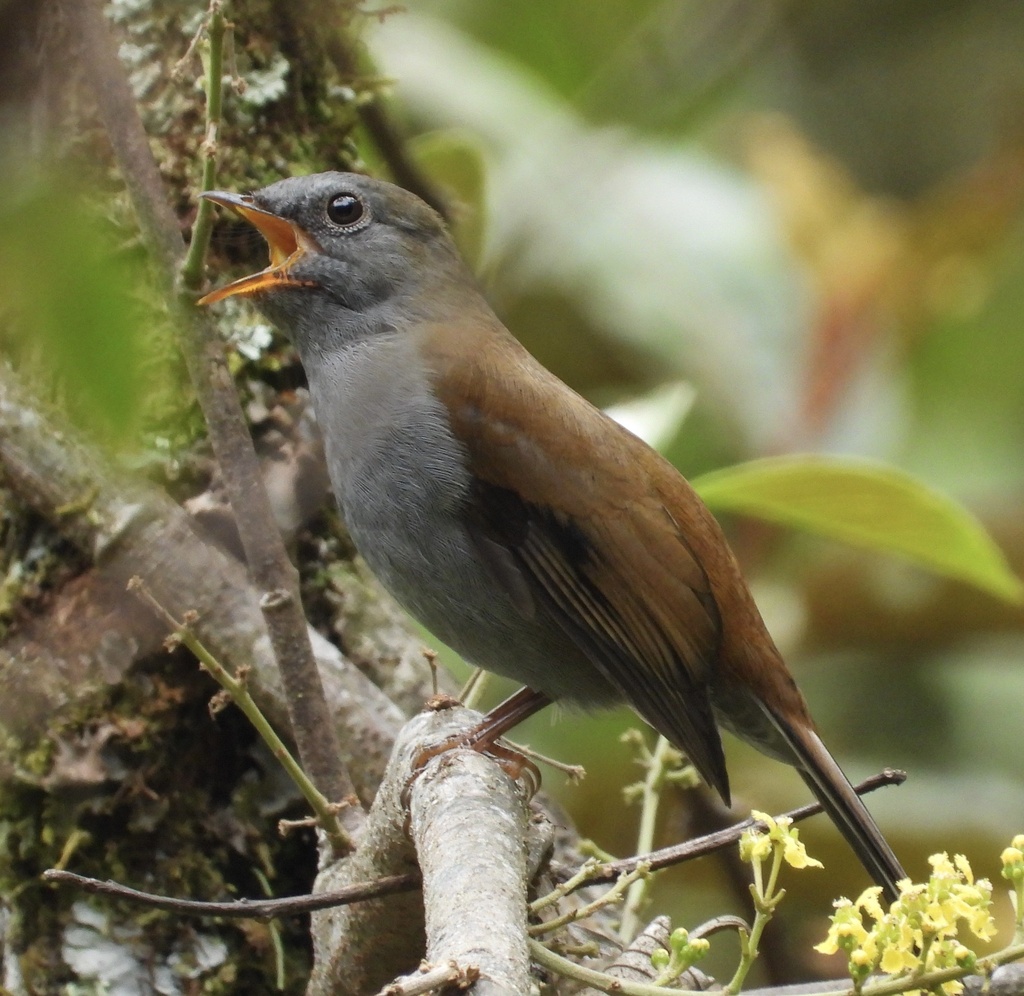
The Andean solitaire (Myadestes ralloides) is a species of bird in the family Turdidae. It is found in Bolivia, Colombia, Ecuador, Peru, and Venezuela. Its natural habitats are subtropical or tropical moist montane forests and heavily degraded former forest.
From the article Andean solitaire on Wikipedia (CC BY-SA), quoted section by section
Description
The Andean solitaire is 17 to 18 cm (6.7 to 7.1 in) long and weighs 25.5 to 37 g (0.90 to 1.3 oz). The sexes have the same plumage. Adults of the nominate subspecies M. r. ralloides have a dull grayish olive crown and black lores on an otherwise dull medium gray face. Their back, rump, and uppertail coverts are reddish brown. Their wings are reddish brown with dark tips on the primary coverts and dark bases on the secondaries. Their tail is reddish brown with white inner webs on the outer feathers. Their underparts are dull medium gray. They have a dusky bill and pale brown legs. Juveniles are similar to adults but with pale buff spots on the upperparts and dark stippling on the underparts. Subspecies M. r. plumbeiceps has richer brown upperparts than the nominate with a gray crown and a dark yellow base to the mandible. M. r. candelae has a dark tawny crown and upperparts and a darker gray breast than the nominate. M. r. venezuelensis is a brighter tawnier brown above than the nominate, with a gray forehead, a brown crown, more olive flanks, and yellowish legs.
Range & habitat
The Andean solitaire has a disjunct distribution throughout the Andes. The subspecies are found thus:
M. r. plumbeiceps: Colombia's Western and Central Andes and south through most of western Ecuador M. r. candelae: the Magdalena River valley in north-central Colombia M. r. venezuelensis: the Serranía del Perijá on the Colombia-Venezuela border; the Venezuelan Coastal Range from Carabobo to northern Miranda; Andes from Táchira south through eastern Colombia and eastern Ecuador into Peru as far as the Marañón River M. r. ralloides: eastern slope from the Marañón in Peru south to Chuquisaca Department in central Bolivia The Andean solitaire inhabits humid forest in the foothills and mountains and also mature secondary forest. It appears to favor ravines and mountain streams. In elevation it ranges mostly between 900 and 2,800 m (3,000 and 9,200 ft) but accidentally as high as 4,500 m (14,800 ft) in Venezuela, between 350 and 2,800 m (1,100 and 9,200 ft) in Colombia, mostly between 1,000 and 2,500 m (3,300 and 8,200 ft) in eastern Ecuador and lower in the west, and mostly between 1,200 and 2,900 m (3,900 and 9,500 ft) and locally down to 600 m (2,000 ft) in Peru.
Wikipedia: “Distribution and habitat”
What it does
The Andean solitaire feeds on insects and fruit. It forages mostly in the forest's lower to mid-levels. It plucks fruit while perched or with aerial sallies from a perch; insects are plucked from vegetation with a sally and taken in mid-air. Though it does not follow mixed-species feeding flocks it does share fruiting trees with other species. It attends army ant swarms but stays in the undergrowth rather than on the ground when doing so.
Wikipedia: “Feeding”
Listen
Looking for field recordings…
Where it lives
Recorded sightings
—
geo-referenced records in GBIF, from museums, herbaria and field observers.
Drag the globe to turn it. Dots are where records exist, not a range map; darker means more records.
In the stacks
Searching the stacks…
Every page naming Myadestes ralloides in the Biodiversity Heritage Library →
This page is assembled live from iNaturalist, GBIF, Wikipedia, the Source Library and the Internet Archive. It is not yet part of the hand-edited codex. iNaturalist taxon 12962.