- Animals
- ›Echinoderms
- ›sea lilies
- ›Sea Lilies
- ›Sea Lilies
- ›Feather Stars
- ›Comatuloidea
- ›Bushy Feather Stars
- ›Comatellinae
- ›Davidaster
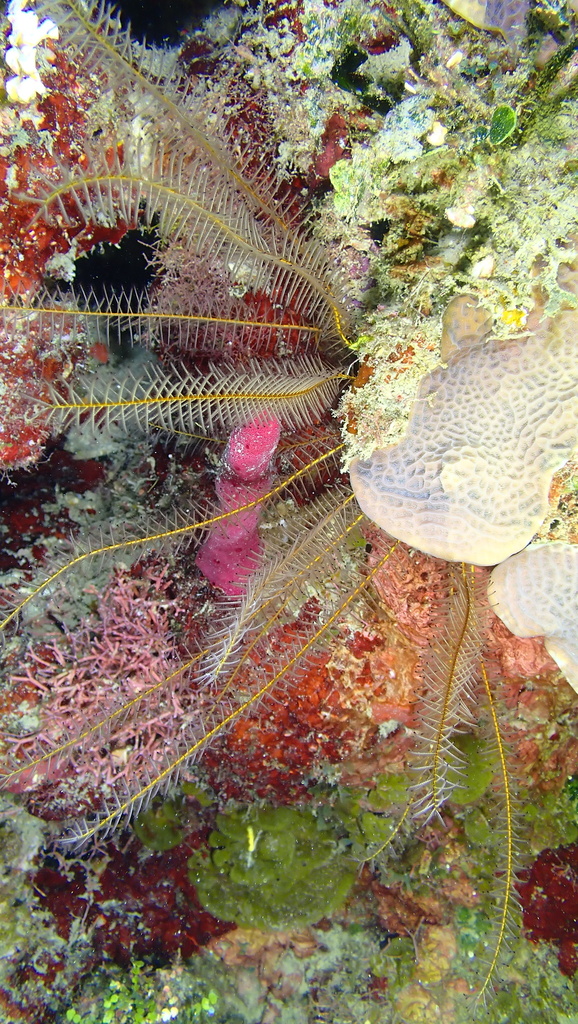
Beaded Crinoid
Davidaster discoideus
Davidaster discoideus or the beaded crinoid is a species of feather star in the family Comasteridae. It was previously known as Nemaster discoidea but the World Register of Marine Species has determined that the valid name is Davidaster discoideus. It is found on reefs in the Caribbean Sea and northern coast of South America.
From the article Davidaster discoideus on Wikipedia (CC BY-SA), quoted section by section
Description
The beaded crinoid has a cup shaped body, usually hidden from sight, from which about twenty arms project. Only a few of these are usually visible at one time and each can be curled up in a coil. Short pinnules extend from either side of the arms like vanes on a feather. Both the arms and the pinnules are formed from a large number of jointed plates which gives them great overall flexibility. There is an ambulacral groove along the oral surface of each pinnule which is continuous with grooves on the arms. These are linked to grooves leading to the mouth forming feeding channels. The grooves have flap-like lappets overhanging them. At each plate junction on the pinnules there are three tube feet of different length used in food capture and manipulation. The arms can be 20 centimetres (7.9 in) long and are the only part of the crinoid normally visible as its body is generally concealed in a crevice or inside a sponge. At the base of the crinoid are several cirri, unbranched appendages with which it grips the rock or other substrate. The arms are orange or red and the pinnules are grey or banded in black and white and have a beaded appearance.
Range & habitat
The beaded crinoid is found in the Caribbean Sea and the Gulf of Mexico. It is found at depths between 15 and 40 metres (49 and 131 ft) and is generally uncommon. These crinoids often live in the same concealed spot for several years and should not be moved by divers as they are very sensitive to changes in water temperature and illumination.
Wikipedia: “Distribution and habitat”
Where it lives
Recorded sightings
—
geo-referenced records in GBIF, from museums, herbaria and field observers.
Drag the globe to turn it. Dots are where records exist, not a range map; darker means more records.
In the stacks
Searching the stacks…
Every page naming Davidaster discoideus in the Biodiversity Heritage Library →
This page is assembled live from iNaturalist, GBIF, Wikipedia, the Source Library and the Internet Archive. It is not yet part of the hand-edited codex. iNaturalist taxon 129661.