- Animals
- ›Echinoderms
- ›Sea Stars and Brittle Stars
- ›Sea Stars
- ›Valvatacean Sea Stars
- ›Paxillosidan Sea Stars
- ›Comb Stars
- ›Astropecten
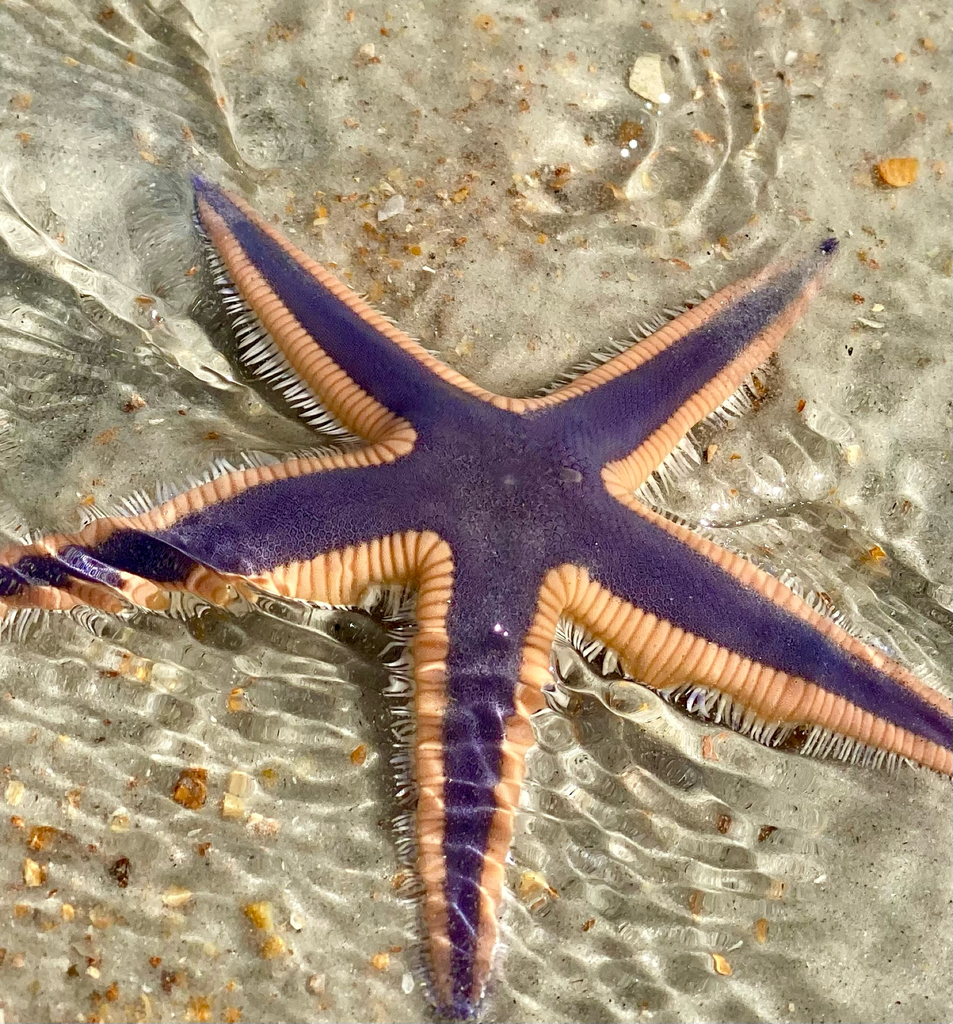
Flat Sea Star
Astropecten articulatus
The Astropecten articulatus, more commonly known as the royal starfish, is a West Atlantic sea star of the family Astropectinidae.
From the article Astropecten articulatus on Wikipedia (CC BY-SA), quoted section by section
Description
The Royal Starfish is characterized by its bold colors. It has a purple granulated disk, which is the central region of the sea star, and the purple color continues to extend to its five arms. The margin of the sea star, which is its outline, is an orange color. Entomologist Thomas Say describes the sea star's margin as “articulated throughout”, meaning that the orange margin that surrounds the sea star is continuous, even at the joints of its rays. It also has white spines that are attached to the orange margin and tube feet at the ends of its rays. The tube feet are cylindrical with conical ends, and the epithelium of the tube foot is covered by a thin layer of cuticle. Underneath the epithelium is the nervous tissue, and underneath that are fibrous tissues in the form of both left and right helices which protect the sea star's muscle tissue layer. The tube feet also contain bilobed ampulla. The ampulla muscle layers in the tube feet allow for the tube feet to elongate and shorten, which allows the sea star to move. Morphologically, the Royal Starfish is very similar to the Red Comb Starfish. In the past, it was thought that a difference between the two species was that the Red Comb Starfish has needle-like granules in its disk while the royal Starfish has spherical ones. …
What it does
The Royal Starfish feeds by swallowing its food whole and digesting it in its stomach, like other members of the genus Astropecten. However, unlike other species in the same genus, it consumes significantly more organisms. In a study investigating the stomach contents of 124 Royal Starfishes, scientists found that on average, each sea star has 12 organisms in its stomach, with the highest number of organisms recorded being 54. When comparing the number of organisms in the Royal Starfishes' stomachs to another study investigating the stomach contents of the Red Comb Starfish, it is revealed that the Royal Starfishes have much higher amounts. Also, one study investigating A. irregularis shows the same outcome, that there are more organisms in the stomachs of Royal Starfishes than A. irregularis, but in another study, the stomachs of both sea star species are relatively the same. Royal Starfishes also feed on a diverse number of organisms. From the previous study, in all of the 124 sea stars combined, there were a total of 91 species of organisms found in their stomachs. The three most abundant species were A. candy, N. pusila, and O. music, which were gastropods, and accounted for 60% of all species that Royal Starfishes feed on. The study also found that the sea star consumes the mollusk shell regardless of whether or not the original organism is still inside. …
Wikipedia: “Feeding and Foraging”
Where it lives
Recorded sightings
—
geo-referenced records in GBIF, from museums, herbaria and field observers.
Drag the globe to turn it. Dots are where records exist, not a range map; darker means more records.
In the stacks
Searching the stacks…
Every page naming Astropecten articulatus in the Biodiversity Heritage Library →
This page is assembled live from iNaturalist, GBIF, Wikipedia, the Source Library and the Internet Archive. It is not yet part of the hand-edited codex. iNaturalist taxon 129680.