- Animals
- ›Chordates
- ›Vertebrates
- ›Birds
- ›Perching Birds
- ›Old World Flycatchers, Robins, and Chats
- ›Phoenicurus
On eBird ↗
Moussier's Redstart
Live sightings near you, the range map, bar charts of when it is seen, and Macaulay Library photos and recordings.
Moussier's Redstart
Phoenicurus moussieri
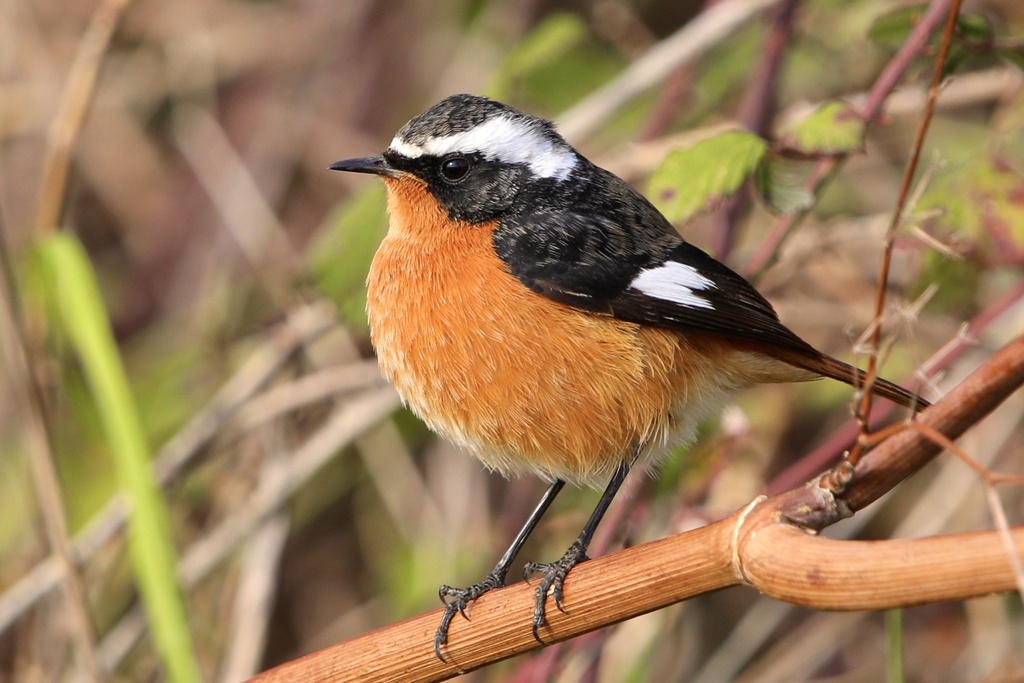
Moussier's redstart (Phoenicurus moussieri) is a small passerine bird in the genus Phoenicurus (redstarts), formerly classed as a member of the thrush family (Turdidae), but is now classified as an Old World flycatcher (Muscicapidae). It is an endemic resident breeder in the Atlas Mountains of northwest Africa. Its habitat is open woodland in rocky areas from sea level up to 3000 m altitude in the mountains.
It is the smallest redstart, only 12 cm long and 14–15 g weight. The male has a black head with a broad white stripe running above each eye and down the side of the neck. The upperparts are black other than a white wing patch, and the rich chestnut tail, from which it and other redstarts get their names (start is an old word for tail). The underparts are a rich orange-red. The female has a pale brown head and upperparts, and the underparts are a paler orange than the male, although generally redder than the underparts of the similar but larger female common redstart.
From the article Moussier's redstart on Wikipedia (CC BY-SA), quoted section by section
What it does
The male's song is a mixture of rasping sounds and svee-svee notes. The call is a plaintive single note, wheet. It is primarily insectivorous, often feeding like a flycatcher, making aerial sallies after passing insects, but also picking and even digging insects out of the ground; more rarely, it will eat small berries. Its nest is built in a bush or on the ground and the clutch is typically 3-6 eggs.
Although largely resident, some show limited migratory behaviour, particularly altitudinal migration by those breeding at high altitudes moving to lower levels in winter. Vagrants have reached north to Great Britain (Dinas Head, Pembrokeshire; April 1988), east to Greece, and south to Mauritania.
Wikipedia: “Behaviour”
Listen
Looking for field recordings…
Where it lives
Recorded sightings
—
geo-referenced records in GBIF, from museums, herbaria and field observers.
Drag the globe to turn it. Dots are where records exist, not a range map; darker means more records.
In the stacks
Searching the stacks…
Every page naming Phoenicurus moussieri in the Biodiversity Heritage Library →
This page is assembled live from iNaturalist, GBIF, Wikipedia, the Source Library and the Internet Archive. It is not yet part of the hand-edited codex. iNaturalist taxon 12999.