- Animals
- ›Chordates
- ›Vertebrates
- ›Birds
- ›Perching Birds
- ›Old World Flycatchers, Robins, and Chats
- ›Phoenicurus
On eBird ↗
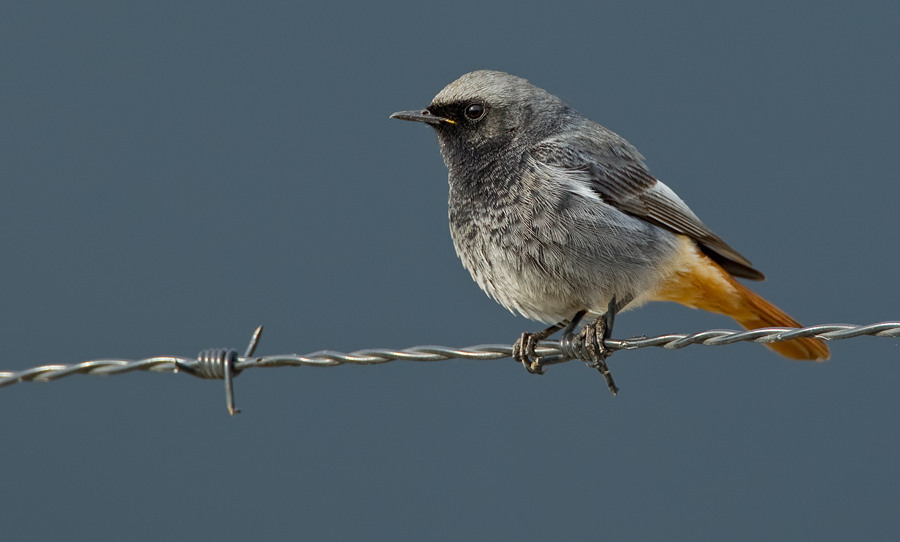
Black Redstart
Live sightings near you, the range map, bar charts of when it is seen, and Macaulay Library photos and recordings.
Black Redstart
Phoenicurus ochruros
The black redstart (Phoenicurus ochruros) is a small passerine bird in the Old World flycatcher family. It is a widespread breeder in rocky habitats across Eurasia and North Africa, from the British Isles south to Morocco and east to central China. It is resident in the milder parts of its range, but northern and eastern birds migrate.
From the article Black redstart on Wikipedia (CC BY-SA), quoted section by section
Description
The black redstart is 13–14.5 cm (5.1–5.7 in) in length and 12–20 g (0.42–0.71 oz) in weight, similar to the common redstart. The adult male is overall dark grey to black on the upperparts and with a black breast; the lower rump and tail are orange-red, with the two central tail feathers dark red-brown. The belly and undertail are either blackish-grey (western subspecies; see Taxonomy and systematics, above) or orange-red (eastern subspecies); the wings are blackish-grey with pale fringes on the secondaries forming a whitish panel (western subspecies) or all blackish (eastern subspecies). The female is grey (western subspecies) to grey-brown (eastern subspecies) overall except for the orange-red lower rump and tail, greyer than the common redstart; at any age the grey axillaries and underwing coverts are also distinctive (in the Common Redstart these are buff to orange-red). There are two distinct forms in first calendar year males at least in western subspecies, with the first ('carei') being similar to females and the second ('paradoxus') approaching adult males but lacking the whitish wing panel that does only develop during post-breeding moult of wing feathers in the second calendar year. This second form is much rarer than the first.
Range & habitat
It is a widespread breeder in south and central Europe and Asia and north-west Africa, from Great Britain and Ireland (where local) south to Morocco, east to central China. It is resident in the milder parts of its range, but north-eastern birds migrate to winter in southern and western Europe and Asia, and north Africa. It nests in crevices or holes in buildings. In Britain, it is most common as a passage and winter visitor, with only 20–50 pairs breeding. On passage it is fairly common on the east and south coasts, and in winter on the coasts of Wales and western and southern England, with a few also at inland sites. Migrant black redstarts arrive in Britain in October or November and either move on or remain to winter, returning eastward in March or April. They also winter on the south and east coasts of Ireland. The species originally inhabited stony ground in mountains, particularly cliffs, but since about 1900 has expanded to include similar urban habitats including bombed areas during and after World War II, and large industrial complexes that have the bare areas and cliff-like buildings it favours; in Great Britain, most of the small breeding population nests in such industrial areas. It will catch passing insects in flight, and migrants often hunt in coastal tide-wrack for flies or tiny crustaceans. …
Wikipedia: “Distribution and habitat”
Listen
Looking for field recordings…
Where it lives
Recorded sightings
—
geo-referenced records in GBIF, from museums, herbaria and field observers.
Drag the globe to turn it. Dots are where records exist, not a range map; darker means more records.
In the stacks
Searching the stacks…
Every page naming Phoenicurus ochruros in the Biodiversity Heritage Library →
This page is assembled live from iNaturalist, GBIF, Wikipedia, the Source Library and the Internet Archive. It is not yet part of the hand-edited codex. iNaturalist taxon 13000.