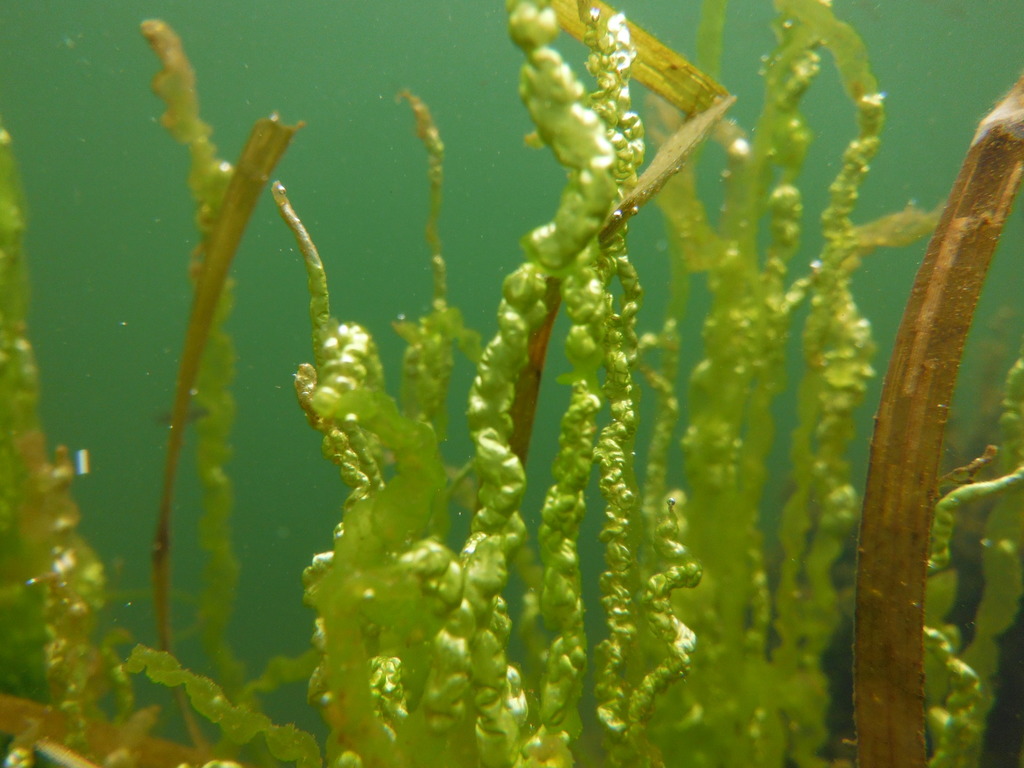
Gutweed
Ulva intestinalis
Ulva intestinalis, formerly referred to as Enteromorpha intestinalis (Linnaeus) Nees, is a green alga in the division Chlorophyta, of the genus Ulva (sea lettuce), also known by the common names gutweed and grass kelp. Until they were reclassified by genetic work completed in the early 2000s, the tubular members of the genus Ulva were in the genus Enteromorpha.
From the article Ulva intestinalis on Wikipedia (CC BY-SA), quoted section by section
Description
The branched fronds are completely tubular and expand in width to mid-thallus, reaching 15 cm long or more. The cells are irregularly arranged and the chloroplast is hood-shaped and placed to one side, generally with only one pyrenoid. The species may be 10–30 centimetres (3.9–11.8 in) long and 6–18 millimetres (0.24–0.71 in) wide. The fronds have rounded tips. This alga may be reproductive at all times of the year, and has a life-cycle with alternation of generations, in which the gametophyte and sporophyte are isomorphic, having identical morphology. In some references the species (Ulva intestinalis) is treated as two subspecies: ssp. intestinalis (L.) Link and ssp. compressa (L.) Link.
Range & habitat
This species has a generally world-wide distribution. In the Pacific Ocean, it can be found in the Bering Sea near Alaska, the Aleutian Islands, Puget Sound, Japan, Korea, Mexico, the Philippines, and Russia, as well as New Zealand. In the Atlantic Ocean, its range includes the Azores, the Baltic Sea, the Mediterranean Sea, and northern European countries such as Ireland, Belgium, Denmark, Norway, and Poland.
Wikipedia: “Distribution”
Where it lives
Recorded sightings
—
geo-referenced records in GBIF, from museums, herbaria and field observers.
Drag the globe to turn it. Dots are where records exist, not a range map; darker means more records.
In the stacks
Searching the stacks…
Every page naming Ulva intestinalis in the Biodiversity Heritage Library →
This page is assembled live from iNaturalist, GBIF, Wikipedia, the Source Library and the Internet Archive. It is not yet part of the hand-edited codex. iNaturalist taxon 130197.