Di Linh Snail-eating Snake
Pareas temporalis
Pareas temporalis, also known as the Di Linh slug-eating snake, is a non-venomous snake endemic to southern Vietnam.
From the article Pareas temporalis on Wikipedia (CC BY-SA), quoted section by section
Description
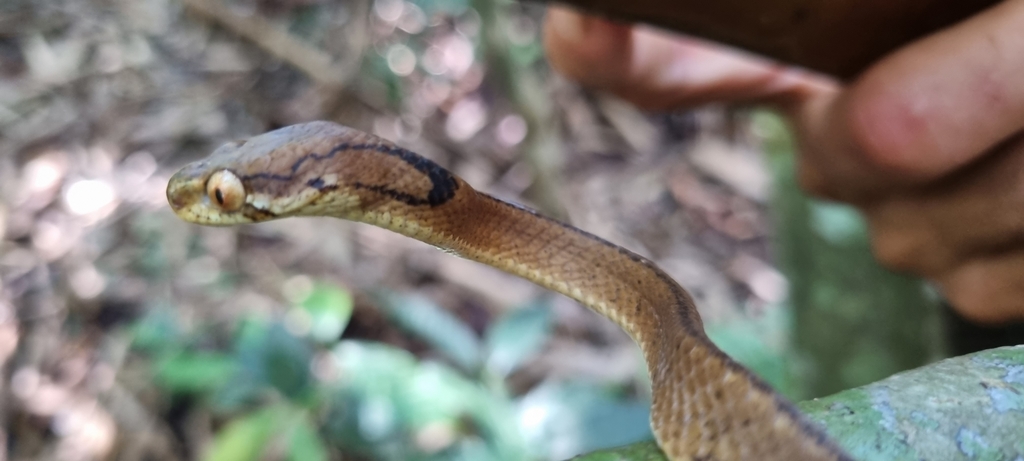
Pareas temporalis has a yellow-brown to orange dorsum with dark brown speckling and a solid dark brown dorsal stripe extending from behind their nuchal collar along the entire length of the body and tail, edged by two light yellowish paravertebral lines. The top of the head is light brown while the supralabial scales are yellow-white, both with occasional small, brown spots. The ventral surfaces of the head, body, and tail are all yellowish-cream with sparse brownish dusting and irregular spots. The iris is amber to bright orange with a black pupil. Two stripes begin at the postocular scales; the upper stripes extend from the upper corner of the eyes to the temporal area before dividing into two long stripes that meet in an 'X' shape at the nape, while the lower postocular stripes, frequently interrupted, extend to the corner of the jaw posteriorly over the lower temporal scales to the eighth and seventh supralabial scales- but not the chin or lower jaw- before converging to join the black nuchal collar.
What it does
Like its congeners, P. temporalis is a nocturnal, semi-arboreal, oviparous snail and slug specialist.
Wikipedia: “Behaviour”
In human culture
The specific Latin epithet temporalis refers to its high number of temporal scales.
== References ==
Wikipedia: “Etymology”
Where it lives
Recorded sightings
—
geo-referenced records in GBIF, from museums, herbaria and field observers.
Drag the globe to turn it. Dots are where records exist, not a range map; darker means more records.
In the stacks
Searching the stacks…
Every page naming Pareas temporalis in the Biodiversity Heritage Library →
This page is assembled live from iNaturalist, GBIF, Wikipedia, the Source Library and the Internet Archive. It is not yet part of the hand-edited codex. iNaturalist taxon 1304741.