- Animals
- ›Chordates
- ›Vertebrates
- ›Birds
- ›Perching Birds
- ›Old World Flycatchers, Robins, and Chats
- ›Luscinia
On eBird ↗
Thrush Nightingale
Live sightings near you, the range map, bar charts of when it is seen, and Macaulay Library photos and recordings.
Thrush Nightingale
Luscinia luscinia
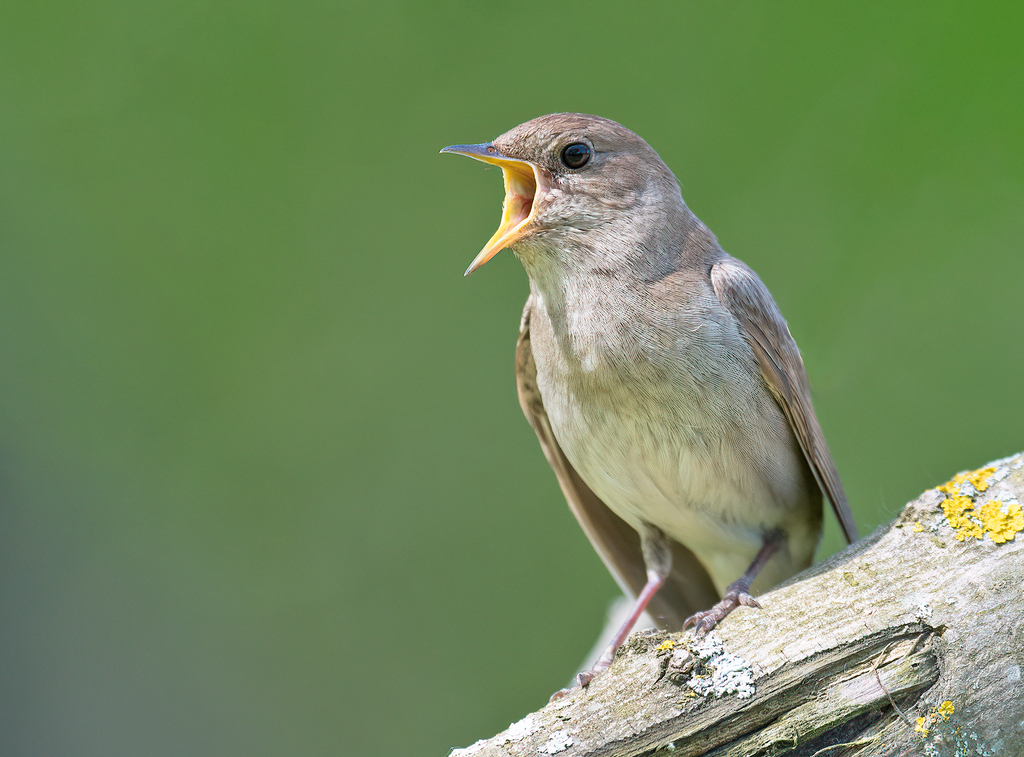
The thrush nightingale (Luscinia luscinia), also known as the sprosser, is a small passerine bird in the Old World flycatcher family. It is a migratory species breeding in forests in Europe and the Palearctic and overwintering in Africa. An insectivore, it nests near the ground in dense undergrowth. Its distribution is more northerly than the very closely related common nightingale (Luscinia megarhynchos), which it closely resembles in appearance. Hybrids between the two have occurred in areas where their ranges overlap.
The thrush nightingale is similar in size to the European robin. Sexes are similar, both being plain greyish-brown above and white and greyish-brown below. Its greyer tones, giving a cloudy appearance to the underside, and lack of the common nightingale's obvious rufous tail side patches are the clearest plumage differences from that species. It also has a similar but somewhat more solemn song than that of L. megarhynchos. The nightingales, and similar small European species, are often called chats.
From the article Thrush nightingale on Wikipedia (CC BY-SA), quoted section by section
Description
An adult thrush nightingale is about 16 centimetres (6.3 in) long with a wingspan of approximately 18 centimetres (7.1 in). The head, nape and the whole of the upper parts of the thrush nightingale are dark brown with a slight olive tinge. The colour is much deeper than that of the nightingale and is not at all rufous. The upper tail-coverts are less olivaceous and the tail feathers are dark rufous-brown. The lores and ear-coverts are brownish-black and the chin and throat are pale buff or whitish, mottled with brown, and are paler in colour than the nightingale. The sides of the throat are spotted brown and the pale feathers of the breast have brown central bands giving the breast a mottled appearance. The under tail-coverts are buff, sometimes barred or marked with brown. The wing feathers and wing-coverts are dark brown and less rufous than the nightingale. The beak, legs and feet are brown and the irises are dark brown. The sexes are similar to each other in appearance and the juveniles are darker and more mottled. There is a single moult in July and August at the end of the breeding season.
Voice. The male's song is loud, with a range of whistles, trills and clicks and includes a flute-like "pioo" with a pure bell-like tone. It is sometimes interrupted by a rasping "dserr" sound and is rather solemn as compared to that of the common nightingale. …
Range & habitat
The thrush nightingale is a migrant species. It breeds in eastern Europe and the western part of temperate Asia. The northern limit of its summer range extends to Denmark, southern Finland, Norway and Sweden, the Baltic States, the Republic of Karelia, Kostroma, Vologda, Perm, Kazakhstan, Turkestan and Altai. The southern limit extends from Austria and the Czech Republic, through Romania, Bulgaria, southern Russia, Ukraine, the Crimea and northern Caucasus. It overwinters in Africa south of the Sahara. It is an occasional visitor to the British Isles.
In its breeding range, the thrush nightingale is found in damp deciduous woodland typically with alder and birch. It favours thick undergrowth with brambles, dense shrubs and tangled vegetation in swampy places and near water. In its winter quarters it is found in dense patches of thorn bush, especially in valley bottoms near water courses, and sometimes in thick vegetation at the edge of woodland. The bird is a host of the acanthocephalan intestinal parasite Apororhynchus silesiacus.
Wikipedia: “Distribution and habitat”
What it does
The thrush nightingale feeds chiefly on the ground taking earthworms, spiders and the adults, larvae and pupae of insects such as beetles, small moths, ants and flies. In the autumn, the berries of currants (Ribes spp.) and elders (Sambucus spp.) are also eaten. Before crossing the Sahara on its migration, thrush nightingales build up their fat reserves. It has been found experimentally that magnetic cues may stimulate the birds to do this. A simulation of the magnetic field found in northern Egypt encouraged birds preparing to migrate from Sweden to further build up their body fat.
Wikipedia: “Food and feeding”
Listen
Looking for field recordings…
Where it lives
Recorded sightings
—
geo-referenced records in GBIF, from museums, herbaria and field observers.
Drag the globe to turn it. Dots are where records exist, not a range map; darker means more records.
In the stacks
Searching the stacks…
Every page naming Luscinia luscinia in the Biodiversity Heritage Library →
This page is assembled live from iNaturalist, GBIF, Wikipedia, the Source Library and the Internet Archive. It is not yet part of the hand-edited codex. iNaturalist taxon 13075.