- Animals
- ›Chordates
- ›Vertebrates
- ›Birds
- ›Perching Birds
- ›Old World Flycatchers, Robins, and Chats
- ›Enicurus
On eBird ↗
White-crowned Forktail
Live sightings near you, the range map, bar charts of when it is seen, and Macaulay Library photos and recordings.
White-crowned Forktail
Enicurus leschenaulti
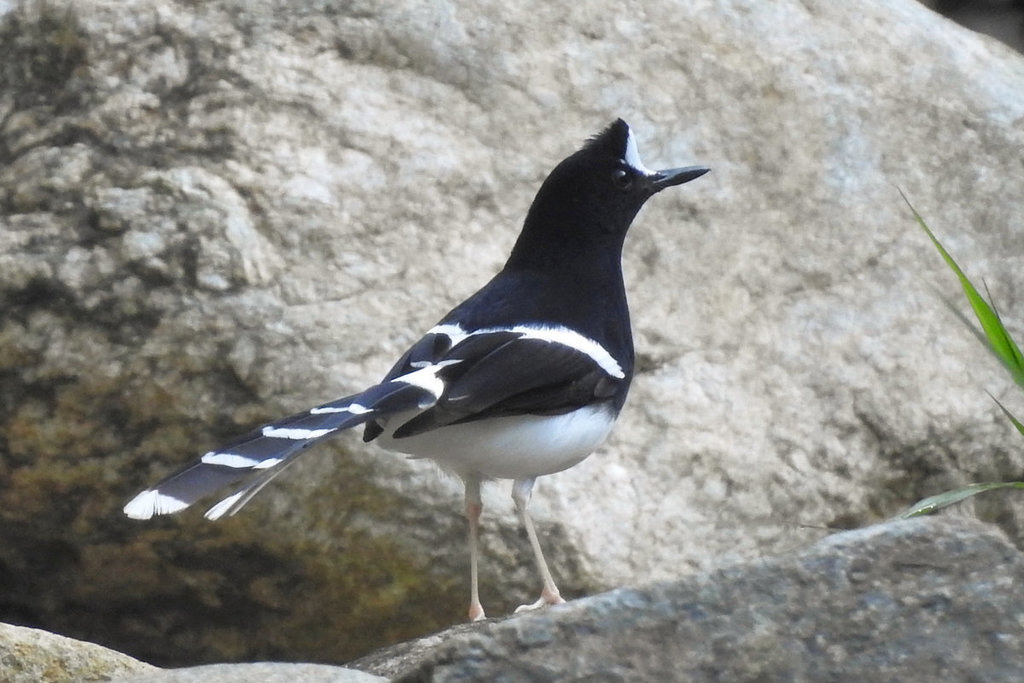
The white-crowned forktail (Enicurus leschenaulti) is a species of forktail in the family Muscicapidae. Formally described in 1818, it has five subspecies, each occupying a different geographic range. The largest of the forktails, Enicurus leschenaulti, is between 25 and 28 centimetres (9.8 and 11.0 in) long. It has a black throat and breast, black mantle, and largely black wings. The rump and lower back are white, and the bird has a prominent white crown, from which it gets its name. As with other forktails, the tail is long, deeply forked, and banded in black and white. A variety of whistling and clicking calls have been described. Slight morphological differences have been observed between subspecies.
A shy bird, the white-crowned forktail stays near water, and forages on the edges of rivers and streams for invertebrates. Its breeding season is between March and September, and possibly extends till October. Its nests are also built near the water, and are constructed of plant material. The eggs are between two and five in number, though there is latitudinal variation. Multiple broods in a year have been observed in China. The white-crowned forktail is found in China, Southeast Asia and also in northeastern parts of the Indian subcontinent. Its natural habitats are subtropical or tropical moist lowland forests and subtropical or tropical moist montane forests. Its elevational range varies across its range, from a minimum of 185 metres (607 ft) above sea level to a maximum of 2,400 metres (7,900 ft).
From the article White-crowned forktail on Wikipedia (CC BY-SA), quoted section by section
Description
The white-crowned forktail is the largest of the forktails. Between 25 and 28 centimetres (9.8 and 11.0 in) long, the white-crowned forktail typically weighs between 27 and 38 grams (0.95 and 1.34 oz), though specimens weighing up to 53 grams (1.9 oz) have been reported. It has black feathering on its throat extending down to its breast, as well as a black face and scapulars. The crown and forehead have a prominent white patch, sometimes visible as a slight crest, from which the bird gets its name. The belly of the bird is white, and is sharply delineated from the throat and face. The lower back and rump of the bird are white. The tail of the species is long and evenly graduated, with a deep fork. It has white tips, and the outer feathers are white. It also has three narrower white bands created by the tips of shorter tail feathers. The wings of this species are largely black with a prominent white band across the greater coverts. Juveniles of the species have brownish black upperparts, breast, and throat, brown flanks, and brown mottling on the belly. They also lack the prominent white crown. The bill of the species is black, while the feet are pinkish in color. Its mantle is completely black, a feature used to distinguish the species from the spotted forktail, which has a speckled mantle, and from the slaty-backed forktail, which has a slate-grey mantle. …
Range & habitat
The habitat of the white-crowned forktail is subtropical or tropical regions in moist lowland forests and moist broadleaf montane forests. As is the case with other forktail species, the white-crowned forktail frequents fast-flowing rivers, waterfalls, and streams within the forests, though it may move to slower moving water sources in the winter. Its elevational range has been observed to vary seasonally, and in the northeastern regions of the Indian subcontinent, it is likely to migrate seasonally; all records from Bangladesh are from winter months. It also frequents damp areas and pools within the forest, including animal wallows, swampy areas, and water ditches. It may be found along slower-moving rivers and streams in the lowland regions of its distribution. It prefers areas screened by dense vegetation. On the island of Borneo the white-crowned forktail is sometimes found in drier areas, including along tracks and ridges in the forest, and in heathland. The white-crowned forktail has a wide geographic distribution across south and south-east Asia, including in parts of India, Bangladesh, China, Myanmar, Bhutan, Thailand, Laos, Vietnam, Malaysia, and Indonesia . The elevational range of the species varies across its geographic distribution. …
Wikipedia: “Distribution and habitat”
What it does
As with other forktails, the white-crowned forktail keeps close to water. It has been observed to frequently wag its tail. It forages along the edges of streams and in the water, primarily for insects, such as black beetles, water crickets, springtails, and caterpillars. Described as a shy bird, it flies close to the ground, usually calling as it does. It is thought to shift its elevational range slightly with the time of year. The white-crowned forktail breeds between the months of March and September, and possibly till October. The breeding period varies slightly across its range. Eggs have been recorded as early as March in Borneo, and on one occasion a parent with a fledgling was recorded in February. The nest is constructed of moss, plants, leaves, and wood fibre, and is in the shape of a large cup. It is usually located near or over the water, and occasionally in forest gullies nearby. It is usually placed in a hole in a bank or cliff, or among tree roots, and has been observed to have been constructed behind waterfalls, with the birds flying through the water to reach their nest. The location of the nest is always damp. The species usually lays between two and five eggs, which are creamy, pinkish, or greyish white, and covered in speckles of red-brown, salmon, and lilac. …
Wikipedia: “Behaviour and ecology”
Listen
Looking for field recordings…
Where it lives
Recorded sightings
—
geo-referenced records in GBIF, from museums, herbaria and field observers.
Drag the globe to turn it. Dots are where records exist, not a range map; darker means more records.
In the stacks
Searching the stacks…
Every page naming Enicurus leschenaulti in the Biodiversity Heritage Library →
This page is assembled live from iNaturalist, GBIF, Wikipedia, the Source Library and the Internet Archive. It is not yet part of the hand-edited codex. iNaturalist taxon 13092.