- Animals
- ›Chordates
- ›Vertebrates
- ›Birds
- ›Perching Birds
- ›Old World Flycatchers, Robins, and Chats
- ›Ficedula
On eBird ↗
Black-and-orange Flycatcher
Live sightings near you, the range map, bar charts of when it is seen, and Macaulay Library photos and recordings.
Black-and-orange Flycatcher
Ficedula nigrorufa
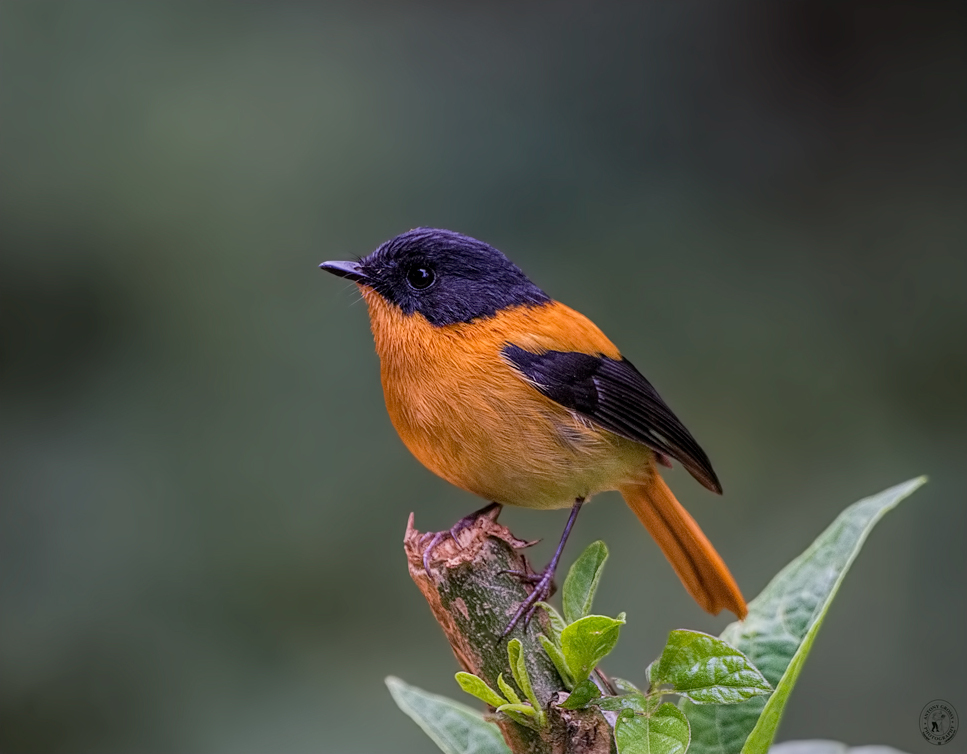
The black-and-orange flycatcher (Ficedula nigrorufa) or black-and-rufous flycatcher is a species of flycatcher endemic to the central and southern Western Ghats, the Nilgiris and Palni hill ranges in southern India. It is unique among the Ficedula flycatchers in having rufous coloration on its back and prior to molecular studies was suggested to be related to the chats and thrushes.
From the article Black-and-orange flycatcher on Wikipedia (CC BY-SA), quoted section by section
Description
A distinctly coloured bird found mainly in the high-elevation areas of the Western Ghats, the Nilgiris, the Palnis and associated hill ranges. The male is distinctly black headed with black wings. The female has the black replaced by dark brown and has a light eye-ring. They are usually seen singly or in pairs. The young bird at around two weeks of age is brownish orange with a whitish vent and abdomen. The head has dark streaks and the wings appear bluish with a trace of brown. There is a pale ring around the eye and the orange tail appears stumpy. Eight weeks after fledging they appear almost like adults except for patches of brown feathers in the crown.
Range & habitat
The main population of this bird is found in the high elevation plateaus above 1,500 m (4,900 ft) areas of the Nilgiris, Palani Hills, Biligiriranga Hills (Bellaji and Honnametti), and Kannan Devan Hills. They prefer areas with high leaf litter and undergrowth in open shola grassland habitats. The density was about 2.8 ha (6.9 acres) per pair during the breeding season. It is a highly parochial bird and no local movements other than dispersal of young has been noted. To the north, it occurs in the Kudremukh National Park and the Bababudan Hills and south to the Ashambu Hills. Some old records of the species from Maharashtra and Sri Lanka have been considered dubious.
Wikipedia: “Distribution and habitat”
What it does
In the breeding season, March to May, these birds are very vocal and they have a repetitive "chee-ri-rirr" or a whistling song "whee-chee-ree-rirr". They feed on insects by flycatching low over the ground (under 2m height) and also pick insects from the ground. Territories are maintained by a pair throughout the year. The threat display involves the male pointing bill up, fanning the tail, opening wings and producing "keet-keet" notes. The alarm call is a zit-zit. Males are usually involved in defense but females may sometimes join in. The nest is built by the female, placed in a low bush or fern. Two greyish speckled eggs form the usual clutch. Young birds are brownish and speckled. The nest is unlike that of most flycatchers and is large, coarse, ball-like and made from sedges. The nest has a foundation of dry leaves and ferns. The nest has an external diameter of about 6 inches (15 cm) and the egg cavity which is devoid of any lining is about 2 inches (5.1 cm) in diameter and 2 inches (5.1 cm) deep. The nest is placed usually at the centre of a bush at about 1 to 3 feet (0.30 to 0.91 m) height with an entrance hole close to the top. The peak feeding activity of the birds is early in the morning and towards dusk. …
Wikipedia: “Behaviour and ecology”
Listen
Looking for field recordings…
Where it lives
Recorded sightings
—
geo-referenced records in GBIF, from museums, herbaria and field observers.
Drag the globe to turn it. Dots are where records exist, not a range map; darker means more records.
In the stacks
Searching the stacks…
Every page naming Ficedula nigrorufa in the Biodiversity Heritage Library →
This page is assembled live from iNaturalist, GBIF, Wikipedia, the Source Library and the Internet Archive. It is not yet part of the hand-edited codex. iNaturalist taxon 13116.