- Animals
- ›Chordates
- ›Vertebrates
- ›Birds
- ›Perching Birds
- ›Old World Flycatchers, Robins, and Chats
- ›Monticola
On eBird ↗
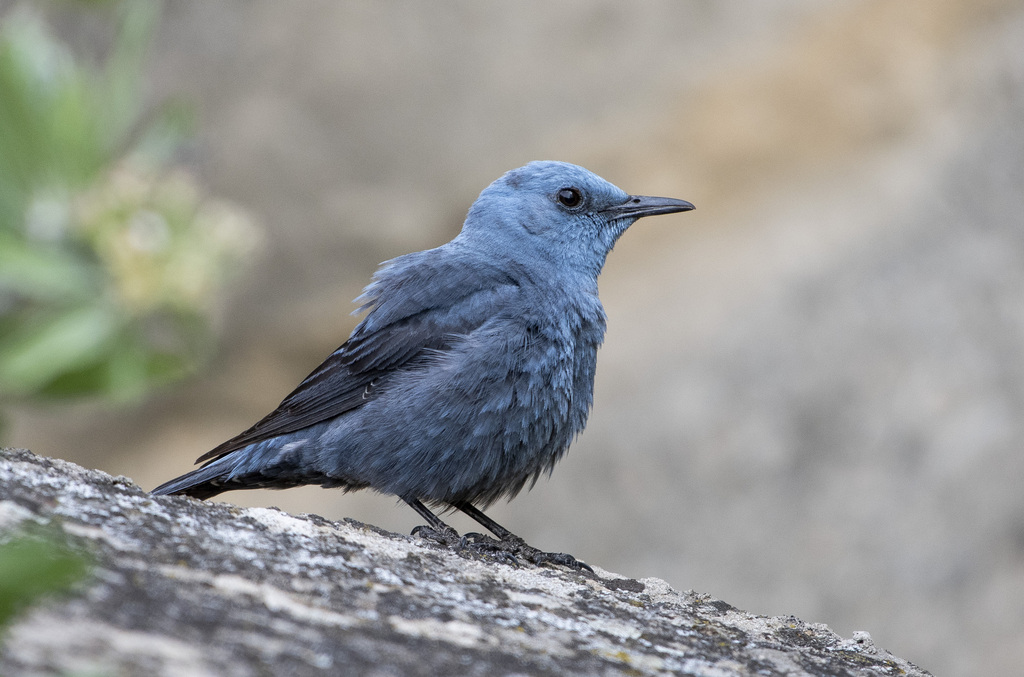
Blue Rock-Thrush
Live sightings near you, the range map, bar charts of when it is seen, and Macaulay Library photos and recordings.
Blue Rock-Thrush
Monticola solitarius
The blue rock thrush (Monticola solitarius) is a species of chat. This thrush-like Old World flycatcher was formerly placed in the family Turdidae. It breeds in southern Europe, northwest Africa, and from Central Asia to northern China and Malaysia. The blue rock thrush is the official national bird of Malta.
From the article Blue rock thrush on Wikipedia (CC BY-SA), quoted section by section
Description
The blue rock thrush is a starling-sized bird, 21–23 cm (8.3–9.1 in) in length with a long slim bill. The breeding male of the nominate subspecies is unmistakable, with all blue-grey plumage apart from its darker wings. Females and immatures are much less striking, with dark brown upperparts, and paler brown scaly underparts. The male of the subspecies M. s. philippensis has rufous-chestnut plumage from the mid-breast down to the undertail. Both sexes lack the reddish outer tail feathers of rock thrush.
Vocalizations. The male blue rock thrush sings a clear, melodious call that is similar to, but louder than, the call of the rock thrush.
The Europe and Asia groups both have a "short song and a long song, consisting of similar melodious whistles, trills and more burry notes." Generally, the vocalizations are similar in both groups. Basic sound traits generally overlap, such as phrase duration, note length, and min./max. frequency. Several notes are identical. The long song is a bit more common in the Asia group. Among populations in Indonesia, there are four basic calls. "The fundamental call frequency appeared to be concentrated around 1.6 kHz, but weak components of the spectrum reached to approximately 4 kHz. …
Range & habitat
The European, north African and southeast Asian birds are mainly resident, apart from altitudinal movements. Other Asian populations are more migratory, wintering in sub-Saharan Africa, India and southeast Asia. This bird is a very uncommon visitor to northern and western Europe. There is some overlap in breeding and wintering ranges with the common rock thrush (Monticola saxatilis); Palearctic and southwestern Asia for breeding and northern Africa for wintering. It is known to have been spotted in North America three times: once in British Columbia in 1997, once in Oregon and the Farallon Islands in 2024, and most recently in Portland in September of 2026. It is unclear whether the Oregon and Farallon Islands spottings were the same bird. It is highly unlikely that the British Columbia sighting was the same individual bird as the Oregon/Farallon Islands sighting as the blue rock thrush typically lives 5-10 years in the wild. Choi, et al., conducted a study of blue rock thrush population on Hongdo Island, South Korea from 2005-2009. The species arrives in spring and disappeared in autumn, indicating that the Hongdo population is migratory rather than resident. Breeding density was estimated at about 8 breeding pairs per km², and individual territories averaged about 2.87 hectares. …
Wikipedia: “Distribution and habitat”
What it does
The blue rock thrush breeds in open mountainous areas. It nests in rock cavities and walls, and usually lays 3–5 eggs. An omnivore, the blue rock thrush eats a wide variety of insects and small reptiles in addition to berries and seeds.
Wikipedia: “Behaviour”
In human culture
The blue rock thrush is deeply imbedded in Maltese culture (the word for it in Maltese being Merill). It became the national bird in 1971. It was on the Lm 1 coins that were part of the country's former currency. It has also inspired place names, songs, stamps, cartoons, poems and literature, and old expressions about talkativeness. It is also the name of a high income fund and a child care center.
Wikipedia: “In culture”
Listen
Looking for field recordings…
Where it lives
Recorded sightings
—
geo-referenced records in GBIF, from museums, herbaria and field observers.
Drag the globe to turn it. Dots are where records exist, not a range map; darker means more records.
In the stacks
Searching the stacks…
Every page naming Monticola solitarius in the Biodiversity Heritage Library →
This page is assembled live from iNaturalist, GBIF, Wikipedia, the Source Library and the Internet Archive. It is not yet part of the hand-edited codex. iNaturalist taxon 13141.