- Animals
- ›Chordates
- ›Vertebrates
- ›Ray-finned Fishes
- ›Spiny-rayed fishes
- ›Cusk-eels
- ›Cusk-eels
- ›Ophidiinae
- ›Ophidion
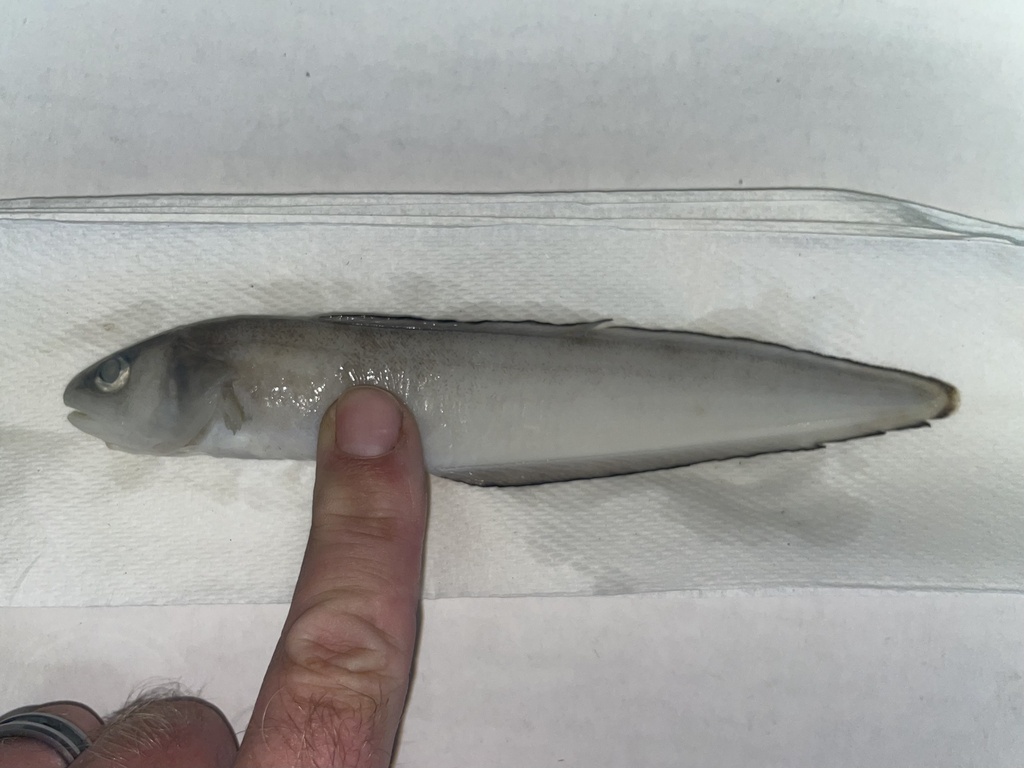
Longnose cusk-eel
Ophidion holbrookii
The band cusk-eel (Ophidion holbrookii) is a fish species in the family Ophidiidae. Widespread in the Western Atlantic from North Carolina, United States, and northern Gulf of Mexico to southeastern Brazil. Absent from The Bahamas. Marine reef-associated tropical demersal fish, up to 30 cm (12 in) long.
Its range under water can be between 0.5–7 m (1.6–23.0 ft), but usually it is found deeper than 18 m (59 ft) below the surface. This species was first seen in the Key West area near Florida, USA in 1874 and described by Frederic Ward Putnam.
From the article Band cusk-eel on Wikipedia (CC BY-SA), quoted section by section
Description
Cusk eels are not true eels. Unlike true eels, they have forked ventral fins: organs attached to the pectoral muscles just below the mouth. They do however, like eels, have an attenuate body and tend to have mouths in the terminal position with cardiform teeth. Though fairly small, the band cusk-eel has a complicated skeletal system. There are 20 ribs to allow for flexibility and 66-69 vertebrae along the spinal cord. This specific variation is a dull tan and lacks scales on the top of the head. The dorsal and anal fins are continuous with the caudal and lined in black. The body is fairly deep and number of rays, used to identify species, varies. The typical range is 117-132 dorsal rays, 97-109 anal, and 19-21 pectoral.
Range & habitat
Cask eels tend to live in the bottom of shallow areas of water and take shelter in anything from caves to other invertebrates. Crevices and mud or sand burrows can be home to solitary fish or groups. A full distribution map of this species has not been made.
Wikipedia: “Habitat”
What it does
Little is known about the behavior of cusk eels in general and what is known is not often specific to species. Many cusk eels are known to cohabitate alongside or within the bodies of invertebrates. Most are known to burrow during the day, possibly to conserve energy and/or avoid predators. This burrowing has been caught on video in multiple species and occurs tail first, the fish backing up and down into soft sand or mud until covered. In soniferous species, a loud jackhammer-like sound is emitted by males for the attraction of a mate. They are thought to feed on small invertebrates such as shrimp or worms.
Wikipedia: “Behavior”
Where it lives
Recorded sightings
—
geo-referenced records in GBIF, from museums, herbaria and field observers.
Drag the globe to turn it. Dots are where records exist, not a range map; darker means more records.
In the stacks
Searching the stacks…
Every page naming Ophidion holbrookii in the Biodiversity Heritage Library →
This page is assembled live from iNaturalist, GBIF, Wikipedia, the Source Library and the Internet Archive. It is not yet part of the hand-edited codex. iNaturalist taxon 131438.