- Animals
- ›Chordates
- ›Vertebrates
- ›Ray-finned Fishes
- ›Salmons, Pikes and Mudminnows
- ›Salmons, Trouts, and Whitefishes
- ›Salmons, Trouts, and Whitefishes
- ›Salmons and Trouts
- ›Oncorhynchus
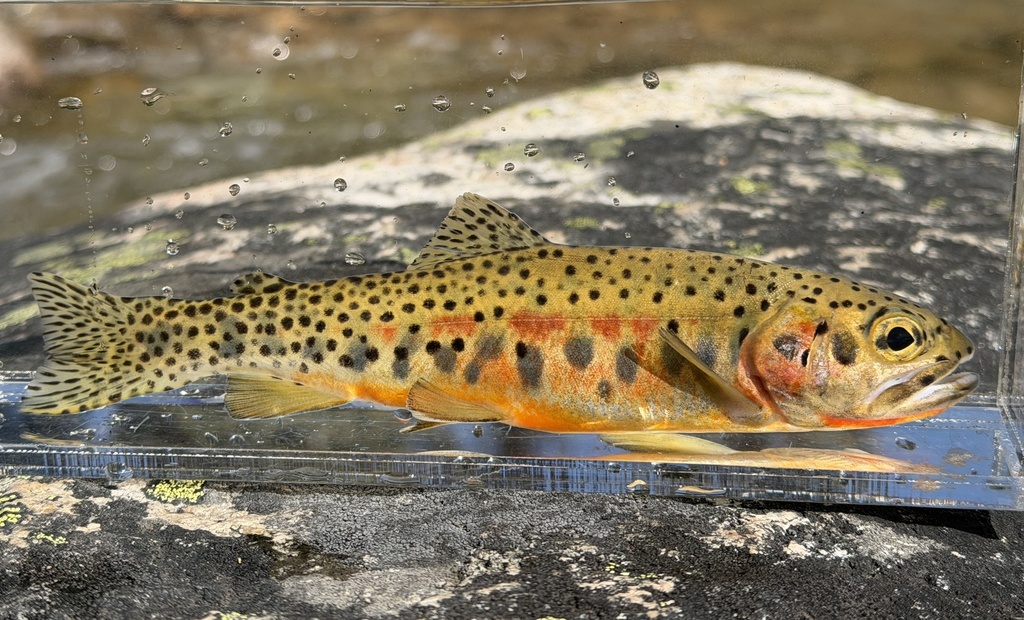
Westslope Cutthroat Trout
Oncorhynchus lewisi
The cutthroat trout (Oncorhynchus clarkii clade) is a clade of four fish species of the family Salmonidae native to cold-water tributaries of the Pacific Ocean, Rocky Mountains, and Great Basin in North America. These four species are the Coastal (O. clarkii), Westslope (O. lewisi), Lahontan (O. henshawi), and the Rocky Mountain (O. virginalis). As a member of the genus Oncorhynchus, it is in the Pacific trout group, which includes the widely distributed rainbow trout. Cutthroat trout are popular gamefish, especially among anglers who enjoy fly fishing. The common name "cutthroat" refers to the distinctive red coloration on the underside of the lower jaw. The specific name clarkii was given to honor explorer William Clark, coleader of the Lewis and Clark Expedition.
Cutthroat trout usually inhabit and spawn in small to moderately large, clear, well-oxygenated, shallow rivers with gravel bottoms. They reproduce in clear, cold, moderately deep lakes. They are native to the alluvial or freestone streams that are typical tributaries of the rivers of the Pacific Basin, Great Basin and Rocky Mountains. Cutthroat trout spawn in the spring and may inadvertently but naturally hybridize with rainbow trout, producing fertile cutbows. Some populations of the coastal cutthroat trout (O. c. clarkii) are semi-anadromous.
From the article Cutthroat trout on Wikipedia (CC BY-SA), quoted section by section
Description
Throughout their native and introduced ranges, cutthroat trout vary widely in size, coloration and habitat selection. Their coloration can range from golden to gray to green on the back. Cutthroat trout can generally be distinguished from rainbow trout by the presence of basibranchial teeth at the base of tongue and a maxillary that extends beyond the posterior edge of the eye. Depending on subspecies, strain and habitat, most have distinctive red, pink, or orange linear marks along the underside of their mandibles in the lower folds of the gill plates. These markings are responsible for the common name "cutthroat", first given to the trout by outdoor writer Charles Hallock in an 1884 article in The American Angler. These markings are not unique to the species. Some coastal rainbow trout (Oncorhynchus mykiss irideus) and Columbia River redband trout (O. m. gairdneri) populations also display reddish or pink throat markings.
At maturity, different populations and subspecies of cutthroat trout can range from 6 to 40 inches (15 to 102 cm) in length, depending on habitat and food availability. Sea-run forms of coastal cutthroat trout average 2 to 5 pounds (0.9 to 2.3 kg). The length and weights of mature inland forms vary widely depending on their particular environment and availability of food. …
Range & habitat
Cutthroat trout are native to western North America and have evolved through geographic isolation into at least 25 genetically-recognizable lineages, each native to a different major drainage basin. Native cutthroat trout species are found along the Pacific Northwest coast from Alaska through British Columbia into northern California, in the Cascade Range, the Great Basin and throughout the Rocky Mountains including southern Alberta. Some coastal populations of the coastal cutthroat trout (O. c. clarkii) are semi-anadromous, spending a few months in marine environments to feed as adults and returning to fresh water from fall through early spring to feed on insects and spawn. Cutthroat trout have the second-largest historic native range of North American trout; the lake trout (Salvelinus namaycush) having the largest. Ranges of some subspecies, particularly the westslope cutthroat trout (O. l. …
Wikipedia: “Range”
How it is grown
Various subspecies of cutthroat trout are raised in commercial, state and federal hatcheries for introduction into suitable native and non-native riverine and lacustrine environments. In the early 20th century, several hatcheries were established in Yellowstone National Park by the U.S. Bureau of Fisheries. These hatcheries not only produced stocks of the Yellowstone cutthroat trout (O. v. bouvierii) for the park, but also took advantage of the great spawning stock of cutthroat trout to supply eggs to hatcheries around the U.S. Between the years 1901 and 1953 a total of 818 million trout eggs were exported from the park to hatcheries throughout the U.S. The Lahontan National Fish Hatchery operated by the U.S. Fish and Wildlife Service exists to restore populations of the Lahontan cutthroat trout (O. h. henshawi) in Pyramid, Walker, Fallen Leaf, June, Marlette, and Gull Lakes and the Truckee River in California and Nevada. The hatchery produces about 300,000–400,000 Lahontan cutthroat trout fry annually. The Jackson National Fish Hatchery produces around 400,000 Snake River fine-spotted cutthroat trout (which is now known as an ecotype of the Yellowstone cutthroat) annually to support fisheries in Idaho and Wyoming. …
Wikipedia: “Artificial propagation”
Where it lives
Recorded sightings
—
geo-referenced records in GBIF, from museums, herbaria and field observers.
Drag the globe to turn it. Dots are where records exist, not a range map; darker means more records.
In the stacks
Searching the stacks…
Every page naming Oncorhynchus lewisi in the Biodiversity Heritage Library →
This page is assembled live from iNaturalist, GBIF, Wikipedia, the Source Library and the Internet Archive. It is not yet part of the hand-edited codex. iNaturalist taxon 1316403.