- Animals
- ›Chordates
- ›Vertebrates
- ›Ray-finned Fishes
- ›Carps, Characins, Catfishes and Allies
- ›Minnows, Suckers, Carps, and Loaches
- ›Carps and Minnows
- ›Cyprinids
- ›Mountain Barbels
- ›Schizopygopsis
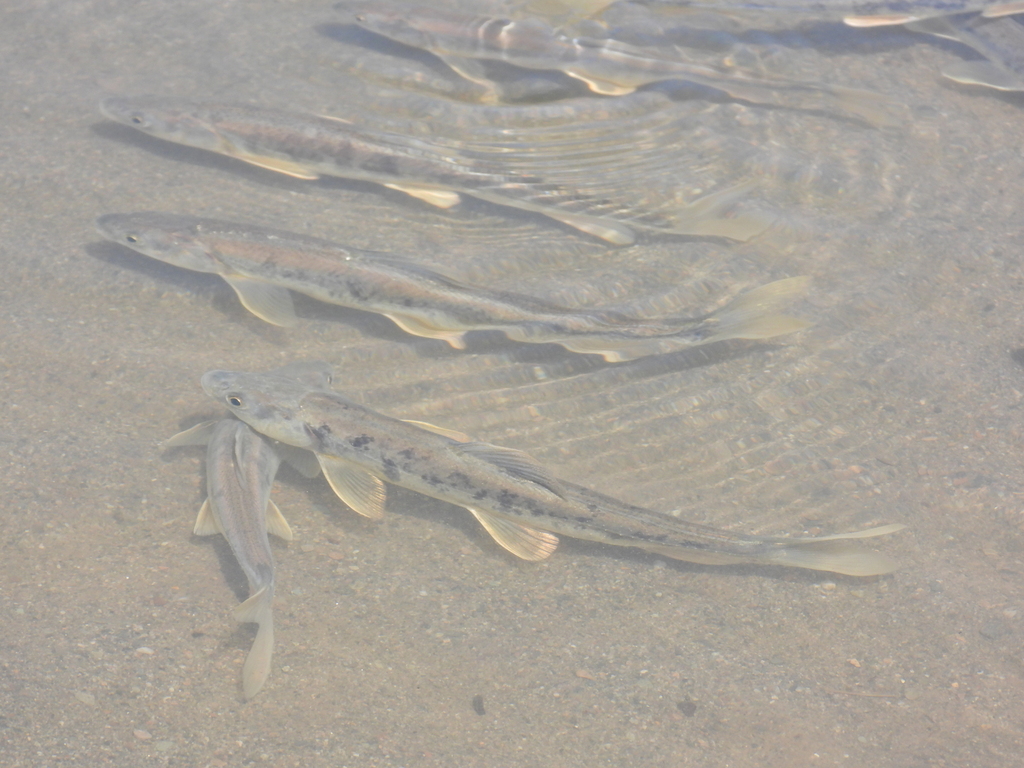
Przewalskii's Naked Carp
Schizopygopsis przewalskii
Gymnocypris przewalskii (also known by previous scientific name of Schizopygopsis przewalskii; common name: Przewalskii's naked carp; also known as scaleless carp; in Chinese: 青海湖裸鲤; lit. 'Qinghai Lake naked carp') is a species of cyprinid that is endemic to the Lake Qinghai basin in China, where it is the dominant fish species (the other natives are four Triplophysa loaches). G. przewalskii is a planktivore with a main population that migrates from the lake to rivers to spawn and another that lives its entire life in the nearby Ganzi River, Gymnocypris przewalskii ganzihonensis. The species is listed as endangered on the China Species Red List due to overfishing and habitat loss, which has led to suspension of its commercial fishery four times since 1989.
From the article Schizopygopsis przewalskii on Wikipedia (CC BY-SA), quoted section by section
Description
Naked carp reach a maximum length of 48 cm (1.57 ft) and are typically 300–500 g (0.66–1.10 lb) at reproductive age. They have long, flat bodies and almost no scales except specialized ones embedded in the dermis near the anus and shoulder girdle, which gives them their common name, "naked carp". They grow relatively slowly and may take 7–10 years to reach reproductive size.
Feeding. They feed mostly on benthic zooplankton about 2 m (6.6 ft) below the surface, though they also feed on other aquatic invertebrates.
Wikipedia: “Characteristics”
Range & habitat
G. przewalskii is solely found in China—specifically it is endemic to Qinghai Lake and its tributaries in the northeastern region of the Tibetan Plateau. This is the largest endorheic saline lake in China; essentially, the lake retains water and does not outflow to other bodies of water. It is anadromous, living in freshwater and saltwater and returning to freshwater to spawn, with a migration cycle further outlined in detail in the following Reproduction and Migration section. Spatially, the naked carp is benthopelagic, found between bottom and midwater zones and in slow currents.
Reproduction and migration. The Qinghai Lake has a salinity of about 14 parts per thousand, meaning that the water is brackish. From April to July adults of the lake population migrate 40–50 km (25–31 mi) to nearby freshwater streams to spawn. Currently, the naked carp primarily uses only five freshwater rivers, the Haergai, Shaliu, Heima, Quanji, and Buha rivers. Much like salmon, they seek sandy gravel banks with slower currents to build nests. G. przewalskii shows a preference for pebble substrate during reproduction and sand substrate during pre and post spawning. When fish return to the lake, their electrolyte levels increase quickly to concentrations similar to Lake Qinghai's salinity, while urine flow, metabolic rate, and oxygen consumption all decrease drastically. …
Wikipedia: “Distribution”
In human culture
Gymnocypris przewalskii is named in honor of naturalist General Nikolai Mikhailovitch Przhevalsky (also spelled Przewalski and Prjevalsky, 1839–1888), who collected the type species. The name was given by Karl Fedorovich Kessler, a 19th century Russian ichthyologist who processed a volume of Przhevalsky’s travelogue of Mongolia that includes Kessler’s description of the naked carp. The origins of the common name comes from Greek, in which gymnos = naked, and kyprinos = carp.
Wikipedia: “Etymology”
Where it lives
Recorded sightings
—
geo-referenced records in GBIF, from museums, herbaria and field observers.
Drag the globe to turn it. Dots are where records exist, not a range map; darker means more records.
In the stacks
Searching the stacks…
Every page naming Schizopygopsis przewalskii in the Biodiversity Heritage Library →
This page is assembled live from iNaturalist, GBIF, Wikipedia, the Source Library and the Internet Archive. It is not yet part of the hand-edited codex. iNaturalist taxon 1316612.