- Animals
- ›Chordates
- ›Vertebrates
- ›Ray-finned Fishes
- ›Spiny-rayed fishes
- ›Butterflyfishes, Angelfishes, and Allies
- ›Seabreams and Porgies
- ›Spicara
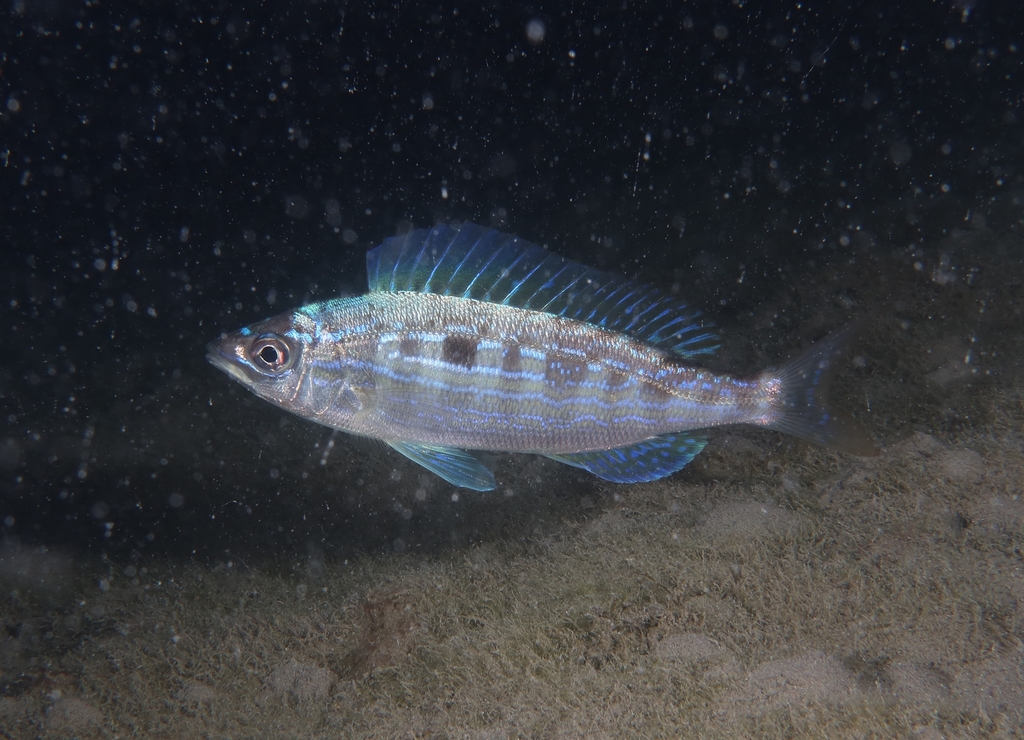
Spicara flexuosum
Spicara flexuosum, is a species of marine ray-finned fish belonging to the family Sparidae, the seabreams and porgies. This species is found in the Eastern Atlantic Ocean Ocean and the Mediterranean Sea and Black Sea.
From the article Spicara flexuosum on Wikipedia (CC BY-SA), quoted section by section
Description
Spicara flexuosum may be identified by the possession of a protrusible mouth; having 73 or less scales in the lateral line. The length of the head is equal to or greater than the depth of the body. The overall colour is yellowish or grey-brownish with a brownish spot at the axil of the pectoral fins. The colour is variable and changes with season, sex and age. This species has a maximum published total length of 23.2 cm (9.1 in), although 14 cm (5.5 in) is more typical, and a maximum published weight of 120 g (4.2 oz). This species is very similar to S. maena but was found to have distinct mitochondrial DNA from that species.
Range & habitat
Spicara flexuosum is found in the eastern Atlantic Ocean, the Mediterranean and the Black Seas. It is a demersal fish found in schools at depths down to 130 m (430 ft) over sand and rubble areas of the seabed.
== References ==
Wikipedia: “Distribution and habitat”
In human culture
Spicara flexuosum has the genus name Spicara, which is a vernacular name for picarels, particularly S. flexuosa in Italy. This is presumed to derive from spica, “a spike”, or spicare, meaning “in the form of or furnished with a spike”, Rafinesque did not explain why he chose this name. The specific name, flexuosum, means "full of bends or curves", an allusion to the wavy yellow horizontal lines along the body of the breeding males.
Wikipedia: “Etymology”
Where it lives
Recorded sightings
—
geo-referenced records in GBIF, from museums, herbaria and field observers.
Drag the globe to turn it. Dots are where records exist, not a range map; darker means more records.
In the stacks
Searching the stacks…
Every page naming Spicara flexuosum in the Biodiversity Heritage Library →
This page is assembled live from iNaturalist, GBIF, Wikipedia, the Source Library and the Internet Archive. It is not yet part of the hand-edited codex. iNaturalist taxon 1316671.