- Animals
- ›Chordates
- ›Vertebrates
- ›Ray-finned Fishes
- ›Spiny-rayed fishes
- ›Jacks, Flounders, Barracudas, and Allies
- ›Jacks, Remoras, and Allies
- ›Jacks
- ›Caranginae
- ›Caranx
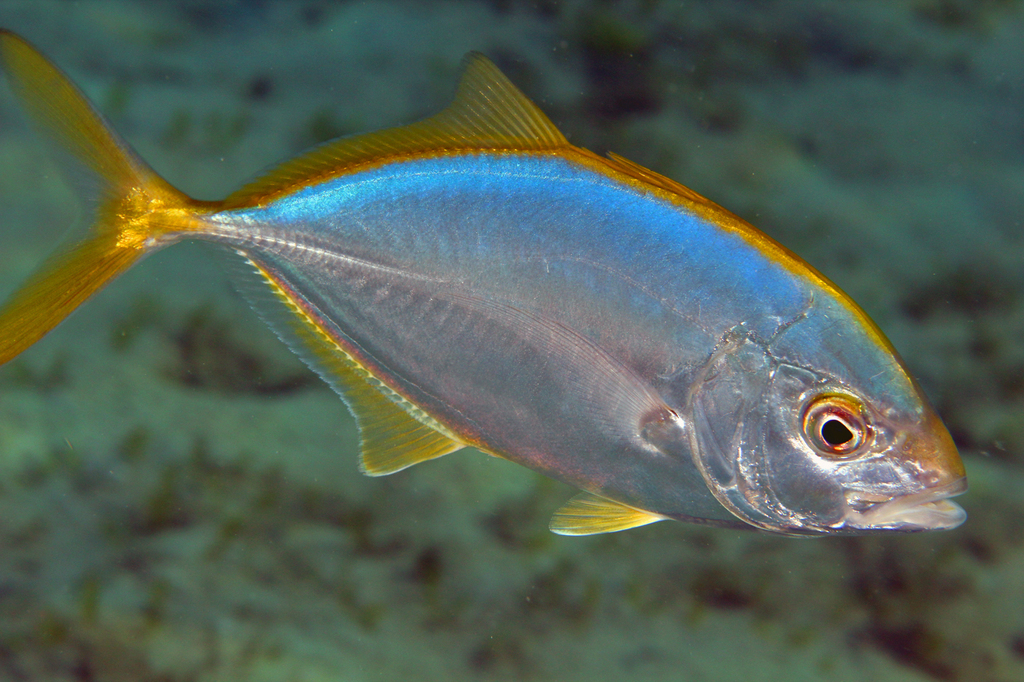
Yellow Jack
Caranx bartholomaei
The yellow jack (Caranx bartholomaei), also known as coolihoo, is a species of marine fish in the jack family, Carangidae. It is one of only two representatives of its genus present in the Atlantic Ocean, inhabiting waters off the east coast of the Americas from Massachusetts in the north to Brazil in the south, as well as a number of offshore islands. The yellow jack can be distinguished from closely related species by the length of the jaw, as well as counts of the rays in the fins. It is a fairly large fish, growing to a recorded maximum length of 1 metre (39 in), and a weight of at least 14 kilograms (31 lb). Yellow jack inhabit reefs, moving either individually or in schools and are predatory fish which primarily take other small fish. Studies in the Caribbean suggest the species reaches sexual maturity between 23 and 32 centimetres (9.1 and 12.6 in), and spawns in offshore waters from February to October. Yellow jack are of minor economic importance, taken by both hook and net methods, and are considered to be fair table fish. They are often caught by boat anglers, although are overlooked for their larger relatives.
From the article Yellow jack on Wikipedia (CC BY-SA), quoted section by section
Description
The yellow jack shows the typical body profile of the genus Carangoides, having a moderately deep, compressed elongate shape, with the dorsal profile slightly more convex than the ventral profile. It is a large fish, growing to a known maximum length of 1 metre (39 in), although more common seen below 45 centimetres (18 in), and a maximum weight of 14 kilograms (31 lb). The dorsal profile of the head is slightly curved from the snout to the nape, with the eye having a moderately well developed adipose eyelid. One of the major diagnostic features is that the upper jaw does not reach to the interior margin of the eye. Both jaws contain narrow bands of villiform teeth, with these bands becoming wider anteriorly. The dorsal fin is in two parts, the first containing seven spines and the second of one spine followed by 25 to 28 soft rays. The anal fin is similar to the second dorsal fin, consisting of two anteriorly detached spines followed by one spine and 21 to 24 soft rays. The lobes of the dorsal and anal fins are slightly pronounced, and the pectoral fin is falcate, being longer than the head. The lateral line has a slight, extended anterior curve, with this curved section being longer than the posterior straight section. …
Range & habitat
The yellow jack is distributed throughout the tropical to subtropical western Atlantic Ocean, ranging on the coast of America from Massachusetts to Maceio, Brazil. The species range includes hundreds of offshore islands in the eastern Atlantic, including Bermuda, the Bahamas, the West Indies and throughout the Caribbean Sea. Along with the bar jack, C. ruber, it is only one of two species formerly in Carangoides present in the Atlantic, with all others having Indo-Pacific distributions. it also can be found in the Libyan coast (in the Mediterranean sea). The yellow jack is occasionally found in inshore coastal waters, but prefers offshore reefs and islands, or open marine waters over the continental shelf. Whilst not often seen in shallow waters near the American continent, yellow jack are commonly seen in the sandy shallows of a number of Caribbean islands foraging with other species.
Wikipedia: “Distribution and habitat”
Where it lives
Recorded sightings
—
geo-referenced records in GBIF, from museums, herbaria and field observers.
Drag the globe to turn it. Dots are where records exist, not a range map; darker means more records.
In the stacks
Searching the stacks…
Every page naming Caranx bartholomaei in the Biodiversity Heritage Library →
This page is assembled live from iNaturalist, GBIF, Wikipedia, the Source Library and the Internet Archive. It is not yet part of the hand-edited codex. iNaturalist taxon 1316792.