- Animals
- ›Chordates
- ›Vertebrates
- ›Ray-finned Fishes
- ›Spiny-rayed fishes
- ›Rivulines, Killifishes, and Livebearers
- ›Cyprinodontoidei
- ›Live-bearers and Topminnows
- ›Typical Livebearers
- ›Poecilia
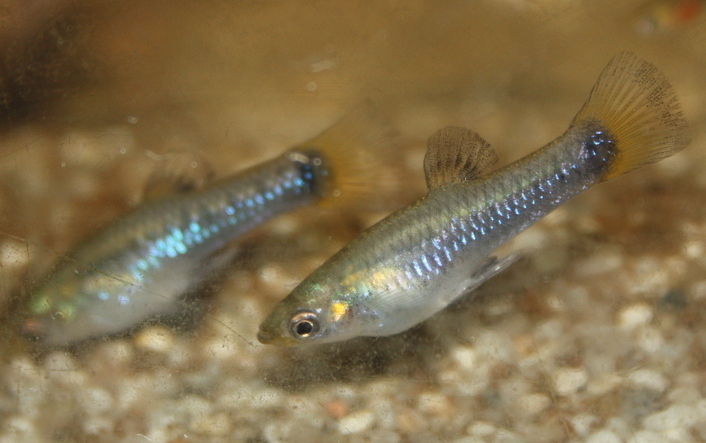
Blackbelly Limia
Poecilia melanogaster
Limia melanogaster, the black-bellied or blue limia, is a poeciliid fish from Jamaica. It inhabits fast-flowing streams. It is a rare livebearer in modern fishkeeping.
From the article Limia melanogaster on Wikipedia (CC BY-SA), quoted section by section
Description
L. melanogaster is the second slimmest species in its genus after L. zonata. The species is exceptionally variable. The base color of the fish is greenish-gray. Adults, and especially males when courting females, exhibit a metallic steel blue gloss. The male's caudal peduncle and dorsal fin are black, while the caudal fin is yellow with a black rim. Male fish usually also have patches of black and sulfur-yellow scales on their heads, fins, and flanks. Sexually mature females instead have a large bluish-black pigmented area around the gonopore called the gravid spot, unique in the genus. Such chromatic distinction from both males and juvenile females is unusual among female poeciliids. Female fish grow to 5 cm (2.0 in) standard length, while the males attain 4 cm (1.6 in).
Range & habitat
Limia melanogaster is endemic to Jamaica, specifically the southern and western parts of the island. It has been collected in the headwaters of the Black River drainage and Blue Hole River. The species prefers fast-flowing and shallow water, usually around 50 cm (20 in) deep. It is also found in flooded areas. One examined habitat was a small, 10–20 cm (3.9–7.9 in) deep stream with a muddy substrate, while the Blue Hole River habitat contains a rocky substrate. The habitats tend to contain little to no vegetation but are rich in aufwuchs. The species shares its habitat with a fellow poeciliid Gambusia wrayi and certain cichlids and gobies.
Wikipedia: “Distribution and habitat”
What it does
L. melanogaster is omnivorous. Its diet consists of worms, crustaceans, insects, and plant matter. Algae make up a significant portion of its diet, especially in brackish water.
Wikipedia: “Diet”
Where it lives
Recorded sightings
—
geo-referenced records in GBIF, from museums, herbaria and field observers.
Drag the globe to turn it. Dots are where records exist, not a range map; darker means more records.
In the stacks
Searching the stacks…
Every page naming Poecilia melanogaster in the Biodiversity Heritage Library →
This page is assembled live from iNaturalist, GBIF, Wikipedia, the Source Library and the Internet Archive. It is not yet part of the hand-edited codex. iNaturalist taxon 1316864.